
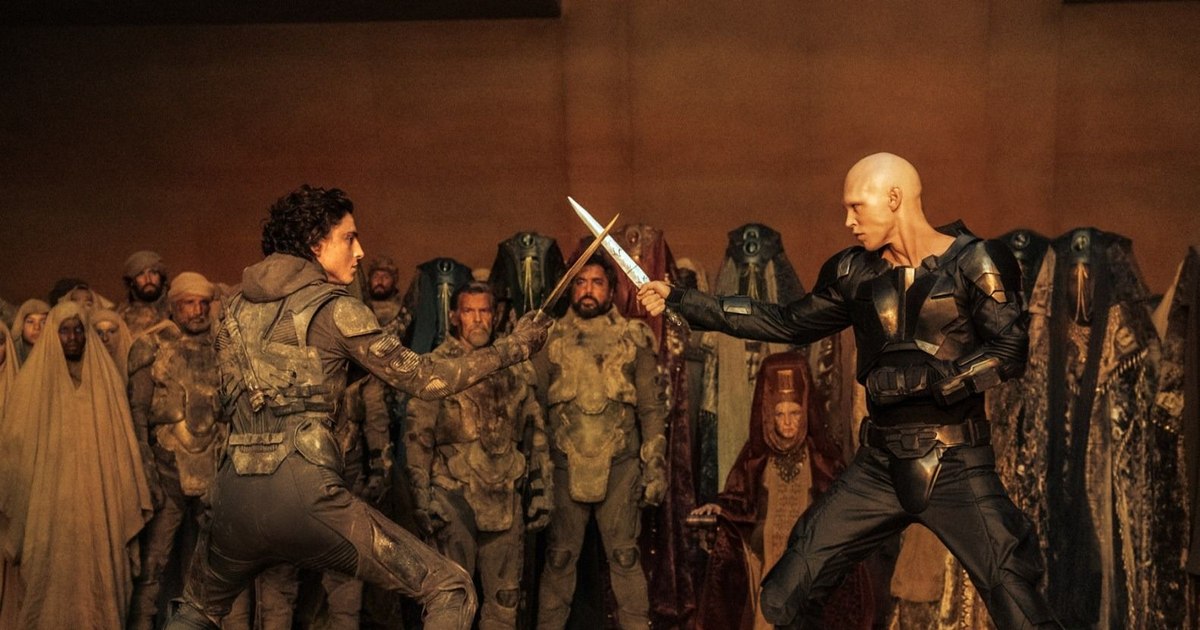
Among the Eastern European countries, including Romania, which have tried to convince the big Hollywood production houses to film here, Hungary, where Dune and Poor Things were recently filmed, is having the most success. The story begins in 2010, when producer Andy Vajna returned home.
Much of the interior scenes of Dune II were filmed in Budapest. PHOTO: Imdb
There is fierce competition between Eastern European countries to attract major film productions.
In recent years, Romania has scored several victories in this regard, such as the famous “Cold Mountain”, awarded with the Oscar for “Best Supporting Actress”, the first series of the popular series “Wednesday”, directed by Tim Burton, the series Killing Eve, Alex Rider, The Asset”, Ghost Rider: Spirit of Vengeance, The Expendables 3, War Dogs etc.
Since the program of fiscal facilities, by which the producers receive back a part of the money invested in the country where the film is produced, did not work properly in Romania, the producers turned to the neighboring countries. Of these, Hungary was by far the most successful, becoming the country with the strongest film industry in Eastern Europe.
Actress Jamie Lee Curtis said, in 2021, in an interview for Focus magazine, that she was surprised by how many American filmmakers work in the Hungarian capital, which is why she called Hungary the Hollywood of the East.
Since then, Hungary has produced many of the most popular films of recent years. Thus, two of the most talked about productions this year, Dune II and Poor Things were also filmed in Hungary.
The explosive battles of Dune, filmed in Budapest
As with the first film, the sets of Dune II were built in the Budapest studios. The sets were shared between Origo Studios – where other films with large sets, such as Poor Things and Blade Runner 2049 were filmed – and Hungexpo, a 103,000 square meter exhibition space, the specialist press reported.
The second part of Dune required an enormous area, at least 40% more compared to the first film.
Built at Hungexpo, Geidi Prime – the planet from Dune II where the Harkonnen house originates – is memorable with its menacing monochromatic design and bulbous shapes, the source said.
Many of the explosive battles and action sequences in Dune and Dune II were filmed in the background of Origo Studios in Budapest.
The other memorable scenes of the film were shot in Altivole (Italy) and the deserts of Namibia, United Arab Emirates and Jordan.
Budapest, after London, in the top of the most popular destinations for filming
Variety magazine wrote, at the end of 2023, that Budapest became the most popular destination for filming, after London.
Another much-talked-about film shot in Hungary this year is Poor Things (2023), which also won the Oscar for best set design. Art director James Price claimed in an interview that the architecture of Budapest allowed him to create scenes from other European cities such as London and Lisbon.
“We were based in Budapest. Alfie's home was the Ervin Szabó Metropolitan Library. The forest is a 20-minute drive from the center of Budapest. The church was actually a crypt, under a church, on the outskirts. The London Medical School was in the old television building right in the center of the city, not far from where Parliament is. And then a place for Lisbon, a restaurant, it was an old orphanage that I made unrecognizable“, he specified.
The artist also claimed that Budapest was also a great place to live for six months – thermal baths, food, culture.
Other important film productions were filmed in Hungary such as: The Martian, Blade Runner 2049, Black Widow, The Witcher, The Crown, The Last Kingdome, Munich, Transporter 3, Tinker Tailor Soldier Spy, Mission: Impossible – Ghost Protocol, World War Z , Treadstone, Terminator: Dark Fate.
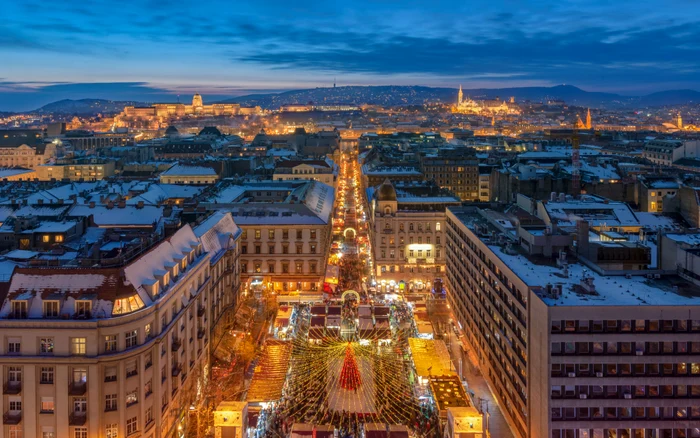
The architecture of Budapest offers the possibility of shooting very varied scenes. PHOTO: Shutterstock
Over a billion euros from the film
The success of the Hungarian film industry is also seen in the financial area.
“In Hungary, the production of the film industry has exceeded the value of one billion euros, about as much as Hungarians through their neighbors have spent on shopping tourism. If in 2012 the sector's contribution to GDP was not even 0.1%, in 2023 the indicator exceeded 0.6%. The engine of growth was foreign productions, their expenses setting record after record in the last three years“, reported Ziarul Financiar.
The competition for filming in Hungary is so great that at local studios reservations are made at least a year in advance.
As for what makes Budapest and Hungary such a draw for the film industry, Hungarian Film Minister Csaba Kael explained to Variety: “After the political changes, it was our opportunity to open our business doors… we switched to a capitalist system.“
The transition to a capitalist system meant the start of new private studios with international partners.
“The partners were German producers, then American, Italian, English and (we) started to build a service background for international productions”Kael explained.
Kael described Budapest as a “versatile” city, making it a great filming location for filmmakers who need everything from “barricade scenes” to “American streets” to “Notre Dame.” Speaking about the incentives for foreign filmmakers to come to Hungary, Kael also mentioned the country's benefits, scenic settings and positive relations with local leaders:
“Around Hungary, we have wonderful places. Old castles, old forts. There is a special program where old castles have been renovated and rebuilt,” said Kael. “We have very good connections with the local administration in small towns and villages which is very open to leave space for productions.“
Other key factors are: the 30% tax reduction on production costs, cheap labor and heavily invested studios.
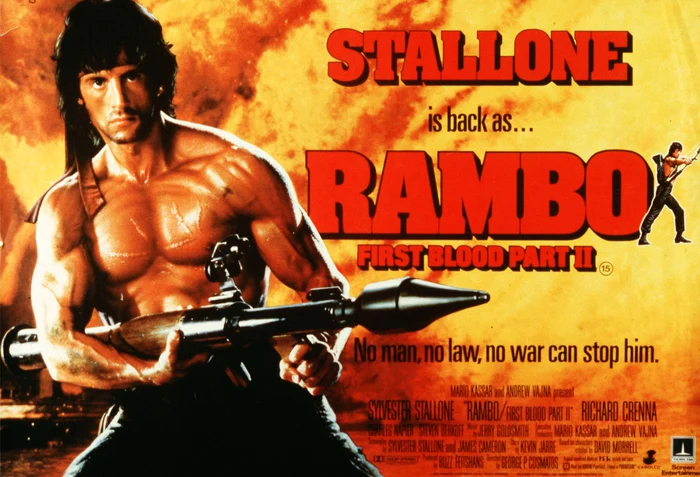
The producer of the Rambo series, Andy Vajma, returned to Ugaria and revitalized the cinema.
Successful Hollywood producer revives Hungarian industry
The story of the country's transformation into the most popular cinema hub in Eastern Europe began in 2010, when the producer of the Rambo and Terminator series, Andy Vajna, returned home to Budapest.
“When the great Hollywood film producer Andy Vajna moved back to Hungary, he took over the country's dying film industry and made his birthplace a destination for international film crews,” reported in 2016, USA Today.
Vajna, who produced the Rambo and Terminator film series and 50 other Hollywood films, admits that Hungarian film producers and critics thought it would destroy their industry, which has a history dating back to the 1920s.
Vajna retired from Hollywood in 2010 and returned home to a struggling Hungarian film industry.
“The Hungarian Motion Picture Public Foundation, which helped finance Hungarian films, was insolvent with debts of $55 million. Vajna, with the support of Hungarian President Viktor Orban, brokered the transfer of state-owned film studios and other properties to a new film fund run by Vajna. The deal used government funds to pay off the debts of the old foundation and began a new financing and production scheme for the industry”, says USA Today.
“When I came in, there was a lot of resistance that my presence would destroy the independent film industryVajna said. He was talked about as a Hollywood producer who produced “all those highly commercial movies”.
Controversial character, measurable results
Vajna answered the critics with a plan and measurable results.
“I set two goals: the revitalization of the Hungarian film industry and the film service industry for foreign filmsVajna said.
The new National Film Fund was to finance 10 locally produced films each year. Vajna hired people to review potential scripts and improve films before shooting began. Results in the first 6 years: 67 Hungarian feature films and co-productions, 140 festival awards and a Golden Globe in 2015 and an Oscar for Best Foreign Film in 2016.
The new film foundation also collaborated with Hungarian universities to train young workers for the industry. He helped spur the construction of three studios, including Origo Film Group and Korda Studios, in which Vajna held a part of the shares. And the Hungarian Parliament boosted its program of reductions for production expenses to 30% of everything spent in Hungary, among the most generous anywhere.
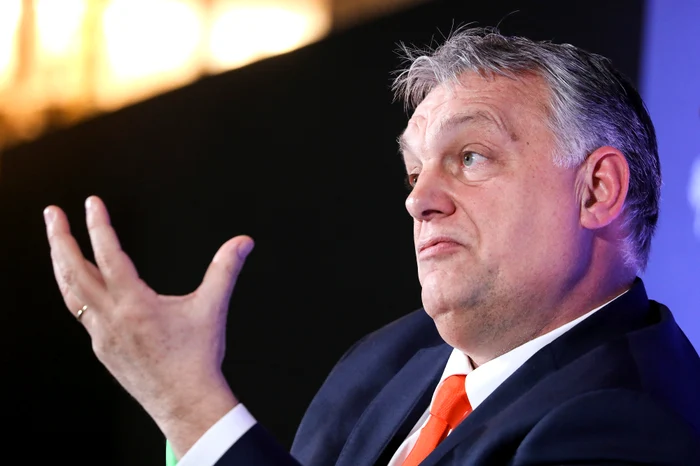
Vajna's TV came to the defense of Prime Minister Viktor Orban. PHOTO: Shutterstock
Close to Viktor Orban's
The results are hard to deny. “Spending on foreign films in Hungary has grown from $5 million five years ago to $280 million today.”Vajna said.
In addition to his film work, Vajna has business interests in casinos, a digital animation company, a donut shop, and a Japanese restaurant.
Vajna's involvement in Korda Studios means he has a vested interest in attracting business to Hungary.
After buying the tabloid-style news channel TV2, it turned into a pro-government outlet, attacking Orban's political enemies. Asked about corruption in Hungary, Vajna dismissed the notion.
“Corruption is a big word, and Americans like to throw it around. I think it's a problem in the US too”he told Variety.
Andy Vajda passed away in 2019.
