
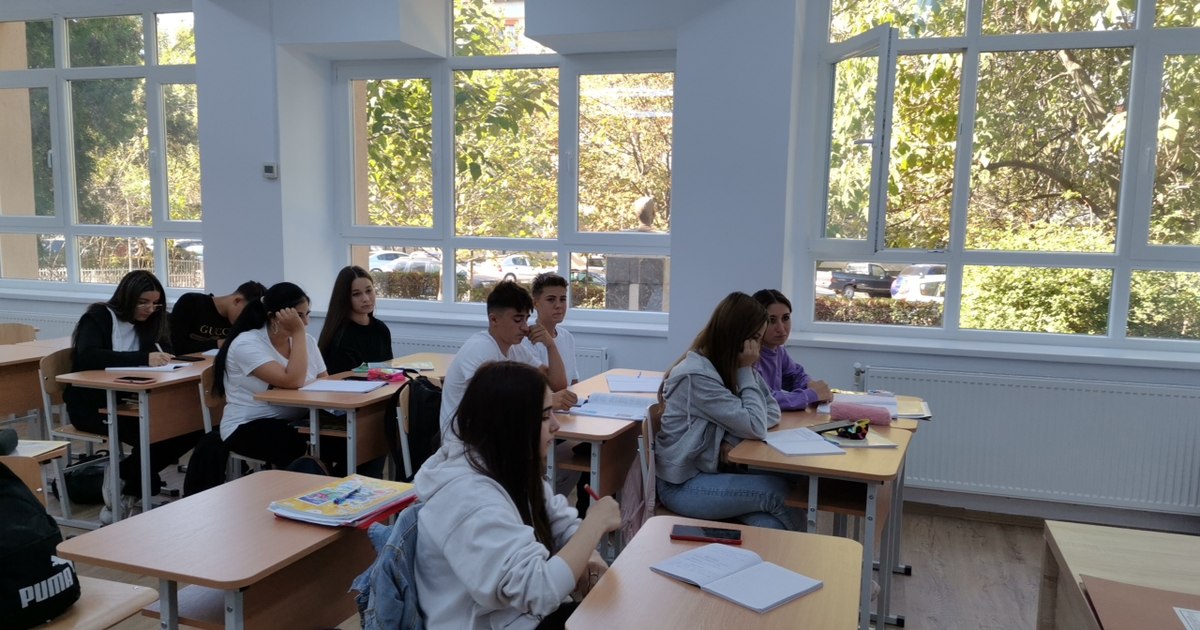
With less than a month to go until the first test of the National Assessment, students are scrambling to improve their performance from one mock to the next. The differences remain enormous between urban and rural areas and are difficult to recover
Students from Slatina. National evaluation PHOTO Alina Mitran
Poor results in the national mock – the first held under exam-like conditions and with papers handed out by computer for correction to teachers across the country – have put pupils and teachers on guard.
Since then, multiple simulations have been organized with exam-style subjects, with teachers following the progress of the students and adapting their strategy. Most schools are seeing improvement in results, teachers say. However, there are also classes where the level is so low that getting a grade 5 means success for many students. The good news is that there's still time for progress, teachers say, if students find the motivation.
Simulations with subjects at first sight
In the simulation with unique subjects at the national level, from the winter, Mathematics posed the biggest problems, only 42.37% of the 8th grade students from the whole country managed to get a grade above 5. In the Romanian Language, they achieved the same ” performance” 82.93%. And from here began the race to improve the results.
Prof. Gabriela Constantinescu teaches Romanian language and literature in one of the secondary schools with the best results in Olt county, which she also leads. He says that the results are getting better from one test to another, but he works for it a lot. There are, on the one hand, the four hours, to which is added an optional Romanian language and two hours of additional work, weekly, over and above the normal school schedule.
The Olt County School Inspectorate organized a simulation at the county level a few days ago, and the results obtained by the students show that the effort was not in vain.
“We have many children with grades above 9. In the last years we did not have so many. I now had a score of 10. I, for example, gave them a simulation about three weeks later and tried to correlate the National Assessment syllabus with the 8th grade syllabus, so that you can solve the problems related to gap, because there are still children who had a superficially retained concept from past years, let's say. But we can see the progress, clearly”says the teacher.
Moreover, the students will not slow down even after the end of the courses, on June 14, but will continue to come to school every day, for two hours of Romanian Language and two hours of Mathematics. The students are not absent from the additional training classes, as happens in other schools, and this is also because the parents teamed up with the teachers in all the years of secondary school, Prof. Constantinescu also states.
The arrears from the pandemic, in the exam syllabus
The teachers of the Romanian language had another task, says Prof. Gabriela Constantinescu, namely to return to the notions excluded from the subject matter taught in the 5th and 6th grades during the pandemic.
“There are assignments that were not done in the 5th and 6th grades, because that's how the derogation from the ministry came, there was no time to do the entire subject online in 40 minutes. After that, 7th and 8th, we had to recover everything: vocabulary notions, sentence syntax, lots and lots. They didn't do the syllabus one hundred percent but the concepts were all asked of them. Then we talk about the subordinates, the past series did not have all the subordinates. They don't get away from any,” said Prof. Constantinescu.
The students had to recover, also from the pandemic, and from the part of literature that was passed over in the run.
“They settle for what comes”
If students from well-rated schools work hard to improve their performance from one test to another, things are much different in the countryside.
“I can't speak for others, I can only speak for my class. Six children passed the threshold of 5 in the last simulation, now 12 have passed it, out of 28 in the class. But there are at least six-seven children at the threshold of 4.60 – 4.70 that remained so. I don't round up their notes because it makes no sense, we're stealing our hat”, says the teacher who teaches Mathematics in this class only since the beginning of the 8th grade.
The school is in a town near Slatina, and the most worrying thing, says the teacher, is that the students don't seem bothered by the low marks.
“They sit relaxed, without any effort, because somewhere-somewhere they will be too. They are only interested in being somewhere in Slatina and that's it, that's the key to disinterest. The generations that caught the pandemic saw that it can be promoted with minimal effort, and they stayed that way, with minimal effort. And I'm not just talking about the 8th grade, but the other grades as well”adds the teacher.
From a class, there are one or two students who have set their goal to reach a specific high school, and the others “they settle for what comes”,
says the teacher. In the winter simulation, the average of this class was 3.50. The teacher's goal is for the class average to be above 5.00 in the actual exam (it has reached 4.90 for now).
Another school, but from the center of Slatina, other results in Mathematics: 9.03 class average, only one grade below 7.00 (and that 6.90) in the last simulation.
Teachers all say that it's not too late to help children improve their performance, but the secret is for them to be motivated to learn and, not to mention, supported by their parents.
The National Assessment begins on June 25, with the Romanian Language test, the Mathematics test being scheduled for June 27, 2024.
