
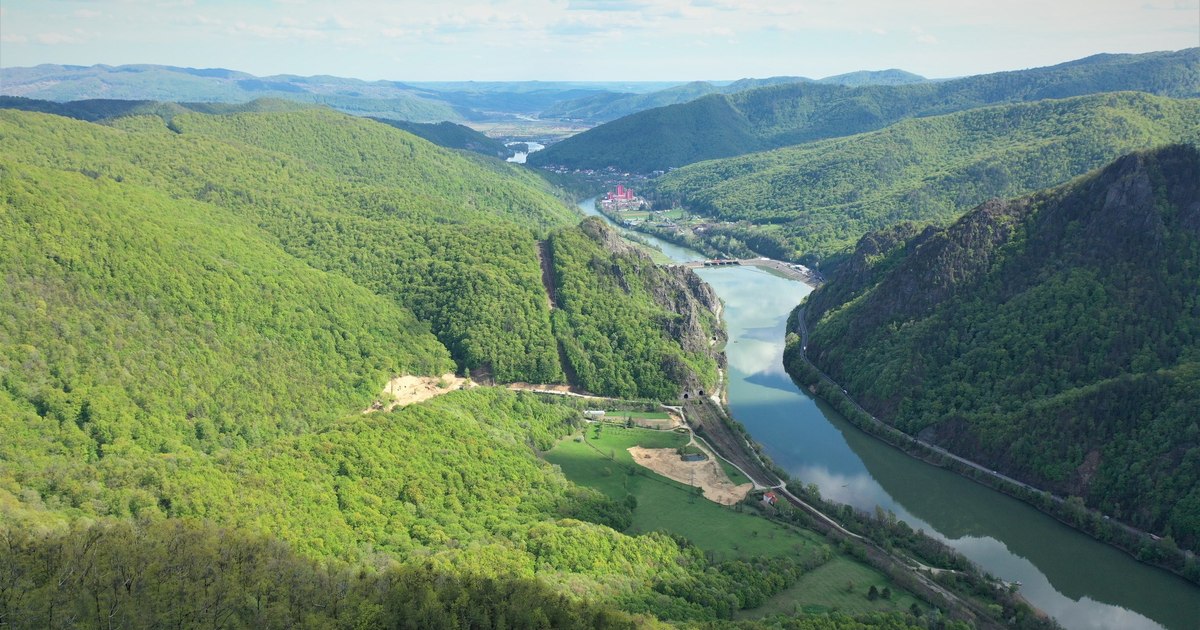
The road on the Olt Valley has a history of almost two millennia. In recent years, it has become one of the busiest roads in Romania, but this summer, road traffic will be restricted, for safety reasons.
Olt Valley Photo Răzvan Oprica, Cozia National Park.
One of the most traveled sectors on National Road 7, the road that crosses the Olt Valley, connecting the cities of Sibiu and Râmnicu Vâlcea, will be closed between July 8 and August 9, 2024, during the day, for works on the Sibiu – Pitesti highway, according to the Ministry Transportation.
The road on Valea Oltului closed during the day
“During July 8 – August 9, 2024, for the execution of the clearing works on the slope located in the protection zone of DN7, on the sector between km 242+600 and km 250+000, the measure of closing road traffic will be instituted daily in the interval schedule 06:00 – 20:00, this will be carried out on the following detour routes. It must be realized that deforestation with open traffic would represent a real danger for traffic safety and for the physical integrity of those who would transit the area where the works are carried out”shows the National Road Infrastructure Administration Company.
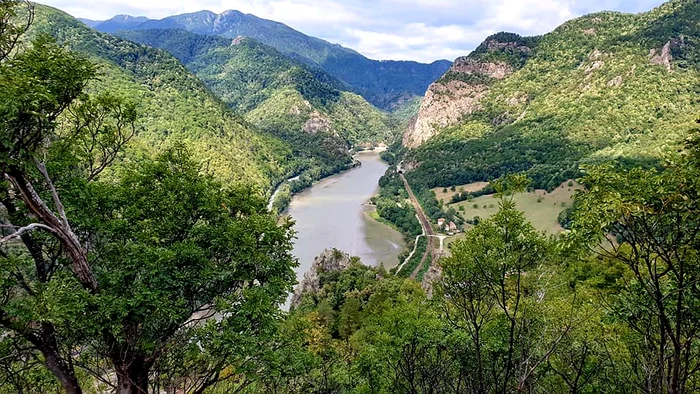
Olt Valley. Photo: National Tourist Information Center Vâlcea
Drivers who transit the region of the Carpathian Mountains, through the Olt gorge (a sector of almost 50 kilometers) will have to use detour routes during this period. With the completion of the works on the Sibiu – Pitesti Highway, the congestion on the Oltului Valley and the inconvenience caused to drivers will decrease, according to CNAIR representatives.
“We apologize for the inconvenience caused, but the construction of the Sibiu – Pitesti highway is extremely important, not only for Romania, but also for the European economy. The Sibiu – Pitesti highway is particularly relevant for traffic on the IV Pan European Corridor, as it ensures a functional crossing from West to East of the national territory. It is also the first connection to the European road network that crosses the Carpathian Mountains, connecting Transylvania and Muntenia through a modern road network that will ensure safe traffic.” informs CNAIR.
The Romanians entered Dacia through the Olt pass
The national road on the Olt Valley has become increasingly congested in recent decades, but its route has been known since Antiquity.
Through the Olt gorge, which connects the historical regions of Transylvania and Muntenia through the Făgăraş and Lotrului Mountains, part of the armies of the Roman Emperor Trajan slipped through, during the Daco-Roman wars at the beginning of the second century.
“The Olt Valley was one of the most important commercial and military roads in Dacia. In 87 AD, the Roman emperor Titus Flavius Domitianus launched the offensive against Decebalus. The Romanian army crossed the Danube on a bridge made of vessels, near the town of Orlea. According to the legend, in order to reach the Red Tower, the place where Decebal’s soldiers were, the Roman troops had to move through the Olt Valley. Here, the Dacians fought heroically, and the Romans trapped in the strait could not retreat, being defeated. In the Olt Valley, in the year 107, Emperor Traian also stayed“, informs the National Tourist Information and Promotion Center Vâlcea.
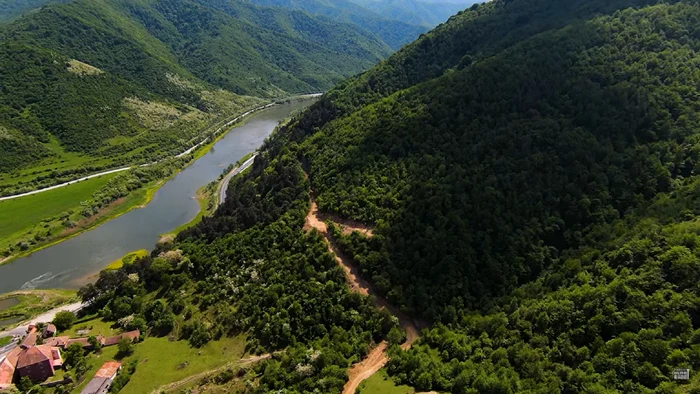
Olt Valley. Photo: National Tourist Information Center Vâlcea
The Romanians built a road in the Olt Valley, in some places suspended on beams, planted in the slopes, and its remains were identified in the Racovița area (Cornet) at the exit from the Cozia National Park. Traces of Roman fortifications can be found on the entire Olt gorge.
The road on the Olt Valley that went up from Copăceni (Olt) to Turnu Roşu was rebuilt in the time of Emperor Hadrian (117-138). The path was also used in the Middle Ages, the pass being remembered in the time of voivodes Mircea the Elder and Mihai the Brave.
Via Carolina, built during the Habsburg era
In the past centuries, until the Great Union of 1918, the Olt Valley was a crossing point between the historical regions of Transylvania and Muntenia. The road in the Olt gorge was laid out in the 18th century, according to some historians, after Oltenia came under the control of the Habsburgs. The road on the Oltului Valley, between Cozia and Câineni, was known as the Via Carolina, after the name of Emperor Charles V. It was opened in 1722.
“Via Carolina. The first concern of the Austrian government, taking possession of Oltenia (1718), was to unite Alpine Dacia (Transylvania) with Middle Dacia (Oltenia) through mutual communications. That is why, on the one hand, he had the Olt bed cleaned of the rocks that prevented any water transport, and on the other hand, he opened with great difficulty the Via Carolina, which went from Turnu Roşu to Bogdănești, close to Râmnicu- Vâlcea
This road on the edge of Olt was considered in those times as an extraordinary work and was compared to the constructions of the Romans, because, says an inscription from Câineni: even Trajan’s bravery stopped here. The construction of this road had cost 60,000 florins. The difficulties were indeed very great, having to overcome the rocky resistance of the Carpathians and the furious whims of the Olt, and the proof is that even today the section of the road between Câineni and the mouth of the Lotru, on a stretch of several kilometers, is still unfinished“, informed the magazine Familia, in 1890.
How the road from Valea Oltului was built
The works on the Olt Valley road were resumed at the end of the 19th century, and in 1901 the Olt Valley railway was also inaugurated.
“In its entirety, the Olt valley from Cozea upwards still today presents a lot of wilderness, with all the works that have been done here. What will it have been two thousand years ago! An old man born in 1836 told me that 40-50 years ago from Căciulata to Cozea, there was only as much road as you could cross with a cart pulled by two mountain oxen, to take supplies to the monastery. From Cozea upwards, there was no question of a carriage road. There were paths that could only be walked on horseback, and at the crossing of the rivers leading into Olt—ponds as the uncle called them—boards were thrown over which the horses crossed, being held by the head and tail so that they would not escape into the precipice. But you remain thoughtful as to how that genius of Rome — Trajan — was able to discover this road on which he penetrated to the heart of Dacia. How was he able to carry his numerous army through these wild places, through which even now an army in case of war would be difficult to pass, being exposed to the attack of the enemy at any moment, and having no opportunity of defending themselves, because there are kilometers long places where no more than 8-10 people can walk side by side”, pointed out the priest Eon. Georgescu, who crossed the road from the Olt valley, in 1907.
In the 20th century, the road continued to be modernized, and road traffic became more and more intense. It was paved before the Second World War and, although it still kept some sections only paved, in the 50s it was considered one of the best roads in Romania,
according to information from the digitized archives of the US Central Intelligence Agency. After the war, it was paved over its entire distance, over 100 kilometers, between Sibiu and Râmnicu Vâlcea.
