
Carlo Acutis, the Italian teenager known as the “influence of God”, for the way he used technology to spread faith, will be canonized on Sunday, becoming the first millenial holy of the Catholic Church.
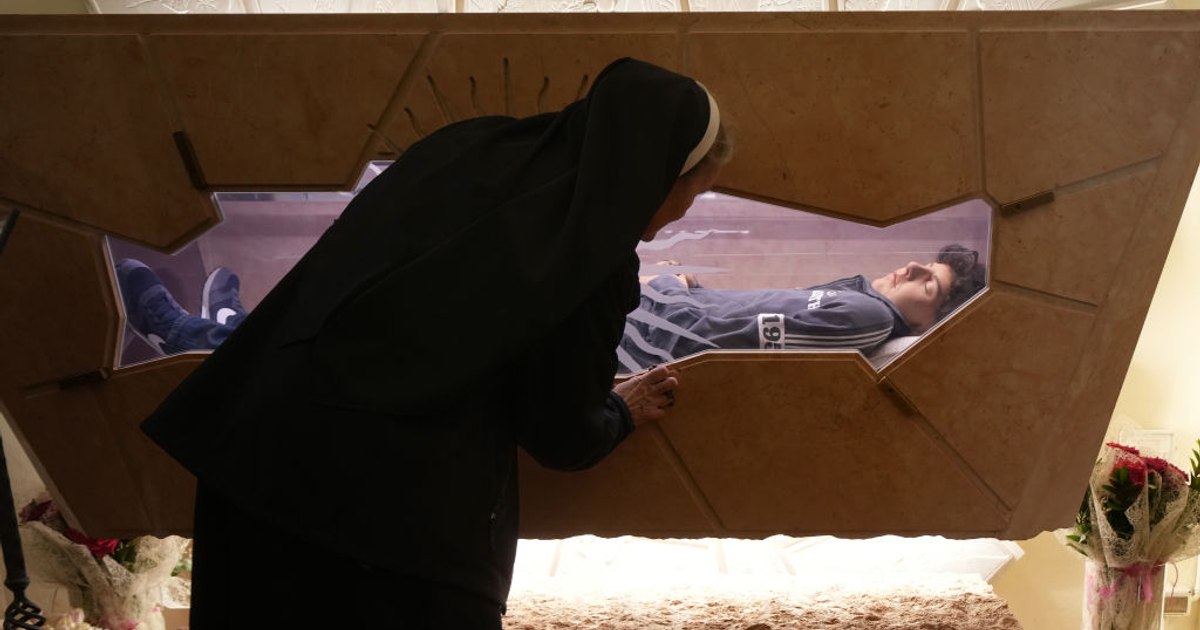
His coffin is in the Church of St. Mary major, in Assisi, Italy / Photo source: Getty Images
Historic moment
Carlo Acutis, an Italian teenager born in the UK, passionate about video games and Eucharist, will become the first millennial Catholic saint on Sunday.
Pope Leo XIV will chair his first canonization ceremony in St. Peter’s Square in the Vatican, bringing the young expert in computers among those venerated as Christian miracles.
Born in London in 1991, Acutis grew up in a family that was not particularly religious, but he always felt a deep connection with God. At the age of three, he pulled his mother to the job, eventually inspiring her conversion. “To always be close to Jesus, this is my life plan,” he wrote at seven years.
The family moved to Milan after his birth. As soon as he began to receive pocket money, he donated to the poor. At school, he defended his colleagues with disabilities when they were victims of bullying. The evening was cooking and delivering meals to the homeless.
The unique child even learned coding to create websites promoting his faith, developing a site called “The Eucharistic miracles of the world” in the last months of life.
His unwavering devotion was abruptly interrupted in October 2006, when, at the age of 15, he was diagnosed with acute leukemia and died in a few days.
The body of Carlo Acutis, almost intact after 20 years after death
From 2020, the body of the young man is in a glass coffin in Assisi, Italy, where thousands of pilgrims visit him annually to honor on “The influence of God”dressed in jeans, Nike sports shoes and a north sails sweater, with the hands around the rosary.
His coffin is in the Church of St. Mary major, in a room called the Sanctuary of renunciation, where it is said that St. Francis de Assisi has thrown his expensive clothes in rejecting excess material.
Acutis’s body was moved there only after beatification – the fourth stage on the road to canonization, when a verified miracle must be attributed to the prayers to the holy person after death.
The first of the two miracles attributed to Acutis was the healing of a Brazilian child, Mattheus Vianna, who suffered from a rare pancreatic malformation in 2009. Pope Francis confirmed the authenticity of miracles only a decade later.
Between 2007 and 2019, Acutis was buried according to his wishes in a cemetery in Assisi. Only on January 23, 2020, its remnants were exhumed and examined for signs of “corruption”.
Incorruptibility – the state of a completely absent body of degradation – is considered a sign of holiness, although not the only one. In 2020, rumors appeared that the teen’s body would have been found perfectly preserved, but the clergy denied speculation.
“Today we see him again in his mortal body. A body that has passed, in the years of burial in Assisi, through the normal decomposition process, which is the inheritance of the human condition after sin separated from God, the source of life. But this mortal body is intended for resurrection.” said Archbishop Domenico Sorrentino from Assisi for Catholic News Agency.
“His body was completely discovered in full, not intact, but in full, having all the organs. He worked on his face”, said Father Carlos Acácio Gonçalves Ferreira for EWTN.
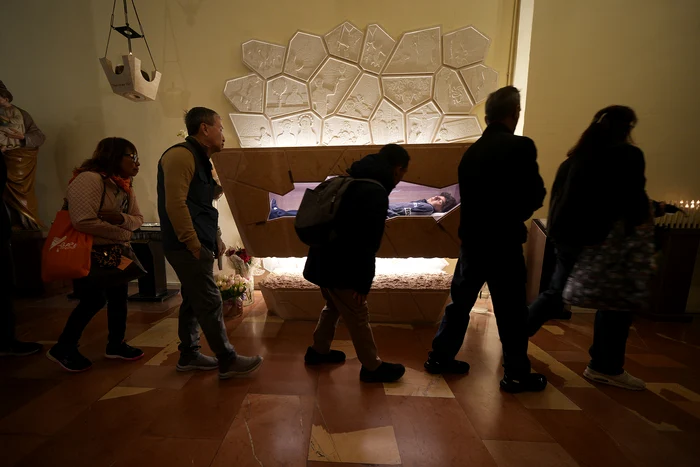
The pilgrims come to Great Nunar to pray to the grave of the young Saint / Photo source: Getty Images
His heart was removed and kept in a golden relic at San Rufino Cathedral
If Acutis looks perfectly preserved today, this is due to the fact that a silicone mask was created to cover the signs of degradation. His heart was removed and kept in a golden relic, transferred to the Cathedral of San Rufino, and parts of the hair and organs were kept as relic for veneration.
His final resting place, where the new saint is buried with a wax mold of his face, has become a popular pilgrimage place, attracting thousands of believers daily.
Earlier this year, Italian prosecutors began an investigation into an illegal market for Acutis relics, after the supposed sale of his online hair with up to 2,000 euros.
“We do not know if the relics are real or false”said Bishop Domenico Sorrentino, who filed an official complaint. “But if they were invented, we would be not only in the middle of a fraud, but also on offense to religious faith.”
Acutis won the name of “The influence of God” because he used technology to spread faith. His best-known technological project is the site about the so-called Eucharistic miracles, available in almost 20 languages.
The site includes information about 196 seemingly unexplained events in the history of the Church related to the Eucharist, which believers believe represent the body of Christ.
Acutis spent hours in prayer before the Eucharist, a practice known as the Eucharistic worship. “This was the fixed meeting of his day ”, Said his mother, Antonia Salzano, in a documentary broadcast on Friday night at the seminar in Rome.
The first canonization ceremony of Pope Leon XIV
Pope Leo will declare the holy acute on Sunday, in the first canonization ceremony, along with another famous Italian, Pier Giorgio Frassati, who also died young. Both ceremonies had been scheduled earlier this year, but were postponed after Pope Francis’s death in April.
Frassati was an Italian young man known to help the needy, who died of poliomyelitis in the 1920s.
The ceremony attracts tens of thousands of pilgrims, especially young Catholics
The ceremony is expected to attract tens of thousands of pilgrims, especially young Catholics, who will be delighted to see the teenager raised at the same level as Mother Tereza and Francisc de Assisi.
Acutis’s mother, Antonia Salzano, told Reuters that her son’s attraction for young Catholics was that she lived the life of an ordinary teenager in the 2000s. “Carlo was an ordinary child. He was playing, he had friends and he went to school. But his extraordinary quality was that he opened his heart to Jesus and put Jesus in his life,” she said.
“He used this ability to spread the good news, the gospel. He wanted to help people have more faith, to understand that there is life afterwards, that we are pilgrims in this world.”she added.
To be declared holy means that the Church believes a person has lived a holy life and is now in heaven, along with God.
Other saints who died young people include Lisieux Teresa, who died at 24 in 1897 and promoted “Little Way” of charity, and Aloysius Gonzaga, who died at 23 in 1591 after taking care of the victims of an epidemic in Rome.
Carlo Acutis’s canonization, suspended following the pope’s death
The canonization of Carlo Acutis, the first saint of the millennial generation, was suspended following the death of Pope Francis.
Carlo Acutis, also known as the “influence of God”, was to be canonized these days. According to the Vatican spokesman, the Holy Catholic year will continue according to the plan, despite the pope’s passing, wrote Reuters.
