

Oncology patients are given a chance of life through this type of radiation therapy, which is now settled by the National Health Insurance House.
Dr. Cristina Iftode is the coordinator of the Stereotaxy Department in the SANADOR Oncological Center
Stereotaxic radiotherapy is one of the most modern radiotherapy techniques in the treatment of oncological diseases, but it is indicated only in certain situations. “Weekend Adevărul” spoke with Dr. Cristina Iftode, primary radiotherapy physician and coordinator of the Stereotaxy Department in the SANADOR Oncological Center, to find out more details about the cases in which stereotaxic radiotherapy is recommended, what the treatment entails and how quickly the patient recovers after such a procedure.
“Weekend Adevărul”: Is stereotaxic radiotherapy new in Romania? What does this type of therapy entail?
Dr. Cristina Iftode: It is a more recent procedure, it has been done here for several years, but in the world it is not a new one, but it was adopted, in its modern form, in the 90s of the last century. It is a very precise and targeted type of radiation therapy that manages to deliver very high doses of radiation therapy in an extremely small number of sessions. In general, patients undergoing radiation therapy are used to fairly long treatments, from several weeks to several months. Through this technique, in very well selected situations, we manage to shorten the total treatment period extremely much. In general, a complete treatment lasts about a week, and the dose is much higher in certain situations than the classical treatment given in a month and a half or even in two months.
What are the differences between radiosurgery and stereotaxic radiotherapy?
And radiosurgery can be performed with a linear accelerator – the device with which we perform radiotherapy sessions, either those with normal fractionation or those in stereotaxic radiotherapy. In certain situations, this limited number of sessions can be reduced to a single session, in which case the procedure is called radiosurgery. Radiosurgery can be administered not only with the linear accelerator, but also with gamma knife or cyber knife. In fact, radiosurgery is largely a form of stereotaxic radiation therapy. In our situation, the difference is the number of sessions. Radiosurgery is done in one session.
Advantages of stereotaxic radiotherapy
In what situations can stereotaxic radiotherapy be used and what are the advantages of this procedure?
We can perform this procedure for tumor volumes quite small in size, up to a maximum of 5 centimeters. Obviously, at the cerebral level, for example, a tumor of such size is considered very large. One of the most common oncological diseases that we treat with stereotaxic radiotherapy is represented by brain metastases. There are patients who come with a single small metastasis, a few millimeters or one to two centimeters, but we can also treat patients with many metastases. Obviously, we decide the therapeutic strategy according to the extent of the disease. In the case of the first category, we can use radiosurgery, as I said, in a single session. However, even in this case, differences may appear depending on the location of the injury. If it is in the vicinity of very delicate organs – next to the optic nerves or near the brain stem – it is more difficult to perform a single session and we have to be careful and divide the dose of radiation therapy precisely to protect those structures as well as possible. Stereotaxic therapy performed with the linear accelerator allows us to divide the dose and intervene even in complicated areas of the head.
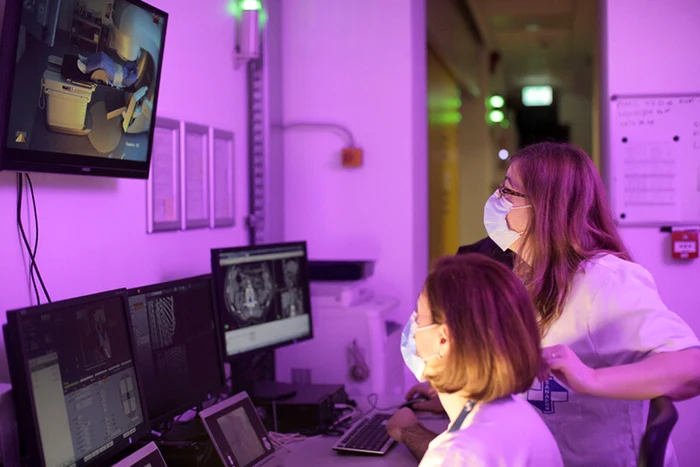
Stereotaxy can also replace a surgical intervention, but only in certain situations
Can this radiation therapy be used in any type of cancer, regardless of the affected organ?
Not. There are certain criteria that we discuss in the interdisciplinary commission. Stereotaxic radiotherapy can only be applied in certain situations. We can propose this strategy to patients with primary tumors: lung tumors in the initial stages – only with the lung lesion, without lymph node invasion, with a size up to 4-5 centimeters, both those with small cells and those without small cells; pancreatic tumor – in selected cases, without direct invasion of the duodenum or stomach; prostate tumor – in the initial stages; hepatocarcinoma. Genital cancers are not initially addressed with stereotaxic radiotherapy. On the other hand, this form of radiation therapy can be used to treat almost any type of metastases: brain, lung, liver, bone, both vertebral and extra-spinal, mediastinal, abdominal, or pelvic nodal tumors. Obviously, not all patients with metastases can be irradiated, only those with a limited number of metastases. In medical terms, oligometastatic patients – those who have up to five metastatic lesions in up to three organs. We must make an important distinction between patients without metastases and those with many metastases. It is clear that in a very extensive disease, with numerous metastases, we cannot help much with a local treatment such as stereotaxic radiotherapy, but the role of the oncologist and systemic therapy is indispensable. With the targeted radiotherapy treatment, we can intervene in patients with this intermediate status between localized and very extensive disease, but these are very well selected cases, analyzed in the multidisciplinary team. Fortunately, this treatment has been settled for several months. Until a few months ago, the treatment was not settled and there was a financial obstacle for the patients, basically they were being deprived of a chance at life.
Stereotaxy, settled by the state
Can the patient who has undergone surgery do this type of radiation therapy?
Depends on situation. If there are small recurrences, stereotaxy may be indicated, but each case must be checked individually. A previous surgical intervention is not a contraindication. However, previously performed radiotherapy could cause problems, because the tissue in question has already been irradiated, as well as the surrounding healthy organs. Stereotaxic radiotherapy allows us to administer high doses of radiation, with a higher chance of therapeutic success, while also avoiding the surrounding organs better, which is a great advantage. In certain situations, we can even intervene on already irradiated areas. Obviously, the ideal case for re-radiation is to be as far away from the previous treatment as possible. All these things are analyzed for each individual case, we personalize the treatment a lot. We have to do this because technology allows us and the National Health Insurance House also helps us.
Can stereotaxic therapy be indicated at any age?
There are no age limits, there are no such contraindications. It is a non-invasive technique, without anesthesia, which does not require hospitalization of the patient. The stereotaxic radiotherapy session lasts a quarter of an hour, so it is convenient for the patient. In certain situations, stereotaxy can also replace a surgical intervention, which is a fabulous advantage, especially when we are talking about metastatic patients. Most of them are already in the course of chemotherapy or immunotherapy treatment, which they often do not even have to interrupt to perform stereotaxic radiotherapy, as is the case with surgery.
What reactions can occur after stereotaxic radiotherapy?
It depends tremendously on the area we irradiate and on the neighboring organs. For example, if we are talking about a lung metastasis, chest pain, cough, fever and difficulty swallowing may occur if the lesion is close to the esophagus. We explain all these things to the patient before starting the treatment, but most of the time no important symptoms appear after the intervention. If, however, reactions occur, we treat them.
A quick recovery
What is the survival rate after such radiotherapy?
It depends on what we are dealing with. If we treat lung lesions, primary tumors in the initial stage, the control rate is over 80% of cases. When it comes to metastases, results vary from case to case. Unfortunately, there are situations when we talk about reduced survival, when it is histologically proven that the tumors are very aggressive. There are also patients whom we actually cure.
If the patient is still working, can he return to work after treatment?
Yes. Many patients do not even need sick leave, but it depends on each individual case.
Can stereotaxy be indicated together with other oncological treatments, such as chemoembolization?
Chemoembolization is another local procedure and is mainly indicated for the treatment of liver lesions. If the lesions are very large or are located in the vicinity of structures that cannot allow other interventions, then we can intervene with stereotaxic radiotherapy. Also, if a chemoembolization has already been done, but the neoplastic tissue persists on the respective lesion, then stereotaxic radiotherapy can also be used. The two are local treatment alternatives, they can be complementary, but there is no procedure that can be applied to all patients. It is important to have as many treatment options as possible and to collaborate to provide each patient with the best treatment solutions.
