
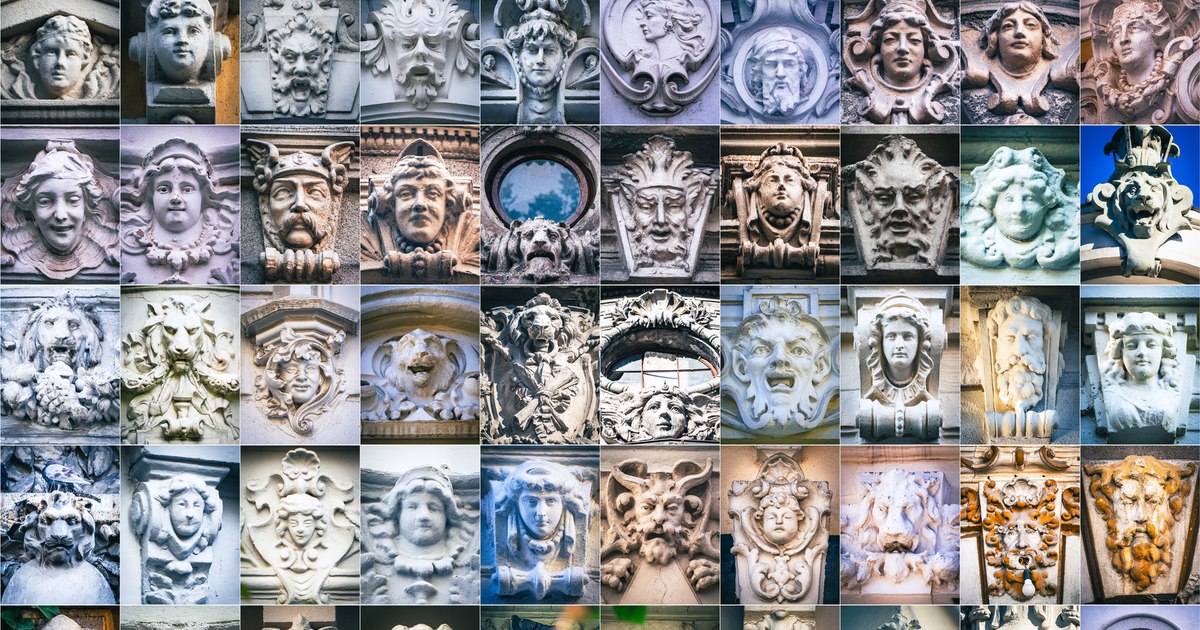
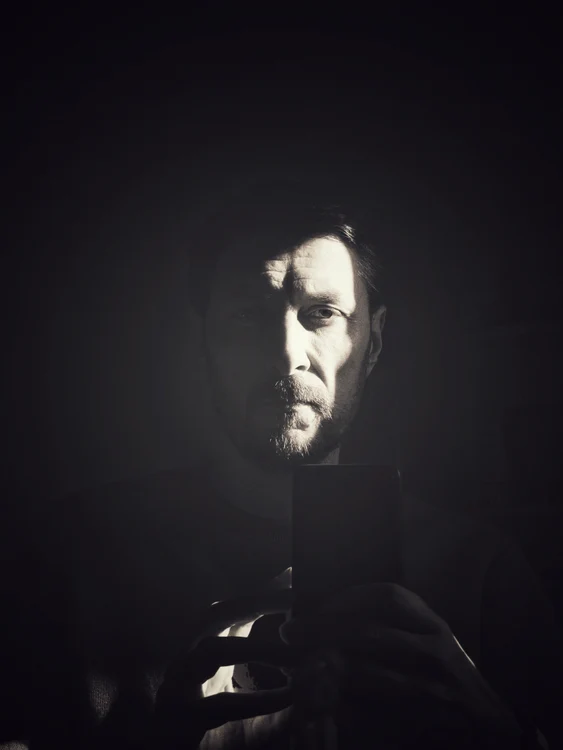
Mihai Barbu, photographer and journalist, roams Bucharest with his eyes up, looking for the sculpted faces that look down on the city from the buildings. He photographs them, collects them on a map and brings them to life online, in the “Faces of Bucharest” project – a living archive of stone faces.
Today he might be on Armeneasca, tomorrow through the Old Center, always with his eyes up, looking for the faces that look at us from the buildings. Some smile just barely perceptibly, others seem frowning or weather-weary. You only see them if you look up and slow down. An entire city follows Mihai Barbu, the photographer who began to inventory Bucharest’s mascarons – the faces carved in stone, metal or plaster, hidden between columns, above windows, at the corners of houses. He photographs them, puts them on a map and publishes them on Instagram, under the name “Faces of Bucharest”, so that we can see them too.
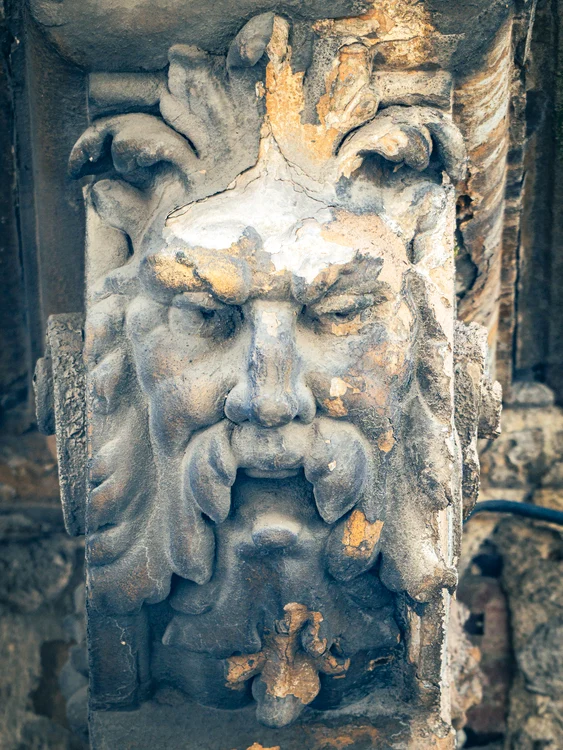
Mascarons are old architectural details, appeared in the 18th-19th centuries, used mainly in Art Nouveau, once intended to protect homes from evil spirits, and later used purely decoratively. Bucharest has hundreds, maybe thousands, but we pass by them every day without noticing them. Mihai patiently searches for them and gives them a second, digital life. Each post is a small walk through a parallel Bucharest, which can only be discovered by those who have the patience to look at it.
He has already collected hundreds of photos and divided them into categories: people, lions, green people, animals and mythical figures. At the moment, only a few dozen faces are marked on the map – a kind of urban atlas of stone looks – which are gradually colored, day after day, with each new post. “Weekend Adevărul” talked to him about the beginnings of the project, how he learned to read the expressions of the city and what is lost when old architecture is modernized to the point of deletion.
The view of the city frozen in time
Mihai Barbu is a freelance photographer and journalist, with many years in the press behind him. The job entered his blood, and the reflex to observe the world through the lens has not left him, even if he has been working on his own for several years. In the “Faces of Bucharest” project, he says that it is not the camera that guides him, but the journalistic instinct – the one that makes him look for stories where others see only buildings.
His connection with Bucharest was always ambivalent. He came from Petrila, Valea Jiului, in ’98, for college, convinced that he would return home after. “My relationship with Bucharest is not the happiest in the world“, he says, remembering the time when the city greeted him with a kind of brutality specific to the late 90s. He was robbed, he had incidents that stayed in his mind, but over time he started to see something else beyond the everyday noise. Mihai admits that he is not the biggest fan of Bucharest, but he always remained curious about its version with old facades – the city in black and white pictures, with ornate facades and wide boulevards.Looking over vintage pictures, I really think he was very good looking in his day – ante-war, inter-war and post-war. During those years, I think he was very handsome and I would love to walk around Bucharest for an hour somehow“.
Curiosity about the city grew out of an old habit from her student days, when she would go for a walk downtown and let the road signs decide her route. “If I had to go right, I certainly wasn’t going left. I was following those arrows on the signs. Don’t ask me what I was doing at the roundabouts, because I met a couple of them and I was having fun“, he remembers, laughing. It was his way of getting lost in Bucharest in a controlled manner.
Years later, Mihai rediscovered walking through guided tours and solitary explorations. That’s how he began to notice the faces that look down on the city from the floors of the buildings. “I thought it was interesting to document this project because I know people don’t see them“. The mascarones, as he later found out they were called, seemed to him like lost expressions of the city. Each balcony or wrought iron gate had something to say, but they lacked one particular element: the expression. The discovery of these faces was a revelation. He began to look for them everywhere, convinced that Bucharest hides much more than meets the eye. “I find it very interesting that no one sees these faces, which are frowned upon, some are even smiling… they are there looking down on us“. He then noticed them in other cities, but none compared. “On a short walk around Cluj, I was looking for something like this and I wouldn’t say that it competes in this respect with Bucharest“. And that’s how “Faces of Bucharest” started – from a moment when he started to see these faces everywhere and collect them, one by one, like in a diary of the city.
Men, lions and gods
Mihai’s gaze gradually transformed into that of an urban explorer. He says that he didn’t start with the idea of doing architecture or history – everything started out of simple curiosity. He has no specific training in the field, and that seems to him to be the interesting part: he ended up discovering the meaning of these faces hiding in the city walls himself. On the Internet he found only a few pieces of information: that they can represent human or mythological characters and that, in the past, they had the role of protecting the house from evil spirits. “It’s the lack of information that intrigues me the most. You build a house in Bucharest at the turn of the century and, at some point, you decide to put some faces on the facade – sometimes not even the prettiest ones. How do you decide to do this?“.
He imagines that craftsmen and owners had a kind of catalog at their disposal, from which they chose their designs. The thought amuses him, but makes him look harder. Some faces appear to be inspired by real portraits, he says. He encountered mascarons that seem to resemble real people – perhaps the owner’s children or wife. Others, however, do not repeat at all. “So far I have photographed a few hundred and I can say that there is a guy who is quite common, a lady’s face, and then about three more who repeat themselves from time to time. But the vast majority, 99% of these faces, are simply unique“.
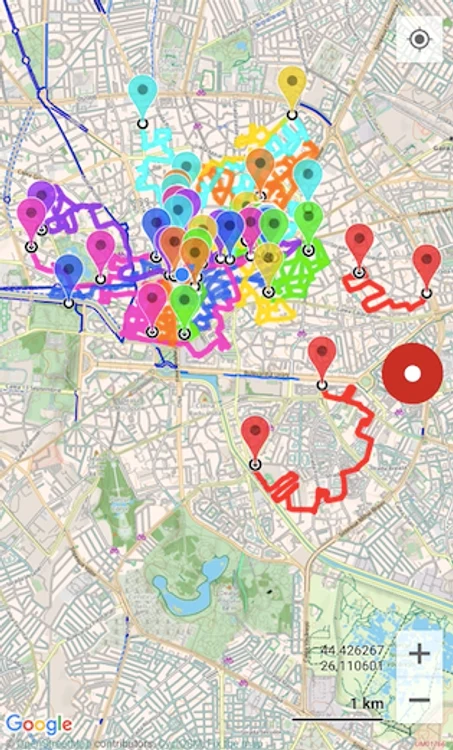
Hence the charm of the project: Bucharest seems full of unrepeatable faces, looks once sculpted by anonymous hands. On Instagram, the “Faces of Bucharest” page links to a map where Mihai has collected, so far, 84 locations. Each point corresponds to a real face, photographed and posted. He divided them into five categories and says each has its own personality. “I like the people category. They are ours, as it were. All these expressions and the fact that they are so different – I would put this at the top of the list of favorites“.
He also likes mythological characters, from Medusa and Pan to Hercules, but especially fascinates him green men – the green people: “It is found as a mascaron from many periods and can be found almost everywhere on the globe. Its theme is the leaf and the tree – it symbolizes man’s connection with nature and is very mythical, the green man“.
When he returns to the map, he is once again amazed at how many lei the city has. “I find it interesting that the city is full of figures with their faces, I really didn’t expect there to be so many“. So far, Mihai has photographed over 650 mascarons and posts one or two every day. Once the picture reaches social networks, a dot also appears on the map with the figurine’s location: “Still, I feel like I haven’t even gotten to half of everything I think is around town“.
“You can find beauty even in Bucharest that you don’t like. It looks down on you”
The map, created by Mihai as a tool for those around him, was born from the desire to turn the project into an urban game. “I think that when you go for a walk, the map is the best guide. It helps you find them, like in a kind of treasure hunt. That’s her idea: to make it easier for those who want to meet mascaronesSince launching it, it has been accessed nearly 25,000 times.
City walks are carefully calculated. Before he goes out to photograph, he starts a GPS application that records his route, so that he does not pass the same streets twice. “It’s very hard to remember all of Bucharest, where you’ve been, where you haven’t been“. That’s how he discovered the areas with the highest density of mascarones: the center, the Armenian Quarter and the Old Town. “I have a special sensitivity for the Armenian Quarter. It’s full of mascarones. In the Old Center I managed to cover only half of the area until it got dark“.
The building that surprised him the most is one that everyone knows, but few look at: the History Museum. “It is simply loaded. If you look up, there are about 15 distinct mascarons – different patterns – repeating“. Among the hundreds of faces in the city, he also has a favorite: a woman with a calm, almost smiling look, located on Praporgescu Street, somewhere between Rosetti and Batiștei. “It’s really the profile picture on Instagram. It seems to me that it has an air of mystery. He looks like he’s smiling, but he’s not really. I really like this lady“, he says about the mysterious “Gioconda” in the center of the Capital.
History that disappears under layers of insulation
In Mihai’s view, the mascarones are a living part of the city’s history, hidden but visible. He says that the very fact that they are there, but we pass by without noticing them, makes them fascinating: “There are things that exist right here in front of us, they are beautiful, but we just don’t see them“.
Often, even he discovers them only after dozens of passes on the same street. He relates that he happened to be walking along a familiar route and suddenly saw a face he had never seen before. “It’s a street I’ve been down hundreds of times, and every time I’ve looked for the mascarones. After dozens of passes I discovered one that was just there in plain sight but I had never noticed“. It amuses him how easily you can miss something even when you’re looking for it, and in his own building, after a few months, he discovered three macarons that he hadn’t noticed until then. The cold period is the ideal time for documentation: without the leaves covering the facades, the faces can be seen more clearly, so take advantage of the winter to photograph as many as possible before the vegetation returns.
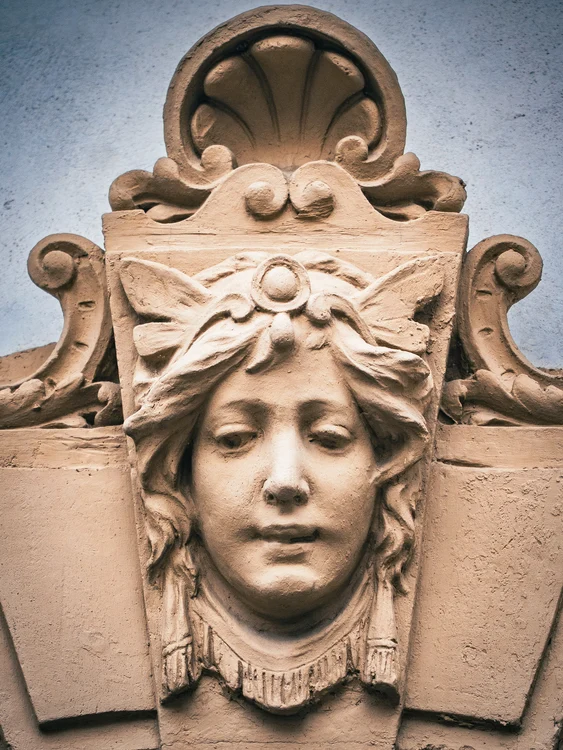
As much as he enjoys these discoveries, he often stumbles upon poorly renovated buildings that bury details under layers of insulation. “I passed by a renovated house, near Carol Park. The mascaron was there, but the isolation had half-swallowed him. It was as if he was sunk into the wallHe says, however, that there are also examples of good practices, such as the house on Praporgescu Street, restored with attention to detail and respect for the original form.
He’s glad he has the photos, because sometimes they’re the only evidence that those faces ever existed. “I passed the houses and was glad to see them – I knew that in a year or two that mascaron would be gone“. In many cases, the images on Google Street View confirm his intuition: from 2009 until now, a lot of them have disappeared. “I think this project may have started too late. Or maybe in 2009 it was already too late“.
Walking through the city changed his way of looking at him. “I learned that you can find beauty even in Bucharest that you don’t like. He’s there, looking down on you“.
As for what’s next, Mihai doesn’t have a fixed plan, but he wants his work to take a clear shape. Maybe a book, an online archive or a multimedia project. It is important that something remains after this visual mapping: “I’d like to consider, at some point, that I’m done with inventory. I tell you honestly, the project is really not made for me. I do it so that people can start to see these details, which are otherwise almost impossible to notice“.
