
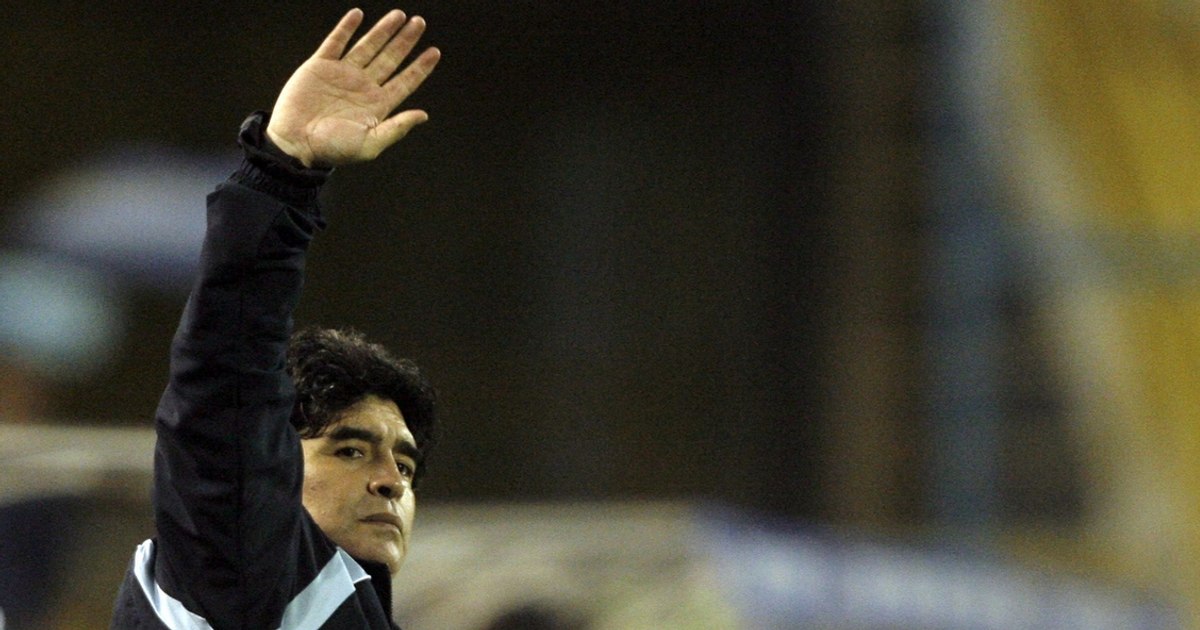
On November 25, 2020, in the town of Dique Lujan in Argentina, Diego Armando Maradona, considered by many football people as the greatest player of all time, passed away. In his wake there were trials that are still pending and whose mission is to determine the culprits for his death.
Diego Maradona, a football icon
Argentine international Diego Armando Maradona was born on October 30, 1960, in Villa Fiorito, a poor community near the capital Buenos Aires.
He began to love football at the age of three, when he received his first football. At the age of 10, he started playing organized football with Los Cebollitas, a team that was part of Argentinos Juniors, a well-known club in Argentina. Los Cebollitas had reached 136 matches without defeat with him, in the formula of the first eleven.
He debuted in professional football at Argentinos Juniors, at 15 years old. He played for Argentinos Juniors (1976-1981), then went to one of the most successful teams in Argentine football, Boca Juniors (1981-1982).
He left South American football for Spanish club FC Barcelona in one of the most expensive transfers in international football at the time, in 1982, around £5 million, according to https://world-soccermuseum.org. He played for Barcelona until 1984, winning the Spanish Championship, the Copa del Rey and the Spanish Super Cup in 1983.
In 1984, he moved to Serie A side Napoli for a record transfer fee this time around £6.9 million, according to https://world-soccermuseum.org. Bringing him to Napoli represented the implementation of the managerial plan of club president Corrado Ferlaino who was determined to lead the club to great performance, according to https://www.football-napoli.net/. On July 5, 1984, Diego Maradona was presented to the public in San Paulo, in front of 75,000 spectators. By bringing in Maradona, Napoli won the first title in history, on May 10, 1987. The club also won the Coppa Italia.
Maradona was the team’s top scorer with 10 goals and at least 10 assists. Diego was a superstar, a leader and a key player at Napoli. His teammate, Francesco Romano described him: “I have never seen such things before. In training, in the warm-up, I have never seen anyone do what he did”, according to the quoted source. He won the title again with Napoli in 1990.
He won the UEFA Cup in 1989 in the final with Stuttgart. In the round match, Napoli won 2-1 with goals scored by Maradona and Careca, and in the second leg of the final it was tied 3-3, Napoli winning the UEFA Cup, the first trophy at the level of continental European competitions.
In his 257 appearances for Napoli, Maradona scored 115 goals.
Maradona left Napoli in 1991 and played in Spain at Sevilla (1992–93), scoring 6 goals in 28 appearances, before returning to his homeland, where he also played briefly for Newell’s Old Boys (1993–94) and Deportivo Mandiyu (1995).
“Hand of God”
His performance for Argentina in the 1986 World Cup was unbelievable. In the anthology match in the quarter-finals, Argentina defeated England, Maradona scoring in the jump, also helping himself with his hand, later called the “Hand of God”. In the final of the tournament, Argentina beat the similar West German national team, which featured big names in German football, 3-2.
In the 91 matches in which he wore the shirt of the Argentine national team, Diego Maradona scored 34 goals.
In 1986 and 1987, France Football and Onze Mondial awarded him the Onze d’Or award, for the best football player in Europe.
In 2000, in a FIFA poll, he was named, along with the Brazilian Pele, for the title of player of the century.
The life of the former great legend of Argentine football was sprinkled with many moments of extraordinary success on a professional and personal level, but also with many difficult episodes, with numerous health problems, which manifested themselves in the collective mind as true curtains of shadow over the lavish career of the legendary player.
In terms of football, his career was crowned by what he wanted: the world title with the Argentine national team, at the 1986 World Cup, the title in the Spanish Championship with FC Barcelona and the King’s Cup (1983), twice the title with Napoli in the Italian Championship (1987 and 1990), the UEFA Cup with the Neapolitan club in 1989, according to https://thesportsside.com.
In his memory, on December 4, 2020, the San Paolo stadium of the Italian team Napoli in southern Italy, where the brilliant Argentinian played for seven years, was renamed the Diego Armando Maradona Stadium.
In Argentina, on November 26, 2020, Boca Juniors supporters paid, at a championship match, an impressive final tribute to their former idol with a lavish display, reminding the whole world of the phenomenal player “El Pibe de Oro” (“The Golden Boy”).
Source: Agerpres
