
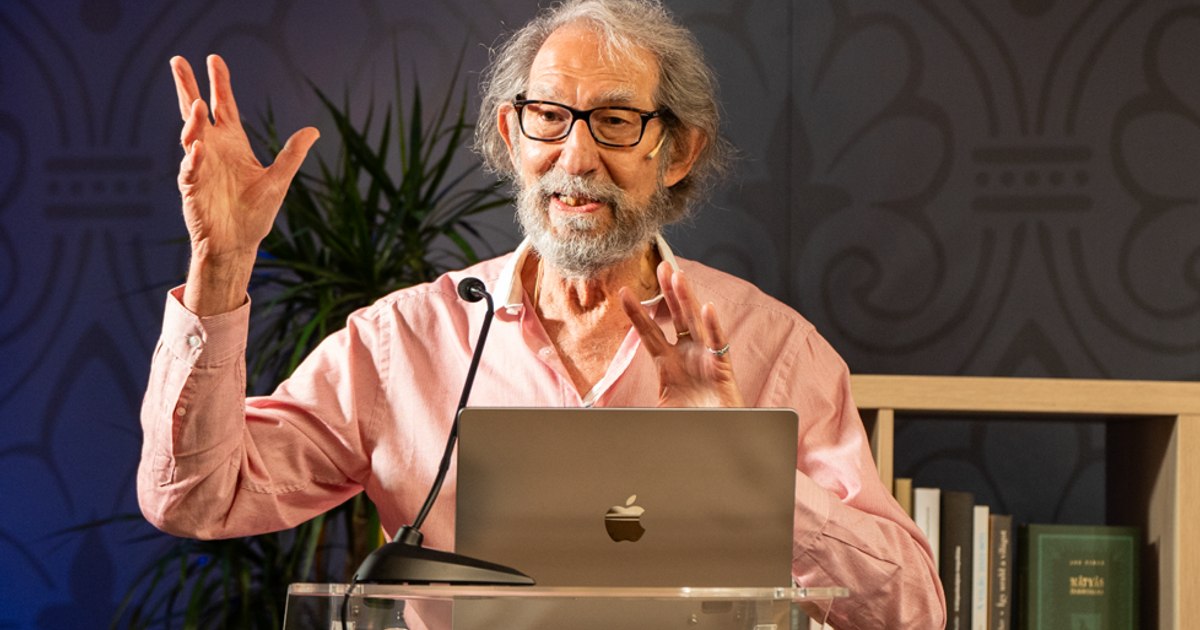
Physicist Geoffrey West, who was included in 2006 by Time magazine in the top 100 most influential people in the world, claimed, in a conference in Cluj, that the rapid pace of world urbanization – by 2050 the majority of the population will live in cities – will lead to their collapse.
Geoffrey West is an Associate Fellow of Green Templeton College, University of Oxford. PHOTO: MCC
Geoffrey West, the American physicist who has dedicated his last years of research to finding a scientific model of cities, lectured the other day in one of the most dynamic cities in Romania – Cluj-Napoca. He participated in the event “Universal laws of life, growth and death – Why companies and people die, but cities survive”, organized in Cluj by Mathias Corvinus Collegium (MCC).
“Cities are the crucible of civilization. By the second half of the century, the planet will be dominated by cities. Cities are at the root of global warming. Pollution, health, disease, economic, financial, energy problems originate in cities. The tsunami of problems we now face in terms of sustainability is a reflection of the exponential growth of urbanization“, claimed the physicist.
The accelerated pace of urbanization can lead to the appearance of a city the size of Cluj every few days. Population growth has become very steep in recent years and can only continue to be viable through innovation – but not technological innovation, but rather at the level of social networks and human behavior. War has become an eminently urban affair – these are just some of the claims made by the world-renowned physicist
Geoffrey West, former president of the Santa Fe Institute, associate member of Green Templeton College at Oxford University, leader and founder of the elementary particle physics group at Los Alamos National Laboratory, was included in 2006 by Time magazine in the top 100 most influential of people in the world.
“In one week, more than a million people move to cities”
The scientist proposes a special way of looking at the world, both from an individual, collective and global point of view. He and the multidisciplinary team he works with look at complex processes from the perspectives of biology, physics and social science, but not only. The laws underlying the most complex processes, says West, are simple and universal.
Urbanization has grown exponentially over the past 200 years: from about 15% worldwide at the beginning of the 20th century to about 30% in 1950 and over 50% around 2007-2008. It is predicted that, by the second half of the 21st century, our planet will be completely dominated by the urban environment. “In one week, more than a million people from all over the world move to cities, so by the end of the week another Cluj-Napoca could appear“, emphasized the physicist.
Urbanization brought with it both processes that increased the quality of life, as well as negative phenomena (crime, pollution, etc.) and a very high consumption of energy. “If we were to evaluate ourselves through the prism of food, we humans are very efficient: we consume only 100 watts daily, the energy needed by a light bulb. But through the rest of the consumption behaviors we reach a social metabolic rate of 11,000 watts“, warned the scientist.
“War itself has become an eminently urban problem – no longer a battlefield, but a city of battle”West pointed out.
“Dynamics gives us the things we love, but it will kill us”
Biological systems and cities show many similarities especially in terms of networks, but if in the case of animals the increase in size is correlated with slower processes (for example lower heart rate in larger mammals), in the case of cities this correlation is direct: once with the increase in size the processes and pace of life in that city accelerate.
Cities are crucial for civilization, innovation, economic growth, but they also contribute to global challenges. “Dynamics gives us the things we love, but it will kill us”the physicist stated categorically.
Thus, given the superlinear scaling present in today's urban society, Geoffrey West believes that systemic innovations will be needed to avoid collapse.
“It's confusing that innovation is usually talked about as just about technology. We will rather need non-technological innovations to “save” us, systemic innovations, coming from the area of human behavior, social networks“, emphasized the scientist. And innovation comes, most often, from outliers, exceptions to the statistical rule, West pointed out.
Research as a factory
A related theme addressed in the meeting was related to the world of academia and research. “Now research is done in a niche, on very specific topics – that's where the grants, positions, and money go. Academic systems do not reward asking the big questions in research for the simple reason that the answers are not readily available.” the physicist mentioned.
He also addressed the topic of research work in large groups. “Collaborations in large groups are not conducive to creativity and innovation because processes become similar to those in a factory: this is my piece, this is yours, and the big picture is often lost.”
The interlocutor of the professor at the event was Gergely Böszörményi-Nagy, the founder of the Brain Bar festival, the director of the innovation agency Design Terminal and the founding president of the Moholy-Nagy University of Arts and Design (MOME) in Budapest.
“It is a great honor that Dr. Geoffrey West accepted our invitation to visit Cluj. Through our Transilvania Lectures series of events, where we bring together elite experts from around the world, we have been trying for more than two years to organize open, useful and valuable discussions for all those interested. We want these exchanges of ideas to benefit the local community and provide a space for discussion about the important issues of our time” – said Botond Talpas, president of MCC.
Mathias Corvinus Collegium is a program of excellence with an international quality education.
