
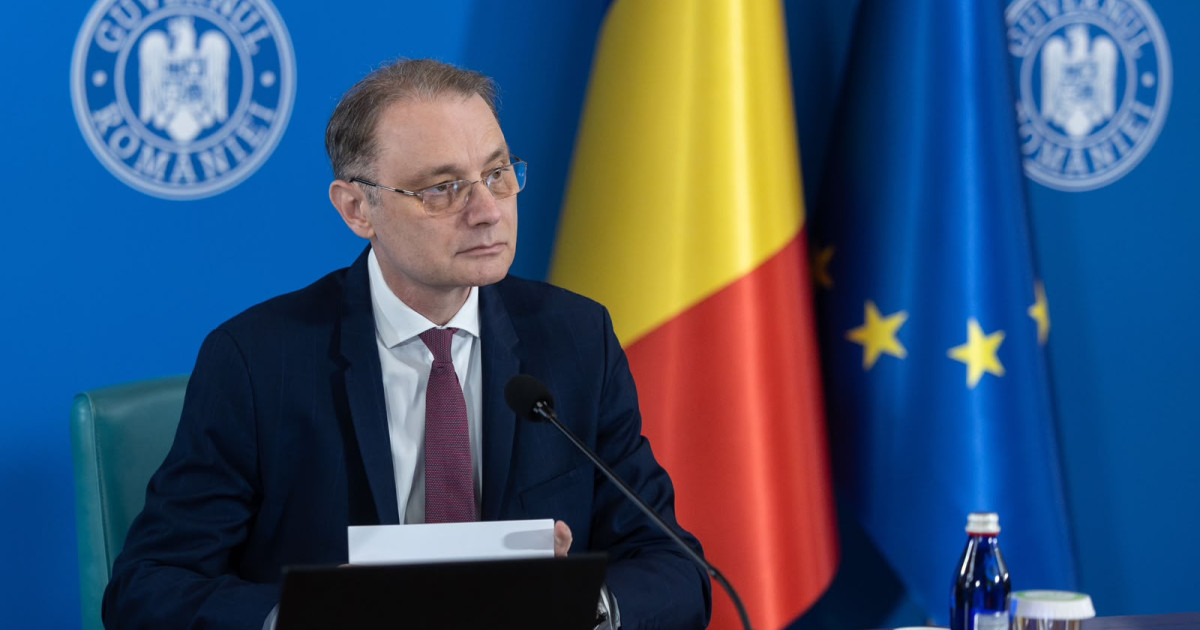
Romania undertakes to reduce the budget deficit below 3% of GDP by 2031 and a fiscal trajectory aimed at reducing both the financing costs of the state and those of the economy, Prime Minister Luca Niculescu said on Tuesday. It proposes the establishment of a committee to develop a competitiveness strategy until 2035, with the participation of independent economists, the Fiscal Council, the BNR and the Presidential Administration.
The statements were made at the launch of the report “Assessing Romania’s Competitiveness. A 2027-2035 Strategic Outlook”, produced by the Jacques Delors Institute, under the coordination of Enrico Letta, and HorizonX, commissioned by the Dialogue for Democracy and Development Southeast Europe Foundation.
The Prime Minister stated that Romania has quickly recovered the gap compared to the European average in the last 25 years, but that the economic model that supported this evolution has reached its limits.
“The question of the report is oriented towards the future: what will Romania live on in 2035? The diagnosis is correct and we assume it. In 25 years, Romania rose from 26% to 78% of the European average GDP per inhabitant, and no state that entered the European Union since 2004 has recovered faster. It is one of the best illustrations of the transforming force that the European Union has,” said Luca Niculescu, quoted by News.ro.
The report places Romania in the 29th place out of 130 economies in the ranking regarding the complexity of exports, but in the 61st place out of 70 in terms of competitiveness, which means the penultimate place among the states of the European Union.
“We know how to produce sophisticated things, but sometimes we manage to complicate the simple ones. There are three figures from the report that stuck in my mind. 0.008% of GDP, that’s what the risk capital invested in Romania means in one year. The European average is about seven times higher. Our stock market is worth 16.5% of GDP, and a third of the companies have capital below the legal threshold. This means that they cannot take credit”, explained the prime minister.
Another highlighted contrast is that between the internet infrastructure and the level of digital public services. Although 96% of households have access to optical fiber, Romania ranks last in Europe in digital public services.
“The report mentions UiPath, Bitdefender, FintechOS, which had to move their headquarters or part of their activity abroad in order to find funding. We have Romanian ideas, good ideas, which grow with capital from elsewhere. 96% of our households have optical fiber. We are in first place in Europe, and in digital public services we are in last place. Two thirds of Romanians abroad who had to solve a paper last year had to physically come to country. There are roads that cost a billion and a half euros a year,” said Luca Niculescu.
The Prime Minister also mentioned the cost of energy price capping schemes, estimated at 19-20 billion euros from 2022 to date, arguing that the support was given to all consumers because the state cannot identify with sufficient precision those who need help.
Deficit below 3% of GDP in 2031
Luca Niculescu presented the fiscal trajectory as one of the necessary conditions for regaining competitiveness and reducing financing costs. The Government’s plan includes targeted energy support, expanding dual education and increasing research funding.
“We are assuming a deficit below 3% of GDP in 2031. We have a fiscal trajectory that will reduce the financing costs of the state and, consequently, of the economy. In energy, we are moving from caps for all to targeted support, and we have proposed that dual education be linked to investments in each region, and research funding to rise to 1% of GDP in 2030,” the prime minister said.
From January, savings and investment accounts would be launched, and the Investment and Development Bank would receive an additional one billion euros in capital. The declared objective is for a larger part of the population’s savings to finance Romanian companies.
The report also points to a problem of political stability, after Romania has had 11 prime ministers in the last ten years. Niculescu argued that the reforms must exceed the duration of one mandate and not be restarted from scratch after each change of government.
A competitiveness strategy until 2035
The Prime Minister announced that he is holding preliminary discussions for the establishment of a Committee for the competitiveness of Romania. The structure would include independent economists and representatives of the Fiscal Council, the National Bank and the Presidential Administration.
The committee would present a first draft of the strategy within six months and the final document within a year. The indicators in the report released on Tuesday would be used to evaluate the results.
“A committee, in fact, is not enough, and the strategy must also withstand the next government. That’s why its targets will enter the Partnership Plan with the European Union for 2028-2034, where the money comes only for fulfilled milestones. And that’s why I propose a pact for competitiveness to parties, employers and unions. We had such a consensus for joining the OECD and we can have it again”, said Luca Niculescu.
The government also wants to strengthen the role of the Fiscal Council and create a handover mechanism between ministers, focused on ongoing projects and reforms.
“The report shows that today every new minister takes it almost from scratch. My government will think of a hand-over mechanism that focuses on the substance, not the form. And I will try to have as few changes as possible to the Fiscal Code by emergency ordinance in 2027. This year is a bit more difficult, because, after almost six months of political crisis, we have several emergencies,” explained the prime minister.
Joining the euro zone, proposed for 2035
The report recommends that Romania aim to join the euro zone in 2035. Luca Niculescu supported this goal and stated that maintaining the fiscal trajectory agreed with the European Commission could allow the fulfillment of the membership criteria at the beginning of the next decade.
“The President of Romania has said several times that it is a wish he supports. Governor Mugur Isărescu said, for his part, that we must take concrete steps again. I join you. What the Government can do is to maintain the fiscal trajectory agreed with the European Commission until 2031. If we do this, we can expect that, at the beginning of the next decade, we will again meet the criteria for joining the zone euro”, declared the prime minister.
One of the scenarios analyzed in the report describes a Romania moving away from the European Union. Niculescu presented this scenario as a warning and argued that the country’s economic development depends on European integration.
“Romania’s place is in Europe. Our prosperity is built in Europe. There is no other way. Romania can go from a country that respects rules established elsewhere to a country that participates in the formulation of the agenda. We are ready. Romania does not lack strategies. In general, it lacks execution. And this is where our efforts will be concentrated”, concluded Luca Niculescu.