
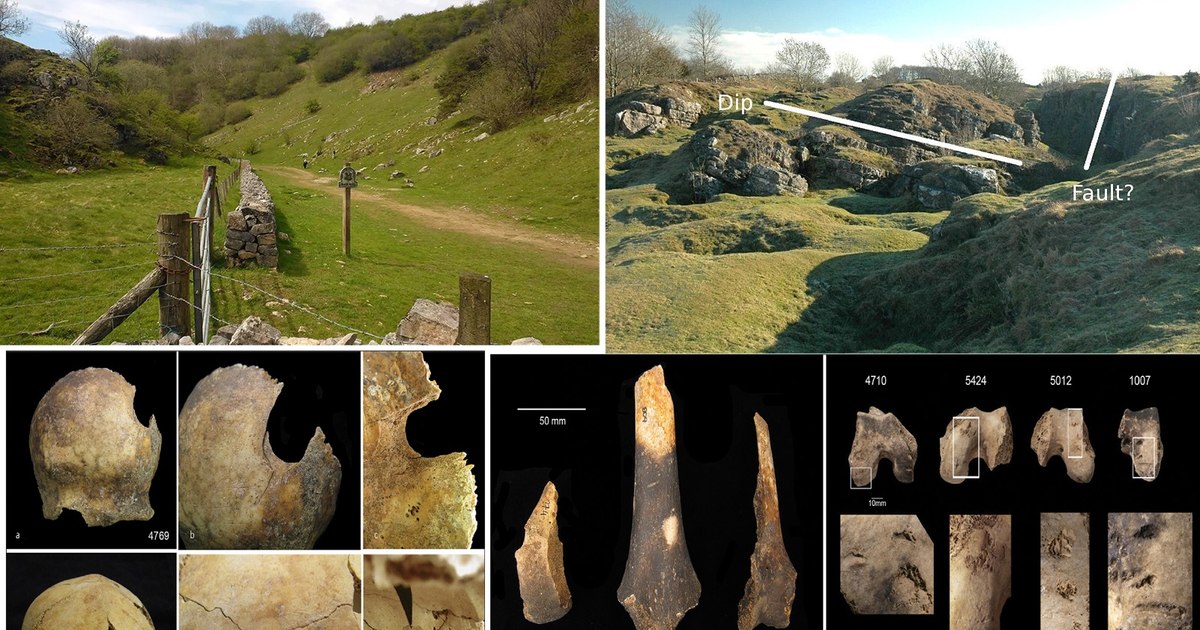
A collection of human bones discovered 50 years ago in a pit in Somerset are evidence of the bloodiest known massacre in British prehistory and Bronze Age cannibalism, archaeologists say.
Charterhouse Warren, Somerset-UK, Terrifying Discovery: Cannibalism DMS Collage
At least 37 men, women and children were killed sometime between 2200 B.C. and 2000 BC and their bodies were dumped in a deep natural shaft in Charterhouse Warren near Cheddar Gorge.
The first major scientific study since the bones were unearthed in the 1970s has now concluded that after their violent deaths, the individuals were dismembered and butchered, and some were eaten.
Charterhouse Warren massacre – terrifying details
Terrifying details have recently come to light during extensive research carried out in Great Britain at an archaeological site discovered half a century ago. According to them, many of the victims’ skulls were crushed by the blows that caused their death, and the bones of the arms and legs were cut after death to extract the bone marrow. The bones of the hands and feet show chew marks, suggesting they were bitten by human molars.
According to Rick Schulting, lead author and professor of scientific and prehistoric archeology at the University of Oxford, nothing of this scale has ever been discovered in Britain from the Early Bronze Age or any other period in British prehistory.
He believes that the massacre at Charterhouse Warren was an exceptional event, even in the context of its time, as he told The Guardian.
A complete mystery of prehistory
“For the early period of bronze in Britain, we have very little evidence of violence. Our understanding of this period focused mainly on trade and exchange: how people practiced pottery, how they farmed, how they buried their dead. There was no significant discussion of war or large-scale violence during that period due to the sheer lack of evidence.”the study’s lead author acknowledged.
Cannibalism on this scale was also not common, Schulting added: “If it was somehow a ‘normal’ practice, you would have expected to find evidence of this phenomenon in other sites. We have hundreds of skeletons from this period and you don’t see things like this.”
Evidence ignored for five decades
The bones were discovered by cavers at the base of a natural trench 15 meters deep. They were summarily recorded, boxed up and, for five decades, largely ignored.
Schulting admitted that when he and his colleagues at Oxford began to reexamine them, “they realized very quickly that it was a much bigger collection than anyone had realized”.
Almost half of the bones belonged to children, suggesting that the entire community had been exterminated in one extremely brutal event.
Revenge or Warning: The Motives Behind Prehistoric Massacre
The exact circumstances of the terrifying event will never be fully known, but Schulting and his colleagues consider the possibility that this act could have represented a form of “violence as spectacle”through which the perpetrators intended to terrorize and send a warning to the entire community. Scalping, butchering and cannibalizing the victims would have had a similar gruesome effect.
“Those who committed this act would certainly have been feared: a fact that would have resonated, I think, through time and space in that region, probably for generations, as a terrible event that happened there.” the researcher admitted.
It may have been a revenge for an earlier massacre or an act that later provoked other reprisals, events for which there is no evidence.
“Charterhouse Warren is a rare archaeological site that challenges our perspective on the past. It is a shocking reminder that the people of prehistory they could commit atrocities as serious as recent ones, bringing to the fore a dark side of human behavior. The fact that this event was not an isolated one makes it even more important to tell the story of this place.” Rick Schulting, professor of scientific archeology and prehistory at the University of Oxford, also mentioned.
research “Dark Angels of Our Nature: Butchered Early Bronze Age Human Remains Discovered at Charterhouse Warren, Somerset, UK” was published in the magazine Antiquity.
