
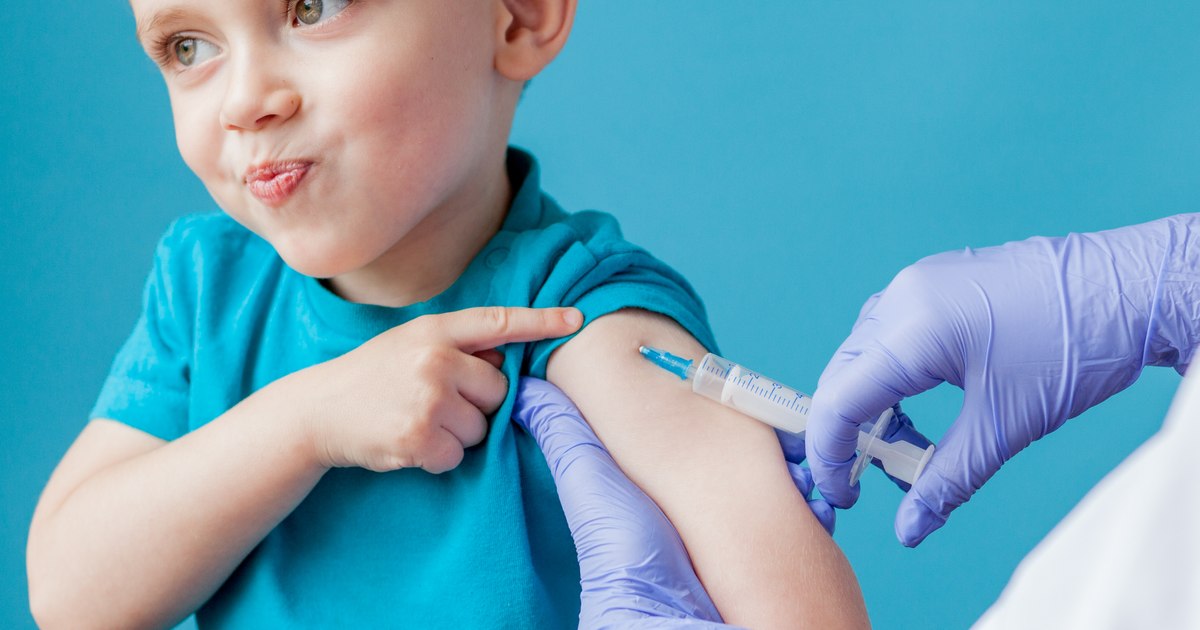
Europe is on alert after the wild polio virus was discovered in wastewater from Spain, Poland, Germany, Finland and the United Kingdom. Also, there is a high risk of an epidemic in Ukraine and Bosnia and Herzegovina, due to the low anti-polio immunity of the population. In this context, the National Institute of Public Health recommends vaccination of children who have not been immunized. The disease, which is not treated, once contacted, leads to irreversible paralysis and even death.
The low vaccination rate “awakens” serious diseases that we thought were eradicated. Archive
On December 17, the National Institute of Public Health sent a notice to the Regional Public Health Centers in Cluj-Napoca, Craiova, Galati, Iasi and Timişoara, but also to the Ministry of Health, after a weekly report on public health threats through communicable diseases published by ECDC on 13 December showed that between September and December 2024, Spain, Poland, Germany, Finland and the United Kingdom have reported vaccine poliovirus in wastewater. The notice also states that countries such as Ukraine and Bosnia and Herzegovina are exposed to a high risk of a poliomyelitis epidemic precisely because of the low vaccination coverage in these countries as well.
In this context, Romania is vulnerable to diseases considering that the vaccination coverage is continuously decreasing: according to the INSP, the vaccination coverage for DTPa – HB-IPV (Acellular diphtheria-tetano-pertussis-polio-Haemophilus B- hepatitis B vaccine – no) it is only 76.7%, compared to 90-95%, which is the optimal level of vaccination coverage. The INSP thus recommends the recovery of lost doses, not yet administered to children, doses included in the free vaccination scheme. For the time being, no cases of illness among the population have been registered in the indicated countries, but the presence of the virus in wastewater is an alarm signal.
The virus is circulating because of declining vaccination rates
Prof. Simin Aysel-Florescu, the manager of the Victor Babeş Infectious Diseases Hospital in the capital, explained the whole context in which the INSP recommendation comes to the Regional Public Health Centers in Romania. “Unfortunately, this situation has been going on for several years, years in which developed countries, in addition to Afghanistan, Pakistan, find the wild polio virus in wastewater. This is an epidemiological method of surveillance of the polio virus, which can be applied anywhere but which is used more by those who have a very well developed health system. The existence of these cases in which the isolated virus appears in wastewater clearly shows that it is somehow circulating in the respective community. The poliomyelitis virus is a virus that is transmitted through the digestive tract, so it is also eliminated through the digestive tract and that is why it is looked for in waste water, to see its circulation. Beyond the clinical cases of disease that we hope not to see in this life, it seems that there is a risk that we will start to see them too. The bad part is that this polio virus is circulating, it is circulating in quite a few places and the reason it is circulating is the decrease in the vaccination rate globally”, the doctor explained.
There are two types of vaccine. How and when to administer
The ECDC report of December 13 comes in the context in which Europe was declared free of poliomyelitis in 2002 Dr. Simin Aysel Florescu explains what the vaccine poliovirus actually means. The identified strain comes from an oral polio vaccine, a vaccine that contains weakened virus. Mumps is normally harmless, but if it circulates for a long time in communities with low immunity, it can become dangerous again. “The wild polio virus has three types of strains, two of them have been eliminated from circulation by vaccination, there is still one in circulation, but at the same time there is also a vaccine-derived polio virus in circulation, the vaccine polio virus. The moment you hear “derived from the vaccine”, you tend to think that it is the vaccine. Not! There are two types of vaccine, there is the vaccine with live attenuated virus that is administered orally, the two drops placed on a piece of sugar, the polio vaccine administered orally, live attenuated”.
The doctor stated that Athe basket is very useful in communities where it is difficult to vaccinate with the other type of vaccine, the inactivated polio vaccine that is administered by injection. “In communities, when you administer the live attenuated vaccine orally, you also determine the immunization of those around the respective child, a group immunity is created, precisely the virus is eliminated digestively, it is of low virulence and immunizes the others around and in this way vaccination coverage is achieved faster and more efficiently. This is for communities that have a high vaccination rate or difficulty. The other, the inactivated virus vaccine, which is administered by injection and has been in our vaccination schemes in the country for some time, is the one that is injectable and from which nothing can happen, it immunizes the respective child. Vaccination with live attenuated virus is very useful in communities with a low sanitary level, where vaccine accessibility is low, until vaccination coverage. When the vaccination coverage is good, there is no way even the attenuated one can circulate, even if it circulates, it has no one to infect, if the vaccine coverage is good, and at this moment the international trend is to give up the attenuated, in areas where there is good coverage, have everyone switch to the inactivated, injectable one. Both types of vaccines are useful. The problem is that, if the vaccination coverage is not good, and unfortunately this is a situation that even the INSP indicates in Romania that there would be 70 or so percent vaccination coverage, then there is a risk of cases appearing, as with any disease in which vaccination coverage is not sufficient”, stated Prof. Simin Aysel – Florescu.
Doctor: “We will see cases of polio these days”
A good vaccination coverage, which prevents outbreaks, diseases in communities is 95%. In our country, the coverage is somewhere around 75%, 20 percent below the effective one. This thing is very serious, because it involves both polio and the other types, diphtheria, whooping cough, measles, haemophilus infections, tetanus, etc. “And unfortunately what we see now that happened with measles and it continues to happen and what happened and continues to happen and whooping cough can continue with polio and the other diseases for which the world has given up vaccinating, especially children”, the doctor also specified.
“It catches us on a very wrong foot and, unfortunately, it is not the fault of the authorities or anyone in particular, it is a rather extensive situation at the European and worldwide level. In short, we will unfortunately see cases of polio these days. The world has the feeling that it is a kind of flu that passes. No, poliomyelitis causes permanent paralysis of the limbs or death. So either the child remains paralyzed forever, they are not remissive, nothing can be done, or they even die from even more serious disorders, including the respiratory ones that occur during the disease, they are also irreversible. There is no antiviral treatment for this type of virus. So complications are possible for any of those who get this disease and the only way we can avoid it is vaccination”, the doctor also said.
Romanians, very reluctant to vaccinate
The problem of anti-vaxers is a very serious problem, the doctor believes. “We try to approach it from multiple sides, because you can’t solve it like that, punctually, it’s especially about those who are reluctant to get vaccinated and whom, by explaining concretely, answering the parents’ questions and anxiety, we can in the several cases to determine them to choose the correct option. There is also the other side of those who are completely against the idea of vaccination and who for the time being are protected, so to speak, by the fact that many of those around them are vaccinated and have the impression that even though they are not vaccinated, they do not get sick. Well, they don’t get sick because many around them are vaccinated, but this thing will change and they will also get sick side by side with the others”, he also specified Dr. Simin Aysel – Florescu, manager of the Victor Babeş Infectious Diseases Hospital in the capital.
