
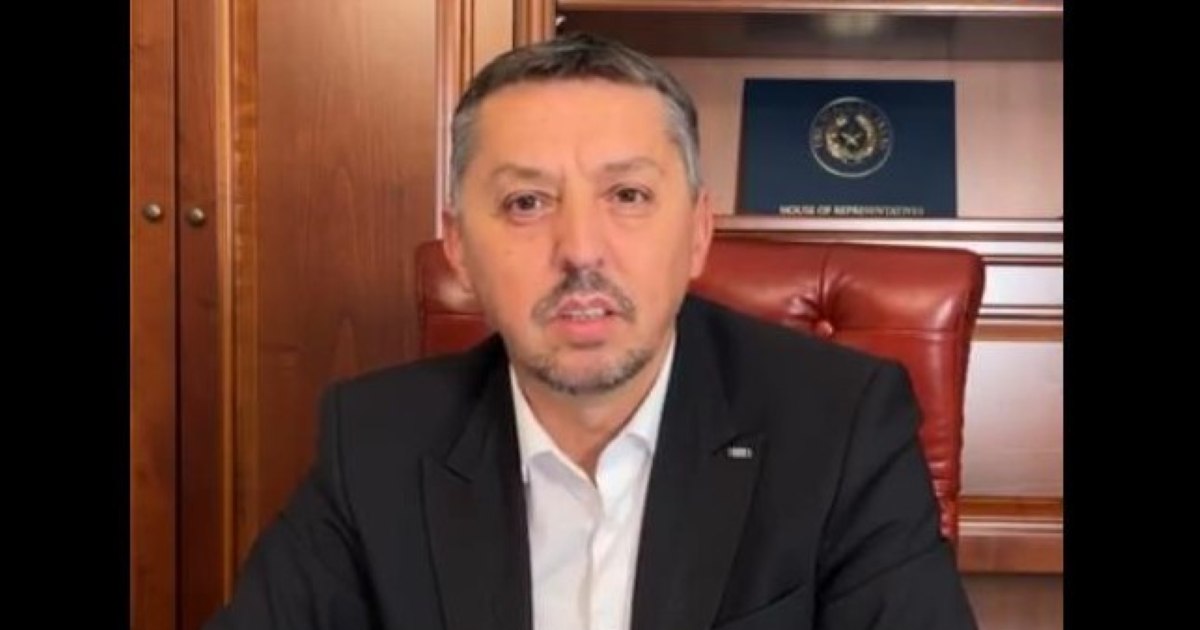
The Minister of Education and Research, Daniel David, presented, on Saturday, June 21, 2025, a short activity report, talking about the objectives with which he came to the ministry and stating the measures and actions he managed to implement. Referred to another term.
Minister Daniel David presented the report of the photo mandate: Capture/Archive
Minister Daniel David spoke on Saturday, June 21, 2025, in a video intervention, about the achievements of the mandate that at the beginning in December last year. Towards the end of his intervention he also referred to the possibility of continuing the activity at the head of the ministry.
“It is an end of mandate. Whether or not it will be another term, we will see next week. As I said in various contexts, I do not want to be a secret, I do not want to be too precious ”, David said. He then returned to the possibility of continuing the activity started when he remembered the QX report, a diagnosis of the education, research and innovation system in Romania.
“I said very clearly that if we succeed in assuming in a governance program the QX report and if it will be support for those reforms under the very complicated conditions that come, as I said, economic-financial and if I will be invited to participate, I will probably accept. If not, I am ready to return to Cluj and be a rector of the University and a man in the system who will continue to have a voice so that our education and research system works best for the benefit of all ”, said David.
“The first objective I consider it achieved”
Three were the objectives he set in taking over the mandate of Minister of Education and Research, coming from the position of rector of Babeș-Bolyai Cluj-Napoca, David said. “1 – To strengthen the profile and the Euroatlantic road of the country in very complicated political conditions, which I think we all remind, 2 – to make sure that a system as important, complicated and complex as the one that refers to education and research, works well, works normally, without major blockages, in economic -financial conditions, which I believe We remind well. The minister began his exposure.
The first of the goals was achieved, being achieved “By correct means”, the minister pointed out.
Regarding the functioning of the education system, the minister stated that he tried to prevent certain problems, and to solve them on the go.
The framework plans for the high school, for which he has already signed the order, mentioned them as “Probably the most important approach. “” It is a process that we should have for about five years. It has been postponed for various reasons, pandemic, war, political conditions. It was time to let it go. We signed the order and from the school year 2026-2027 we will enter into a new curricular logic, to work, to work. At the training and training of the teachers. of one’s own life ”said the minister.
“The school, teachers and students are not prepared for such a powerful level of decentralization”
David pointed out that in the approach to develop the framework plans for high school each involved part tried to maximize his influence, considering himself more important than the others. “However, the role of a minister is to keep a balance, to put things so that we can achieve this vision, this target – good specialists, good citizens and people satisfied with their own lives.” the minister continued. In the end resulted a form in which some important changes are found, “Both the framework plans we have, functional at this time, as well as the variants we started in January.”
In the final form of the frame plans, it is emphasized and content is offered to the defined specializations.
“If you have mathematical-computer specialization, the computer discipline cannot be less than many other disciplines in the framework plan. Then we do not understand what we are talking about. So we tried to really give content to the specializations that we defined at the high school level ”the minister exemplified.
David acknowledged that, regarding the decentralization of the decision, the final form of the framework plans gives less power to the schools than in the initial version, debated at the beginning of the year.
“” We have retained the decentralization element. Decentralization is much stronger than what we have now, but it is right, it is not as strong as the option I walked in January. Because I learned during the debates that the school, teachers and students are not prepared for such a powerful level, so, in other words, debates ”, said the minister.
There are still teachers, said Minister David, who reproaches them to have cut hours. “I do not understand that the mere fact that the hours do not have the same number they had before does not mean that they have been cut. The hours are found in the decentralized area, in the flexible specialized curriculum, in the curriculum that is about choosing the students from the school offer, and if you do quality education and if you convince the school and what you do, you have to do this, you can only The minister said, specifying that some things will be able to be corrected on the go.
The minister also recalled that, supporting decentralization, a frame-pilot variant was launched, accessible to high schools that want a more flexible structure.
What brings new version is that the mandatory condition of maintaining certain disciplines in the common trunk is kept, but a general budget of hours is offered, and the schools have the opportunity to achieve their own architecture within this budget and respecting the condition of maintaining the obligatory disciplines in the common trunk.
“We no longer say what hours it must have or how many hours each discipline must have, but we have a general budget for hours. Of course, the specific plans will have to be thought of by the units that want to pilot this framework plan, looking at the graduate profile, how the baccalaureate looks. And very important in this process, the ministry will have a group of experts who will provide consultancy to school units who will want to implement this more personalized framework plan. And of course, a commission through which we will approve or not the option that will result from this personalization. These school units that will pilot the specific framework plan will have to signal this very clearly on their own site and take the proposed and approved version, approved by the ministry, in the educational contract. So whoever wants to allocate the hours differently, to bring other disciplines beyond the common trunk compared to the ones we have proposed in the standard version, will have the opportunity to do so in this pilot variant ”said the minister.
The integrated plan for managing the phenomenon of bullying in schools, introducing the surveillance cameras and generalizing the electronic catalog were also mentioned. Regarding the electronic catalog, the minister stated that it is being worked at the level of the ministry in the elaboration of a project that will be submitted next week to obtain financing.
What will happen to units in the field of research, development and innovation
Defining the mission of the University is the most important aspect in the 6 -month mandate, in the university education sector, according to the minister’s evaluation.
“We are much more transparent to future students, to our own community, to society when we have assumed a certain mission and we force the universities that will have to be evaluated through the mission they have assumed, not through other criteria. And also, at the university level, we have eliminated administrative blockages regarding the organization of academic programs and we only held the quality criteria, so that a university that wants to organize a masters in an area can do so even if it does not have a license in that field, but meets the quality criteria for organizing that masters, for example. I think it’s an important approach. I didn’t invent him. It represents a set of good European and international practices, but in Romania we did not have this ”, David said.
The evaluation of the research, development, innovation units, a process started in his mandate, was also mentioned in the balance sheet. The minister also explained what will happen at the end of this evaluation process that has aroused many criticisms from the system at the time of its statement.
“Some will remain independent and will be well supported. Others will be encouraged to enter into academic concentrations, either institutes, or institutes with universities and, why not, universities, in a logic, safe, from bottom up, in a voluntary logic, at the same time receiving a support from the authorities. I think it is a very important approach by which we relocate the architecture of the national system of research, development, innovation ”, the Minister of Education and Research said.
The renegotiation of the PNRR was also a point on the minister’s list, about this aspect, mentioning that thus the loss of large amounts was able to lose.
“Complicated things follow”
“Some said I tried to do too much. Others told me I could do more. I think I did no more, no less than what I promised to do ”said the minister, finally talking about the third objective, the QX diagnostic report, through which he also proposed reforms. These reforms will continue if it is proposed for a new term, the minister said.
“If they will be implemented or not, we will see it, but we certainly understand better, if we read that report, what is with the education system, what is with the research system and what could be done, without the pretending that they are the only possible solutions. They are the solutions that I see possible, but I could not be better. This would be about the mandate. David said.
