
When it comes to Turkey, everyone has heard of Istanbul, about the pearls of its fantastic coastline bathed by the Aegean, the Mediterranean, or the Black Sea. But mysterious lands, with history and stories that are lost in the mists of time, are waiting to be discovered.
Turkey's hidden treasures on the Hittite Trail – the royal tombs of Alacahöyük
It is known that the lands of Turkey host countless vestiges that ancient peoples, such as the Greeks or the Romans, left in their passage here. But not much is known about its mainland side, at least not outside the borders, by tourists eager to discover lands still unexplored.
These places hide treasures, mysteries and little-known stories about other ancient, forgotten civilizations that have ruled the Anatolian peninsula throughout history.
Turkey's remarkable distinctive cultural mosaic could not be missing Anatolia's first empire – the powerful and influential Hittite Empire, which left behind a vast and incredible legacy.
For those who are passionate about history, culture, art and nature, who every time propose in their holiday plans to explore new places and things, on less “beaten paths”, we propose, as a travel idea, the Hittite Route, a different Via Transilvania from us, which includes ancient treasures left behind by the first empire of Anatolia.
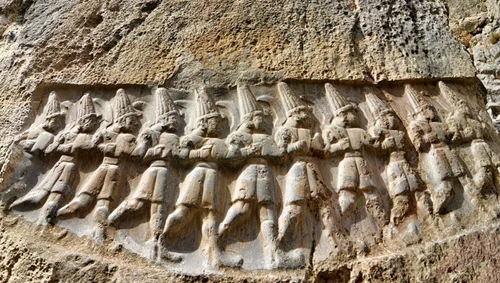
Image 1/10:
Turkey's hidden treasures on the Hittite Trail Alacahöyük archaeological site
The testament of the first empire of Anatolia, one of the pillars of ancient history
The Hittite Empire is considered one of the significant pillars of world history. Although the exact origin of the Hittites is not known, they are believed to have migrated to Anatolia at the beginning of the second millennium BC, but the language they spoke is one of the oldest Indo-European languages. Researchers such as Vladimir Gheorghiev and S. Bugge noted similarities between the language spoken by the Hittites and that of the Thracians from whom the Dacians are also descended.
The Hittites left as a legacy, among other things, the oldest peace treaty, but also the first love poem known in history. The Treaty of Kadesh was concluded in 1274 BC after a battle with the Egyptians and is an early example of diplomacy and international negotiations. And the love poem, discovered in the ruins of the Capital of the Hittite Empire – today's Hattusa – is even older – it dates back to around 2000 BC. It was written on a clay tablet in the cuneiform language adapted from the Sumerians. Their writing, on the other hand, is unprecedented, in the sense that one line was read from left to right, and the next from right to left, a unique feature deciphered on the Hama Stone.
Incidentally, from the Hittites we have thousands of cuneiform tablets documenting laws, myths, rituals and treaties, but they also left behind impressive temples, palaces and defensive walls, proving that they represented an advanced and organized society.
According to some tablets discovered in Egypt, the Hittites are the reason for the destruction of the powerful Babylonian Empire and the Hammurabi Dynasty. They are also mentioned in the Old Testament and are credited with the first use of light chariots.
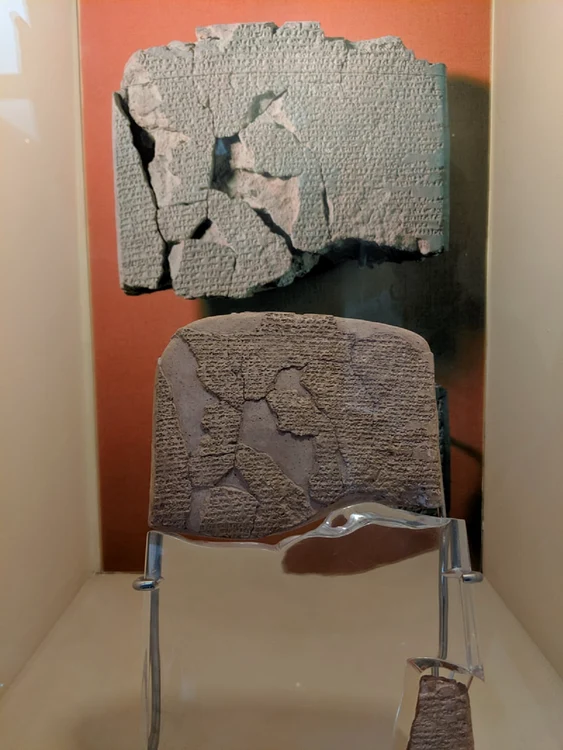
The first ever peace treaty between the Hittites and the Egyptians Source Gordon Doherty
The trail exploring the settlements and legacy of a highly advanced civilization
More than three millennia ago, the Hittite Empire – one of the largest civilizations of the Bronze Age – spanned the entire territory of present-day Anatolia. During over four and a half centuries of rule, the mighty empire contributed significantly to human history and culture.
Archaeological discoveries in the 20th century have brought back to light the importance of this forgotten civilization, renowned for its achievements in architecture, art and engineering.
Today, the Hittite Trail is a lesser-explored hiking route in Turkey that offers the opportunity for the historical settlements of this ancient civilization to be discovered and explored to learn about its vast and amazing cultural heritage.
The most remarkable Hittite ruins are found in Çorum Province, in Central Anatolia, Turkey.
Amazing hiking route of about 400 km in the heart of Turkey
With a total length of 385 kilometers, the Hittite Trail starting from a national park includes 17 hikes over a distance of approximately 236 kilometers and six other alternative routes, such as off-road bike trails.
The main destinations on the route are Hattusa / Hattusa – the old Capital of the Hittites, Alacahöyük – the largest city of the empire and Sapinuwa / Șapinuwa – the first military and administrative center of Anatolia.
Boğazkale-Hattusa-Sapinuwa, Alacahöyük-Alaca-Sapinuwa and Boğazkale-Alacahöyük form the core of this fascinating route.
There are countless accommodation options on the route, from modern hotels to bungalows, guesthouses or campsites, available in places such as: Alacahöyük, Boğazkale and İncesu.
Alacahöyük – one of the Bronze Age legacies left behind by the Hittites
Alacahöyük, one of the three main Hittite cities in Çorum Province is the starting point of the Hittite Route. It holds one of the first national excavation sites in Turkey, being extremely important to those interested in Bronze Age archaeology. The area has been inhabited for more than 6,000 years.
It was originally a city of the Hatti culture, before it was conquered by the Hittites.
The settlement is notable for its extensive defense systems and imposing gates, built to prevent invasions.
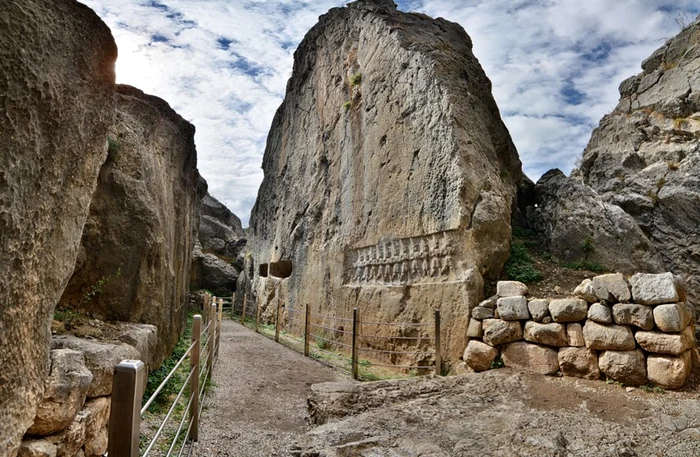
Archaeological site on the Hittite Route in Turkey
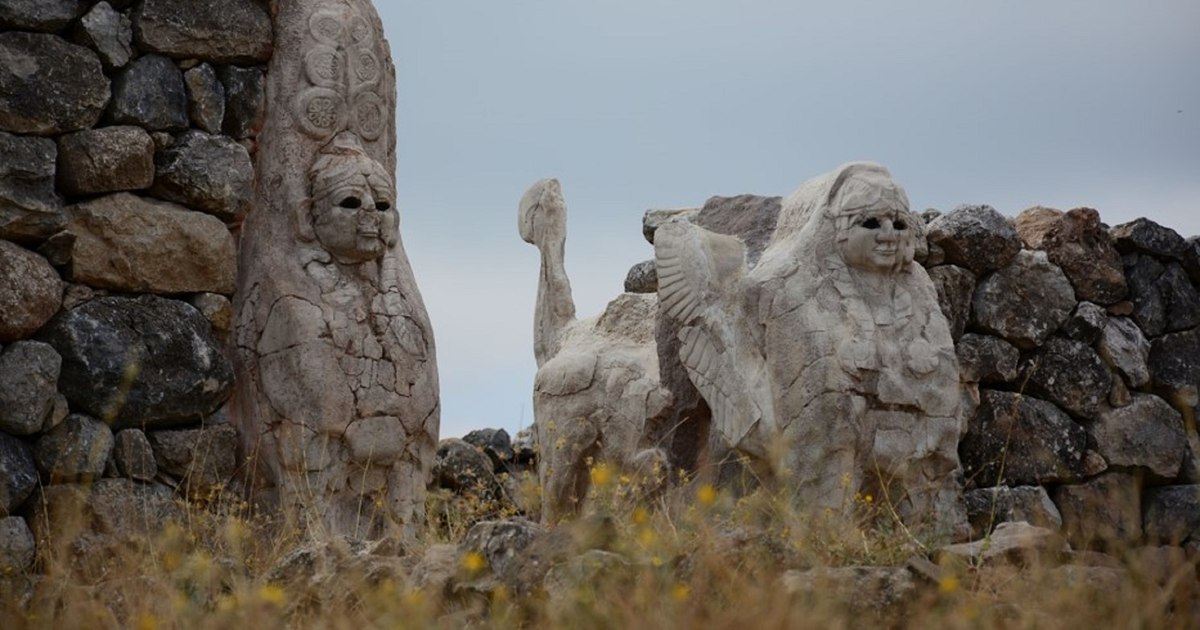
Among the remarkable discoveries here are: the Sphinx Gate, decorated with sphinx sculptures, and the Royal Tombs, dating from the Hatti period, being also used by the Hittites. Rich artifacts, including jewelry and cult objects, were discovered in them.
The “Sphinx Gate” was one of the two main entrance gates to the city, with towers, stone blocks and carvings on the outer wall. In reality, it marked the entrance to a temple. The Temple Palace houses the Royal Tombs, in addition to huge storage rooms.
In the Alacahöyük Museum, artifacts spanning three millennia are exhibited, dating from the Chalcolithic (Copper Age, which begins around 3,700 BC), Early Bronze, Hittite and Phrygian (13th – 7th centuries BC) periods. ).
More about Alacahöyük can also be found at the Museum of Anatolian Civilizations in Ankara which houses some of the most significant finds from the site, including the original decorations of the Sphinx Gate and the bronze sun courses – emblematic of Hittite civilization and art – as well as a statue of a stag, in bronze and silver – funerary art discovered in the Royal Tombs; and a figurine representing a bull also in bronze and silver from the Hatti period.
Hattusa – The ancient Hittite capital, the next stop on the route
In Boğazkale District, “City of a Thousand Gods” as noted on many of the 30,000 clay tablets discovered at the site, it served as the capital of the Hittite civilization for 450 years. Hattusa is today included in the UNESCO World Cultural Heritage along with nine other sites of Turkey, as well as on the UNESCO Memory of the World list.
Among the clay tablets discovered here and preserved in the Archaeological Museums of Istanbul and the Museum of Ancient Oriental Art is the Peace Treaty of Kadesh.
Hattusa, located south of Alacahöyük, looks like a giant stone puzzle in the greenery from a distance, and is considered a remarkable open-air museum due to the ruins of temples, gates, royal buildings and city walls. Here too is a Sphinx Gate similar to the one in Alacahöyük, but also the King's Gate, as well as the Great Temple, dedicated to the Storm God Teshub and the Sun Goddess Arinna.
Next to the main site is the Lion Gate, a masterful work of art that shows how advanced the Hittites were in stoneworking, being decorated with massive lion sculptures. The Great Citadel is also an impressive fortification system, with massive walls and defensive towers.
Also near the site is the Yazılıkaya Open Air Temple, which contains a series of rock-carved reliefs representing gods and goddesses of the Hittite pantheon. The two main rooms are also decorated with images of Hittite gods, including the divine king and queen. The reliefs are extremely well preserved and provide valuable information about Hittite religion and mythology.
Artifacts and remains excavated from the ancient city of Hattusa are also on display in the Museum of Anatolian Civilizations in Ankara and the Boğazköy Museum.
Sapinuwa – the religious center of the Hittites
In today's Ortaköy District, there was an important military and religious center during the Hittite era. The city is home to two temples built separately in the name of two storm gods, as well as vital institutions of those times, such as the Queen's Palace and the Army Headquarters.
About 4,000 Hittite cuneiform tablets have been found in this city. The indisputable evidence of the Hittite civilization is today part of the collection of the Archaeological Museum of Çorum.
Also on the Hittite Trail are the Alaca River Valley and the İncesu Canyon, near the town of Sapinuwa. Starting from the Gerdek Stone Tomb, near the village of Geven, the valley extends to the village of Cemilbey. White water rafting is another popular activity in the canyon.
