
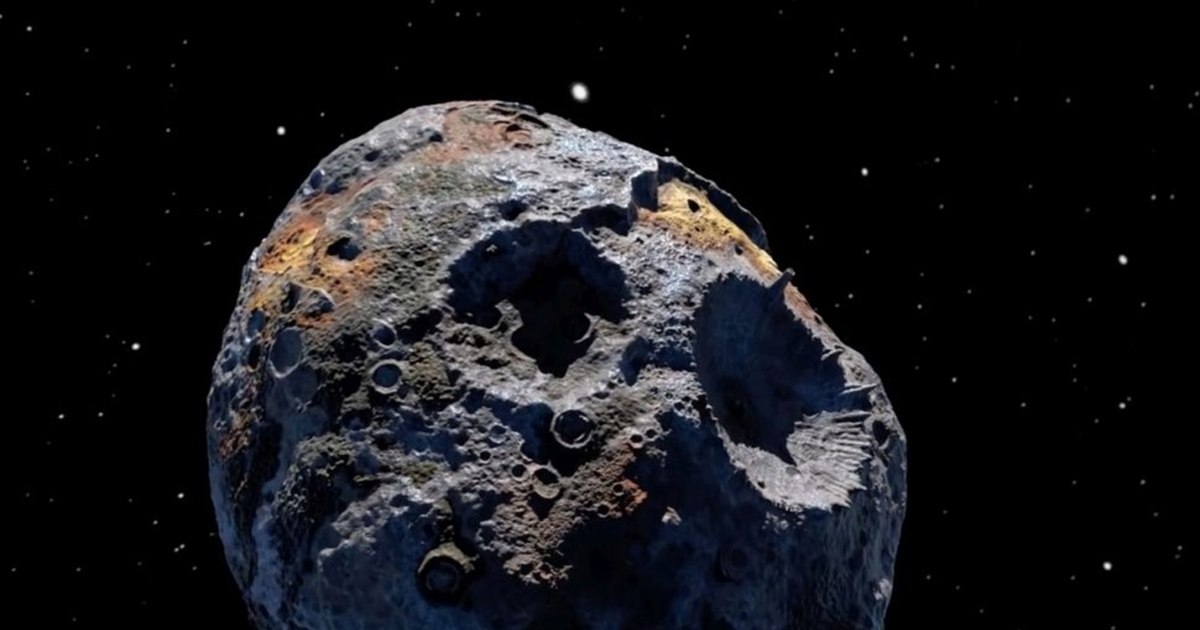
The asteroid that has been the highest risk of impact on the land in the history registered so far now has a 0% chance to hit our planet. The probability that the asteroid 2024 YR4 to hit the Earth was reduced to zero due to the new data collected on Sunday, February 23.
Asteroid. Photo: Archive
Discovered in December 2024, the 2024 YR4 asteroid climbed quickly to the tip of the NASA’s risk table, with a 1 to 32 chance to hit the ground. This raised it to level 3 on the Turin scale, a system used since 1999 to classify the potential impact events with the Earth, writes space.com.
Level 3, which falls into the yellow band of the Turin scale, is described as: “a close meeting, which deserves the attention of astronomers. Current calculations give a collision chance of 1% or higher, capable of localized destruction ”.
“The NASA JPL center for the study of objects near the Earth (CNEOS) now lists the probability of impact of 2024 YR4 as 0.00005 (0.005%) or 1 of 20,000 for its passage near the Earth in 2032”, He said exclusively for Space.com Richard Binzel, a planetary science professor at Massachusetts Institute of Technology (MIT) and the creator of the Turin scale. “This is the probability of zero impact, good people!”, he says.
“The asteroid 2024 YR4 has now been re -admitted to the zero level of the Turin scale, the level for” without danger “, because the additional pursuit of its orbital trajectory has reduced its possibility to intersect the Earth below 1 to 1,000”, Binzel continued. „1 in 1000 is the threshold established for relegation at level 0 for any object less than 100 meters; YR4 has an estimated size of 50 meters ”.
As 2024 YR4 continued to benefit from the attention of news agencies around the world, Space.com consulted with “The hunter” by asteroids David Rankin from Catalina Sky Survey, who found images of the space rock in the archive data that were collected before its official discovery.
From the beginning, Rankin anticipated that the chances of impact of 2024 YR4 will initially increase before decreased dramatically. He explained where this uncertainty comes from when the trajectory of an asteroid is followed.
“Imagine holding a stick for a few meters long. If you move the stick in your hand with a fraction of centimeter, you almost do not notice any movement at the other end ”, said Rankin. “Now imagine that the stick has a length of many millions of kilometers. The movement of your hand with a fraction of centimeter will cause dramatic changes at the other end. ”
