
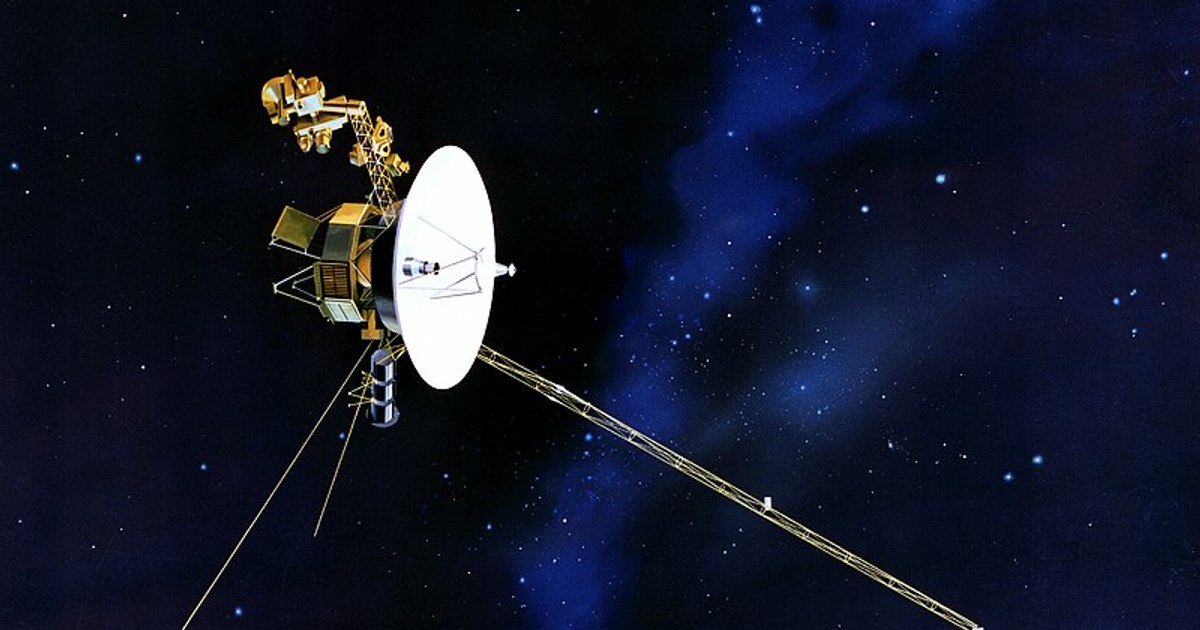
NASA has shut down one of Voyager 2’s key science instruments, the Science Plasma Detector, as the spacecraft’s power supply continues to dwindle.
NASA shuts down Voyager 2’s plasma instrument PHOTO X/@MarijkeLouisevd
The decision, made to conserve energy, comes as Voyager 2 explores the interstellar medium more than 12.8 billion miles from Earth. Despite the shutdown, Voyager 2 will continue to collect data from other instruments, extending its mission into the 2030s, according to the Daily Galaxy.
NASA has disabled one of Voyager 2’s science instruments as the spacecraft’s power level continues to decline.
Launched in 1977, Voyager 2 is currently more than 20.5 billion kilometers (12.8 billion miles) from Earth, exploring the interstellar medium beyond the heliosphere, the Sun’s outermost influence layer.
While still operating, the spacecraft is powered by slowly decaying plutonium, which gradually reduces the energy available to operate its systems.
How the decision was made to shut down Voyager 2
The disabled instrument is the Plasma Science Instrument, one of the key instruments aboard Voyager 2 that measured the density and direction of ionized particles.
Since entering interstellar space in 2018, this instrument has been instrumental in confirming that Voyager 2 has passed beyond the influence of the solar heliosphere, allowing scientists to monitor the transition from space dominated by the solar wind to largely uncharted regions from beyond.
However, as the mission progressed, the plasma survey instrument was used less frequently, with data collection occurring only once every three months during a full rotation of the spacecraft.
NASA engineers faced a difficult decision, but ultimately chose to disable this system.
“The team has confirmed that the shutdown command was executed without incident and the probe is operating normally,” NASA’s Jet Propulsion Laboratory said in a recent statement. Despite its importance, the plasma science instrument was shut down to save power, while the other instruments continued to operate.
This is the seventh of the original ten instruments aboard Voyager 2 to be shut down, leaving only a handful of instruments still active to study the far reaches of interstellar space.
Voyager 1 and Voyager 2 are powered by radioisotope thermoelectric generators (RTGs), which convert the heat produced by the decay of plutonium-238 into electricity.
At launch, Voyager 2’s RTGs generated about 470 watts of power, but that power drops by about 4 watts each year as the plutonium fuel decays. Energy conservation therefore became increasingly important to ensure that Voyager 2 remained operational for as long as possible.
The decision to shut down the plasma science instrument is part of NASA’s long-term strategy to extend the life of the mission. In recent years, mission specialists shut down various systems that were not essential to the spacecraft’s operation, including heaters and other instruments that were no longer essential to data collection.
As Voyager 2 ventures further into the interstellar medium, the challenges of maintaining communications and functionality increase. With a communication delay of nearly 18 hours each way between Earth and the spacecraft, every adjustment and command must be executed carefully.
According to NASA, the remaining four instruments still in operation on board include a magnetometer, which measures magnetic fields in interstellar space, and a cosmic ray system, which detects high-energy particles from outside the solar system. These tools are essential for understanding the structure and composition of the interstellar medium.
NASA hopes to keep Voyager 2 operational until the 2030s, but until then, it will likely have only one active science instrument. As power levels continue to decrease, engineers will need to prioritize which tools are most valuable for continued exploration.
The reduced utility of the plasma science instrument in recent years due to its orientation and the position of the spacecraft contributed to the decision to disable it.
