
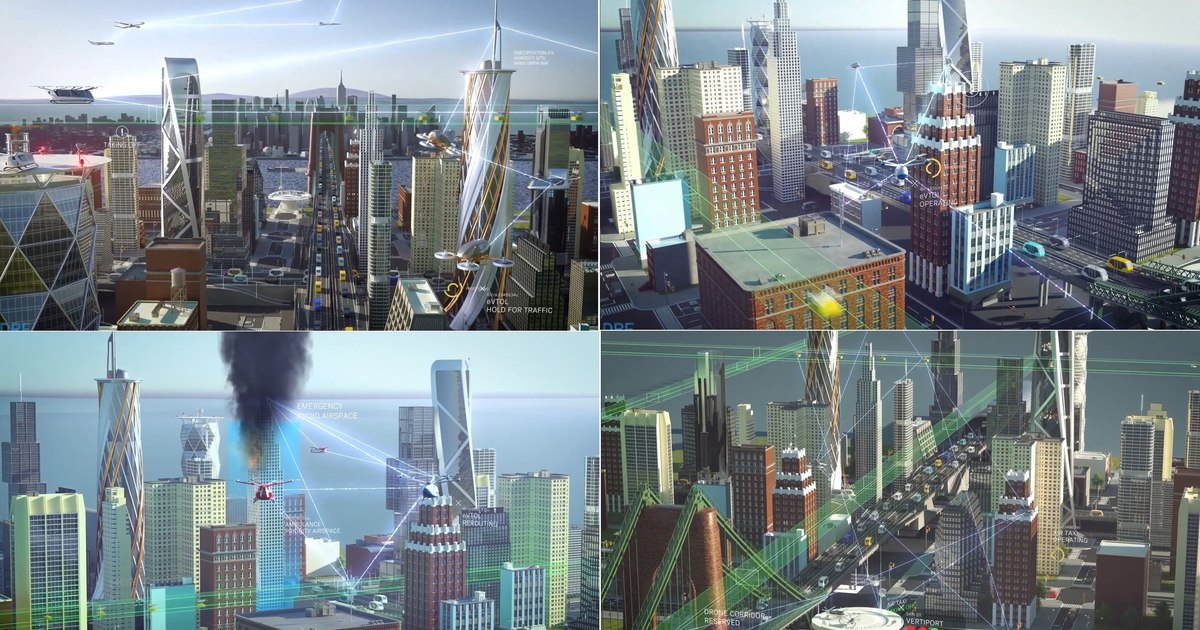
A system developed by NASA, initially exclusively for drones and aircraft, will also be implemented in road traffic.
In the not very distant future, flying cars could become a reality in the big cities of the world. Although this scenario seemed once detached from the science-fiction, the technological progress of companies suggests that air taxis could become operational by 2030.
To ensure safe and coordinated air traffic, NASA has developed the Data Reasoning Fabric (DRF) system – a decentralized digital ecosystem, capable of transmitting vehicles in real time, adapted to each one.
Originally intended exclusively for managing air traffic, DRF is to be extended for space exploration per month, but also for road transport, According to NASA representatives.
As technology progresses, autonomous cars are becoming more and more present in the plans of large companies. Waymo and Tesla, for example, have recently presented their robotaxes, autonomous vehicles without steering wheel or pedals. Although they use different software platforms, a system like DRF would allow these cars to communicate with each other and with smart road infrastructure, thus reducing the risk of accidents and blockages.
NASA technology to connect all air and road vehicles for safe collage traffic
What is DRF: from heaven to ground – how can autonomous transport be revolutionized
This ambitious NASA project is based on the ability of vehicles to make real-time decisions, using data from a variety of sensors, rooms and other sources. The purpose is not only to reduce the risk of collisions, but also to improve the efficiency of transport in general.
Thus DRF can be understood as an interconnected network (NASA calls it “Digital decentralized ecosystem”), capable of transmitting drones and airplanes – whether autonomous or piloted – specific information, adapted to the needs of each real time.
The project was initially designed for autonomous drones, and NASA explained its way of operation through an analogy with applications such as Waze or Google Maps. These applications use various types of data – maps, reports about accidents, traffic information – to analyze and recommend the best user route. Similarly, DRF will provide autonomous vehicles essential information, allowing them to make optimal decisions at the right time.
A future of more efficient and safer transport
NASA, therefore, intends that vehicles connected to DRF can anticipate and avoid potential traffic obstacles, offering quick and safe answers. “DRF is designed to operate in the background. Companies develop autonomous technology, but their systems are not compatible with each other. DRF creates bridges between these differences, coordinating vehicles to collaborate effectively.”explained David Alfano, the head of the Division of Intelligent Systems at the NASA research center.
This innovative system could revolutionize not only road transport, but also the entire infrastructure of urban mobility, offering a safer and more fluid environment for all traffic participants.
How can NASA technology transform the safety and efficiency of road traffic
The engineers at NASA’s Ames Research Center are now adapting their innovations for terrestrial transport, where collaboration between systems could contribute to creating safer and more efficient routes.
NASA has provided some examples of how DRF could work on the roads: the system could anticipate events like a truck that slows down to turn or a hidden traffic light to be red. DRF could also guide the drivers to the nearest loading or food station and could prepare the windscreen brakes and wipers depending on the weather forecast.
By safe sharing of data with traffic lights, traffic signs and other traffic vehicles, DRF would act as a choreographer, a smart conductor, ensuring optimal traffic flow and reducing the risk of accidents.
Autonomy coordinated for real tests: How did your NASA efficiency DRF
In order to test and demonstrate the impact of technology in a real environment, the researchers collaborated with the city of Phoenix, the US to an aviation solution meant to improve the rapid transport of essential medical materials from urban centers to rural communities with limited access to these resources. An autonomous system identified the locations where it was urgently needed and directed their taking over and delivery in an optimal time.
Have simulated on the computer various scenarios in which DRF could be useful, creating this way “Digital twin” of the city.
An analyzed example was the use of drones for the delivery of medical supplies from the city center to the peripheral areas. Thus, it was tested if, in the case of an emergency, such as the need to deliver insulin to people with limited access to medical services, this could be done efficiently and safely.
The simulation included other situations, such as take -off and landing or reaction to unforeseen events. The simulated autonomous aircraft managed to make real-time decisions, based on the data collected by sensors and rooms located in the city. They provided information on the position, speed and environment of each aircraft. Also, drones and aerotaxes have been able to communicate with each other to coordinate their movements and avoid collisions.
“All parts must fit perfectly, and this requires considerable effort. DRF technology offers a framework in which suppliers, medical centers and drone operators can collaborate effectively. The purpose is not to eliminate human involvement, but our support to achieve more.” said Moustafa Abdelbaky, IT specialist at the Ames Research Center.
From the moon to the depths of the earth, to revolutionize mining
In addition to terrestrial traffic, NASA is particularly interested in the potential of this technology in coordinating the autonomous movements and operations of the vehicles it will send on the Moon, but also in areas such as the mining industry. Given the complexity of the environment and the isolated locations in which many mines operate, where advanced technology is already used, DRF integration could be a revolution. For example, this technology could be applied to high -tonnage vehicles, such as the electric and autonomous truck capable of transporting 240,000 kilograms.
In fact, the specialists of the space agency already collaborate with a mining company to identify the possible applications and improvements that this platform could bring in various exploits. “If one company develops an autonomous forest, and the other creates transport trucks, these two cars work after different rhythms,” explained Johnathan Stock, an innovation researcher at the Intelligent Systems Division of the Ames Center.
“Currently, these equipment must be manually coordinated for safety reasons. DRF technology can synchronize these autonomous operations, allowing mining companies to largely implement automation, creating a safer and more efficient working environment.”added the engineer.
For future tests related to this field and spatial exploration, NASA has Ames Rostats, a specially arranged area for testing of rovers and vehicles for monthly and Martian missions. This land, the size of a football field, includes craters, a hill, rocky obstacles and is covered with crushed rock – a landscape that resembles a terrestrial mine.
NASA orchestrates the future of autonomous mobility
As autonomous technologies evolve and extend to Earth, in orbit and month, NASA researchers are ready to coordinate this technological harmony, ensuring a fluid and efficient operation: “When all systems work at the same rate, everything becomes simpler, safer and opens new possibilities.”
For now, the agency has not established an accurate date, not even estimated, for the implementation of DRF. However, NASA intends to continue tests, both in simulations and in real environments, to determine to what extent this system can help various types of vehicles communicate with each other and improve terrestrial, air and even spatial transport.
