

There is a 2% chance that over seven years the asteroid 2024 YR4 will hit the ground with the force of an 8 megatone nuclear weapon. Here are its possible impact points.
Asteroid passing by Earth. Photo: Shutterstock
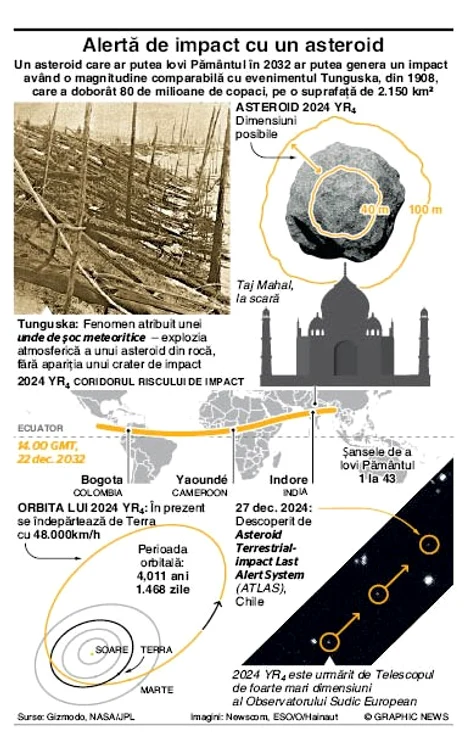
Asteroid 2024 YR4, which measures about 40 to 100 meters wide, will pass very close to the earth in December 2032 and could even hit the planet. Due to the size, speed and possibility of impact, the Internet users gave him the nickname of “The destroyer of the city”.
Major spatial agencies, such as the European Space Agency, estimate that there are about 2% chances that 2024 YR4 will hit the Earth, although this risk figure will be updated as scientists find out more about asteroid trajectory. Although the asteroid is more likely to bypass the Earth, the places that could be affected by a collision have already been identified, Wired.com reports, according to scientists’ estimates.
The destructive potential of 2024 YR4 depends on its composition, speed and mass. Because the asteroid is still very far, these features can only be estimated, and the consequences of a blow are therefore somewhat imprecise at this stage. Currently, astronomers believe that 2024 YR4 would create an air explosion – or air explosion – at impact, which would be equivalent to almost 8 million tons of TNT, or 500 times the power of the atomic bomb thrown on Hiroshima. This explosion would affect a radius of about 50 kilometers around the impact.
Where could the asteroid 2024 yr4 be hit
For the location of the collision, some experts, such as David Rankin, an engineer at Catalina Sky Survey Project of NASA, sketched a “Risk Corridor”. According to the current asteroid trajectory, and if the probability of 2% becomes a reality, the asteroid should fall somewhere in a tape that extends from northern South America, over the Pacific Ocean, to the south of Asia, the Arabian Sea and Africa. Countries such as India, Pakistan, Bangladesh, Ethiopia, Sudan, Nigeria, Venezuela, Colombia and Ecuador would be in danger.
The threat represented by asteroids and comets that could hit the ground is measured on the 11 -point Turin scale: the higher the score, the higher the risk that a space object will hit the ground and cause great damage. The YR4 2024 asteroid is currently ranked at level 3, which means it is large enough and will be close enough to deserve to be carefully monitored. However, most international agencies are confident that the risk level will decrease over time to zero, as the asteroid trajectory becomes clearer. Initially, the probability of impact was 1.2%. Then it was adjusted up to 2.3%, before the latest evaluation reduces the risk to 2%.
In response to 2024 YR4, the UN activated an emergency protocol for the protection of the planet. For now, given that the asteroid is at level 3 of the Turin scale, this is limited to continuous monitoring to understand asteroid movements.
Asteroid Apophis
This is not the first time that such alert was launched, nor is the 2024 YR4 asteroid not the most risky space object that has been monitored. Asteroid Apophis, which was discovered in 2004, sometimes obtained a score higher than 2024 YR4 both on the Turin scale and on the probability of collision. Shortly after it was discovered, it was given a 2.7% chance to hit the Earth. However, after a few months and with better observations, scientists adjusted their calculations to more realistic values. Now, although it will pass very close to the earth in 2029, the chances of collision are zero.
Also, measures are being developed to protect the soil from asteroids with destructive potential. These include kinetic strokes, in which rockets are sent to space to collide with asteroids, to deviate from a collision trajectory with the Earth. NASA’s Dart 2023 mission has shown that such blows can be launched and that they can move space objects, testing this technique on a harmless asteroid called Dimorphos.
