
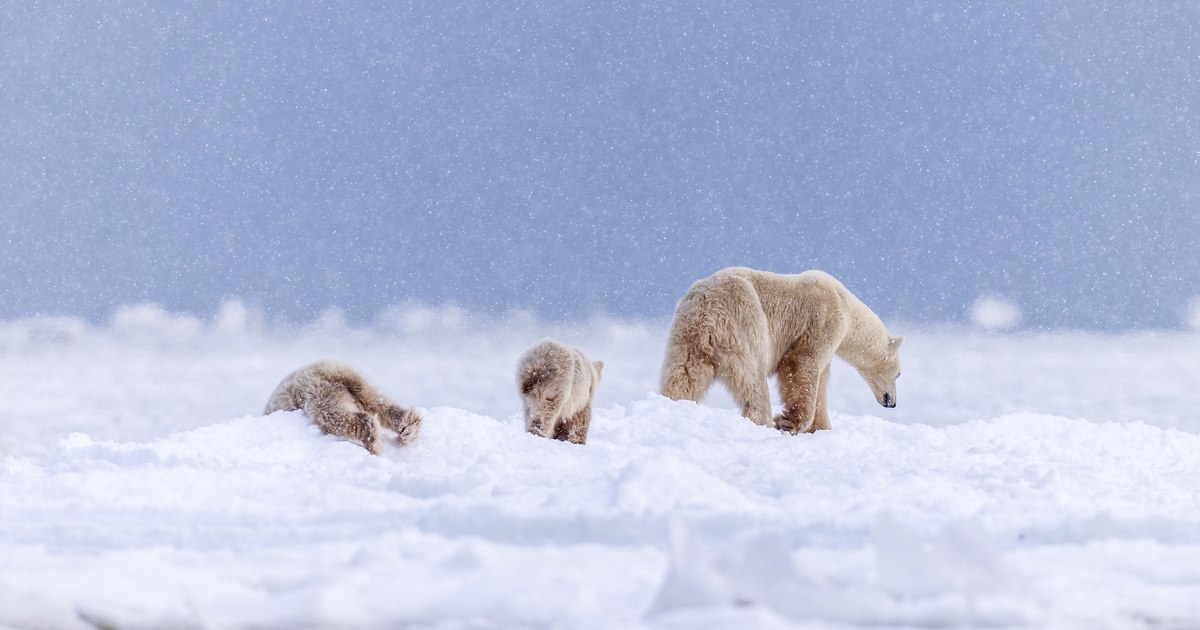
Rareș Beșliu, a photographer in love with nature and animal life, starts the photographic project North of words, a parallel between the Arctic regions and the impact of climate change felt in Romania. He went on a series of expeditions to the coldest areas of the Planet – Svalbard, Greenland, the Canadian Arctic Archipelago – and his stories and photos, collected under the Jurnal de Nord hat, will be constantly published on ertudin.ro and in ” Weekend Truth”.
Polar bear family. PHOTO: Rareș Beșliu
Day 4, December 6. We saw 21 polar bears.
It's like I'm living in a movie where the morning continues with a similar moment that happened in the evening. Yesterday, before going to sleep, I wrote how I ended the day with the bear run by conservation. Today, in the first hour, I saw how the rangers' car scared two bears, each in a different direction. Their methods may be contested by some (I was also saying that they might stop when they see they have served their purpose), but they seem to work. After all, for several years now, the locals have had to adapt to living with bears, and all this time they have found the best methods. And their solution is to leave them alone as long as they don't get too close to the city, but to intervene when the people are in the slightest danger. And it's normal to be like that. Day and night, the rangers receive alerts, stand guard, monitor the area and intervene quickly when necessary. As they did in the morning, but also in the afternoon, when we sat in the car and watched a bear cross the street, as if we were watching a movie. Apparently we were too close to the city so the character was chased away with blaring horns.
In addition to conservation, another very important role is played by those from Polar Bears International (PBI), one of the largest organizations dealing with protecting bears and studying everything related to them and their habitat. Like rangers, PBI intervenes whenever needed and attends all important moments. I'm hoping to find someone here to interview for the blog.
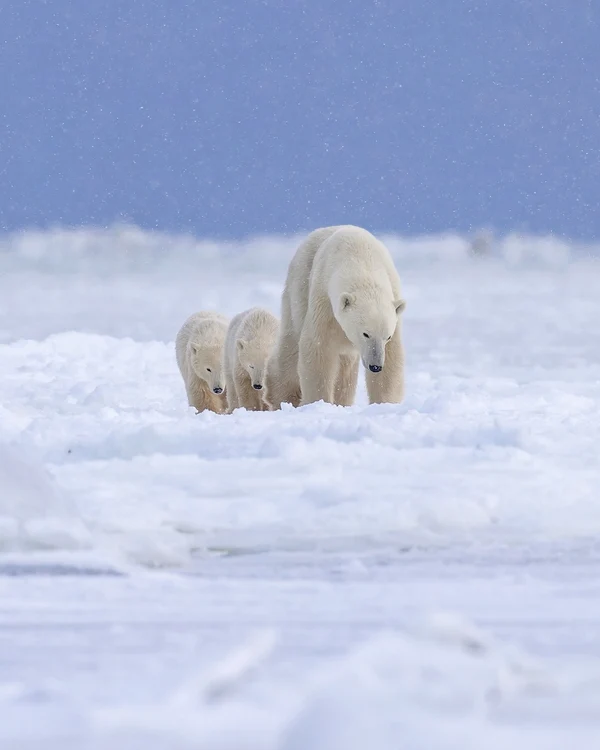
The cubs stay with their mother for two years. PHOTO: Rareș Beșliu
I thought yesterday was a busy day, but today I lost count of the bears. At last count there were about 21. I'm convinced that this crowding is due to the bay changing from day to day. When we got here, there wasn't even a piece of ice on the water. Yesterday shy patches had started to form, and today the entire coastal area is white.
By far, the most beautiful moment today was offered to us by a mother bear with two cubs so cute, that you would have thought they were brown, not polar. They must have realized that we like their company, so they put on a show in front of us until our wrists froze. I've watched them follow their mother's lead and follow in her footsteps, literally. They tired her, tested her patience when they fell through the mud or decided to take a break from playing. They bounced around in the snow as if they were breakdancing. She turned her head after them, stopped each time and waited for them to approach.
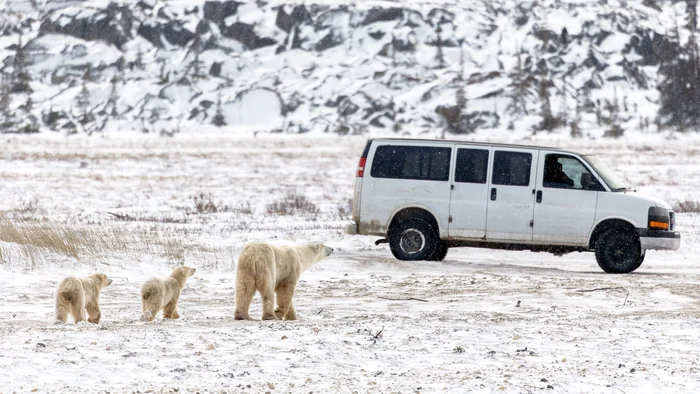
Friendly family, out for a walk. PHOTO: Rareș Beșliu
When he finally got tired, they lay down behind a snowbank on the freshly frozen ocean. They poked their heads out one by one, like curious snowdrops. But even then they did not calm down and took turns – when one calmed down, the other took over the role of “agitated”. I waited for them motionless until they stood up again and took it towards us. I also managed to photograph them facing me, when they were hiding behind each other and only one eye could be seen from each. I also caught them in front of the wreck of the Ithaka, a symbol for Churchill. I didn't photograph the moment, but I also saw them passing by a male, with the mother in front of them, raised on two legs and ready to defend them with her life.
Cubs and mom stay together for about 2 years, but it's fascinating what happens before they're born. I learned today that females only get pregnant in October if they have enough body fat to carry the pregnancy to term. The couple makes love in the spring, and the female must hunt seals all summer so she can get pregnant. In December, the little ones are born, and they only see the first rays of the sun in March. The mother, who hasn't eaten for months, drained of energy by the little ones, now has to teach them to take their first steps. It will be a good few months before they can go on their first adventure together and, why not, until their first party.
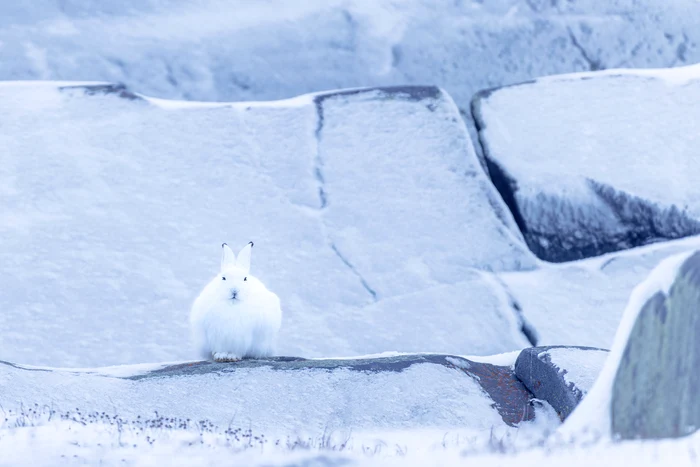
In Churchill, there are also rabbits, not just bears. PHOTO: Rareș Beșliu
The day couldn't end better than with an arctic hare in the blue hour light. He stood motionless, his fur camouflaged with snow, his eyes, nose, and the tips of his ears the same dark shade as the rocks hidden under his mane. He was staring so intently I could have sworn he was the White Rabbit from Alice in Wonderland. After we locked eyes with each other, I caught sight of the little fox out of the corner of my eye. It was a cross fox, a melanistic variant of the red fox. She looked agitated and was pacing from left to right and back. Even though it was a bit far and the light quite dim for the photo, I was able to catch its silhouette on top of the rocks and managed to frame the tree with half branches. It's an image that I could only get here, with subject and “decoration” specific to the place. As I write these lines, I think I can see why the fox was agitated. He may have sensed (or even seen) the rabbit and wanted to attack him right then and there. And we ruined her plans and left her without dinner. I don't know whether to be happy for the rabbit or feel sorry for it, but I'm sure nature will do justice to the one who deserves it.
I go to sleep with gratitude for everything I have experienced here and with the dream of seeing a polar owl tomorrow or the day after. That's all I need to be reconciled. And I hope our plane flies the day after tomorrow, because today's plane broke down, so the only flight from Churchill was canceled. Not that I'm not looking for reasons to stay here, but there's a storm coming next week and the town will become a “ghost city” with only a few stray locals.
