
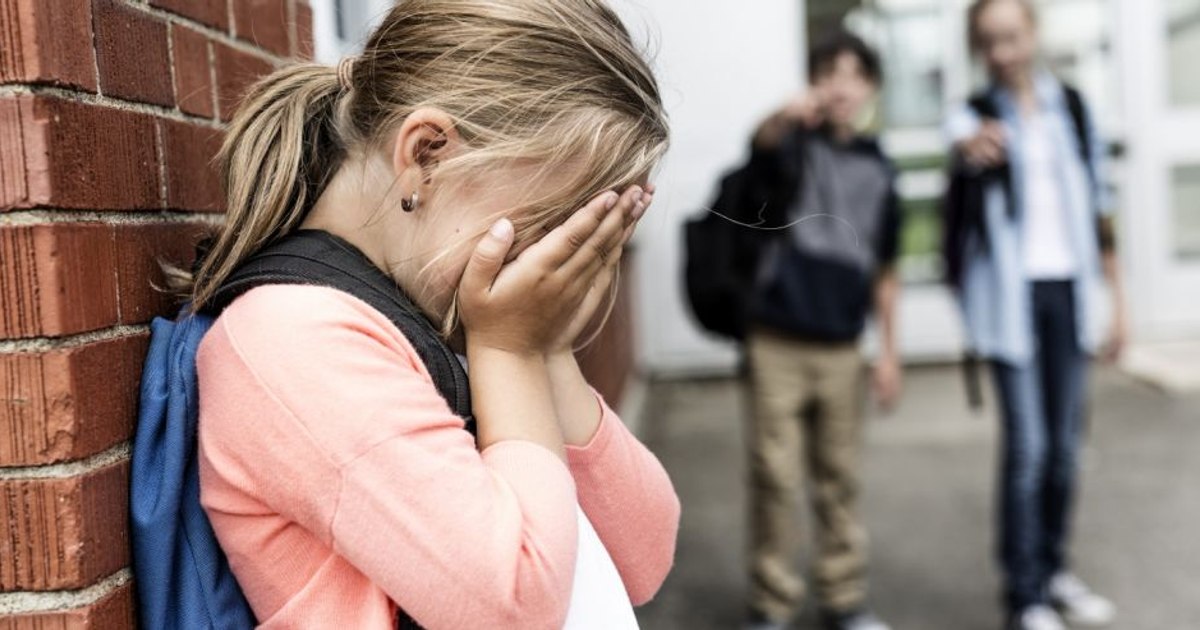
According to a Save the Children study, out of about 600 educators, more than 85% said that there are children in their classes who have been subjected to insults or aggressive behavior. Also in the same survey, over 50% of the teachers stated that there are children in their class who do not have a play partner. Moreover, it seems that the phenomenon of bullying faced by students takes an increasingly large scale from the first years of kindergarten.
Bullying is practiced from younger and younger ages, Source: archive
The study shows that parents are mainly responsible for the aggressive behavior of children in society. “We can talk about certain behaviors that they take from the adults around them, because we know very well that at this age children learn by imitation. Of course, we can also speak of an attempt by children to test limits. They’re at the age where they’re testing limits, testing how far they can go with a behavior. The geranium is a form of socialization, of relationship frequently encountered among kindergarten children”, explains Mariana Moraru, Save the Children trainer.
Psychologist Radu Leca emphasizes the same thing. According to him, bullying and isolation have the same source: it is called home. “Bullying and isolation come from the home through the non-involvement of parents and the appearance of the nanny, through the total isolation from reality of children who are forgotten in front of mobile phones or tablets. Through these elements, which somehow seem natural for the year 2024, both bullying and isolation manifest themselves where parents do not expect them in any way, i.e. in kindergarten”. explains the psychologist.
The case of Bogdanel. “The child left at kindergarten does not cry for his parents. He just wants to go home”
The relationship between parents and children suffers, in many cases, a split, continues the specialist, which raises a big alarm signal. “There’s a trend that’s been taking shape for a while: the little kid who cries when he’s dropped off at daycare isn’t necessarily crying for mom or dad, but rather because he wants to go home. Not at parents, but at home. And that should give us serious thought. Because we are in front of a neglected child”. The psychologist gives the example of the case of Bogdănel, a four-year-old child whose parents took him to psychotherapy. “The child took the home dog’s leash with targets in his kindergarten school bag. Which he tried to wear around his neck. The teacher got scared, called the parents, they took the child aside and asked him why he resorted to such a gesture. The little one replied that he wanted to be like Azorel. Why? Because he just stays at home. Imagine how much suffering this little child neglected by his parents could gather in his soul. It’s a disturbing story that brings anyone to their knees. But it must be said, because this is what it means not to be near your child. This is what gives birth to the lack of parents in the universe of the little one”.
What does a neglected child do? He takes revenge, says the psychologist, he resorts to various behaviors to attract attention, to be noticed. And he is aggressive, but this anger is directed at his colleagues: he hits, scratches, pinches, pokes, pulls hair, spits. Or, worse, there are children who express this suffering through deviant behavior.
More bullying, same drama
The psychologist believes that a child capable of bullying at such a young age, on the one hand, can imitate some behaviors that he sees in the family, on the other hand, he can try to control those weaker than him, as he is controlled by parents. “There are situations when bullying does not manifest itself through physical aggression. It can be verbal aggression: look fat, look stupid, look ugly. But, most of the time he hears these words in the environment where he comes from, in the family. And this is where education has to go.” But, the psychologist continues, it is very difficult to correct children whose parents themselves are aggressive, violent. “And before sending their offspring to a psychologist, they themselves should do therapy, so they can figure out where they went wrong.”
Bullying is of many kinds, it takes many forms, the specialist explains, and they should all be taken into account. Because, often, words hurt more than a gesture. “We have bullying expressed through physical aggression, when the act takes place away from the eyes of those around, bullying with physical aggression, when the victim is positioned in the middle of the crowd, is humiliated in front of classmates. Then we have psychological bullying. This form manifests itself by addressing insults, humiliating words that inspire shame, fear, fear such as “I hope to die”, “I hope to fall”, “I hope to hit you”. The last form of bullying is public bullying. The perpetrator laughs at the victim, humiliates and mocks her in front of everyone. And in kindergarten, the forms of bullying are much crueler and more brutal than in primary classes or if we refer to older children”.
Bullying comes from the family and is resolved with family support
Radu Leca recalls another case, that of a little girl who was bitten on the hand by a colleague. She didn’t know how to react and laughed, said she wasn’t in pain and didn’t care. In the next second, five other colleagues who had witnessed the scene rushed to her and bit her too. Motorcycles? “That he cares. To learn to recognize and accept dominance,” explained the psychologist. “In this case, the parents and the authorities intervened…but there are other situations where the mother and father are too concerned with their own lives to keep an eye on the children. They don’t ask, the little ones don’t talk. Moreover, the parents themselves are flawed. Many, many adults do not want to clean up their lives, they are warriors, rebels, consumers of everything bad and eager for scandal. Romanians, as a society, represent one of the eminently flawed peoples from almost every point of view.
In order for a therapist to succeed in correcting the behavior of an aggressive child, he must also invite the parents to the therapy. “Not involving the family in therapy is assuming failure. That’s why there is systemic psychotherapy for families and couples. Without systemic psychotherapy, these children cannot be helped, saved”.
As far as psychological counseling at kindergarten or school is concerned, this form of therapy has not yet yielded results, says Radu Leca. “It is the biggest attempt by the specialists, namely to find a solution at the national level. I hope with all my heart that it will be a real solution, that will actually work, but so far it has not borne fruit”.
