
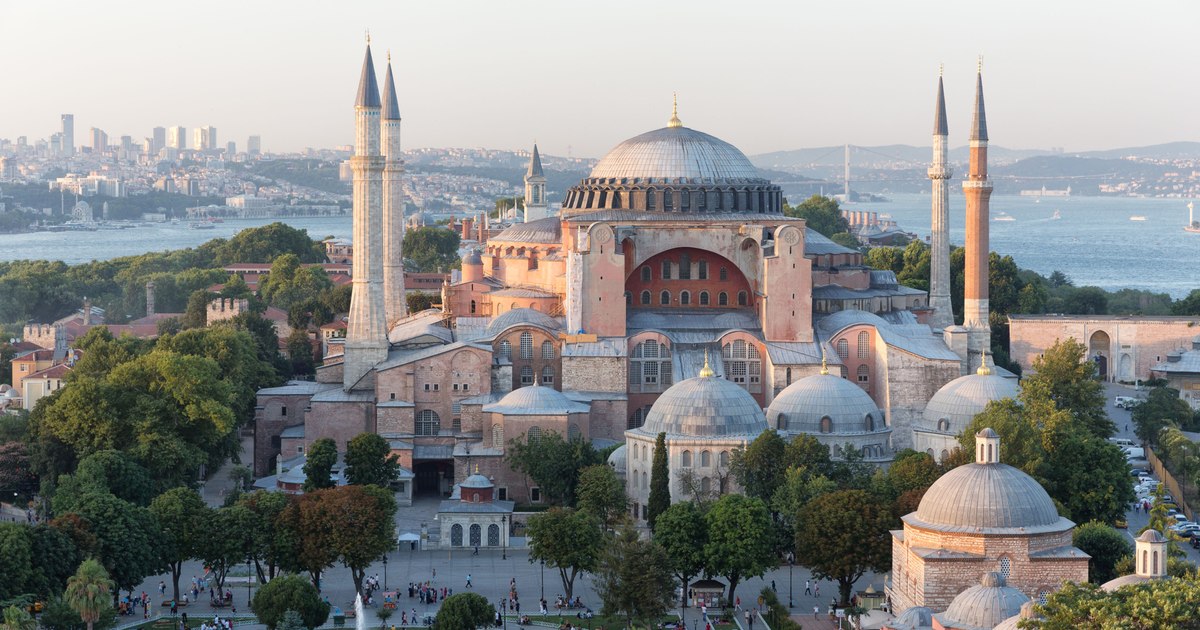
Extensive restoration works concern the iconic dome of Hagia Sofia in Istanbul, but also the preservation of elements hidden from the general public: ancient tunnels, Viking inscriptions and mosaics rediscovered after centuries.
Hagia Sofia: Restoration and Secrets of 1500 years of History Shutterstock
The 1,500-year-old masterpiece of Istanbul, Hagia Sofia, enters a large restoration process-the most complex of the last decades. The Turkish authorities not only implement plans to consolidate the famous Dom, but also reveal a series of secrets preserved over time.
Symbol of civilizations that have left deep fingerprints on Istanbul, Hagia Sofia is one of the most impressive sacred constructions in the world and an architectural jewel of Turkey. Currently, the monument lives a new stage of restoration and conservation, meant to ensure its survival for the following centuries.
Throughout the time, Hagia Sofia has been transformed from Christian basilica into mosques, museum and again, an evolution that reflects the cultural, spiritual and political wealth of the metropolis on the banks of the Bosphorus. Today, the works focus on the restoration of his dome, considered an engineering masterpiece of late antiquity.
Beyond the impressive aspect of the project, Hagia Sofia hides fascinating stories and details, related to the profound symbolism of the construction, the architectural genius of Mimar Sinan and the challenges of restoring a structure that survived centuries of earthquakes and changes of regimes.
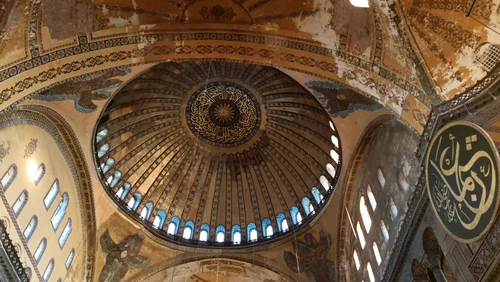
Image 1/14:
Impressive Hagia Sofia dome in Istanbul Photo Daciana Stoica for Adevărul
Fragility and ingenuity: Historical restoration of the dome of Hagia Sofia over 40 m high
Hagia Sofia has benefited from several major restorations over time, each of them aiming to protect this architectural masterpiece. The last extensive restoration took place between 1993 and 2009, when significant works of consolidation and restoration of mosaics, structures and elements have been carried out over the centuries.
The current works, which began in 2020, focus especially on the restoration and strengthening of the iconic Dom, in order to protect this symbol of Istanbul and to ensure the future. The restoration is not only aimed at preserving a spiritual masterpiece, but also extensive technical interventions, meant to protect the structure in front of the time to come.
The works will be performed exclusively from the outside, to protect the interior mosaics of invaluable value. The lead roof will be disassembled, then refurbished or replaced, and the entire area will be covered with a metal structure and a special high quality tarpaulin, meant to protect it from the weather, but also to protect the interior.
At the same time, the mosaics inside the dome will be restored with the help of a platform suspended over 43 meters high, supported by four columns. The religious activity inside the mosque will continue uninterrupted, while the teams of specialists will be able to work safely.
For the height works, a special designed crane will be installed for this objective: 41 meters high and an extensible arm of 60 meters, capable of operating without affecting the structure of the monument.
Restoration in stages, complete digital archiving
The project, carried out, has already included the rehabilitation of the tombs of the Sultans Mehmed III, Selim II and Murad III, as well as works at the historical primary school (Sbyan Mektebi) and on the chronometrist’s room (Muvakkithane). The upper floor of the gallery was cleaned, maintained and reopened to the public.
Another essential step was the complete digitalization of the complex, by creating a “Digital twin” 3D of Hagia Sofia. This modern archiving allows more efficient restoration planning and offers a form of virtual conservation, accessible to future generations.
The greatest Christian place of the world for a millennium today the legend of the Muslim world
Hagia Sofia is an impressive masterpiece, included in 1985 on the UNESCO World Heritage List, as part of the historical area of Istanbul.
Raised in 537, Hagia Sofia known as the Church of the Holy Wisdom, was, for almost a millennium, the largest Christian place in the world. After the conquest of Constantinople in 1453, Sultan Mehmed II transformed the basilica into a mosque, adding Islamic elements and covering its Christian mosaics and golden frescoes. Over the centuries, four minarets have been erected, and the building has suffered multiple interventions to strengthen the structure.
In 1935, under the regime of Mustafa Kemal Atatürk, Hagia Sofia was transformed into a museum, as part of the Turkish secularization process. After almost a century, in 2020, a gesture that generated a wave of international reactions.
The most significant consolidation works were carried out by the architect Mimar Sinan, in the sixteenth century, when he added buttresses and modified the structure to prevent collapse from earthquakes. Due to these measures, Hagia Sofia has resisted many major earthquakes that affected Istanbul.
Restoration of the Dom – “crown” To this historical edifice – it represents today not only a conservation work, but also an act of continuity, meant to keep in life the memory of two empires and a civilization that model Istanbul.
Beyond Dom: Hagia Sofia’s less known secrets
The story of this fascinating building will be explored more widely in a future material.
Today, however, we will mention only a few of the hidden details of Hagia Sofia, which are not as visible to ordinary visitors.
Did you know that the central dome has a diameter of over 30 meters and was, for centuries, the largest in the world? It is larger than any other structure in the Byzantine Empire and has survived numerous earthquakes throughout history.
Under the marble floor there is a vast system of ancient tunnels and tanks, which are believed to serve the imperial palace and the religious complex during the Byzantine period.
In the upper walls of the gallery are kept over 170 graphics inscriptions, some left by crusaders or northern visitors, including a famous Runic inscription attributed to a Viking soldier named Halvdan. These discreet traces offer a rare window to the multisecular history of the monument, marked by empires, pilgrims and conquerors who have left their fingerprints.
Another spectacular detail is the so-called “Corner of tears” – a column inside the building about which tradition says it has healing powers. Visitors insert the thumb into a circular niche, and if it comes out wet, it is considered a sign of blessing. Although its origin is legendary, the phenomenon is, in fact, caused by the condensation accumulated in the thick stone wall.
At the upper level, some rare Christian mosaics are preserved, including the image of the Virgin Mary with the Baby Portraits, rediscovered only in the 20th century, after they had been covered for centuries. (See photo gallery). These mosaics are accessible only from the gallery which, until recently, had been closed to the public.
Through these less visible details, Hagia Sofia keeps an aura of mystery and continues to reveal unknown stories, even after almost a millennium and a half of existence.
In 2024, over one million Romanians chose Turkey for their holidays, attracted by top destinations of this country – from Vibrant Istanbul to coastal resorts, such as Antalya and other pearls of the Turkish river. In fact, 2024 was a historical year in terms of the number of visitors, with a tourist explosion that brought over 50 million tourists from all over the world to Turkey.
