
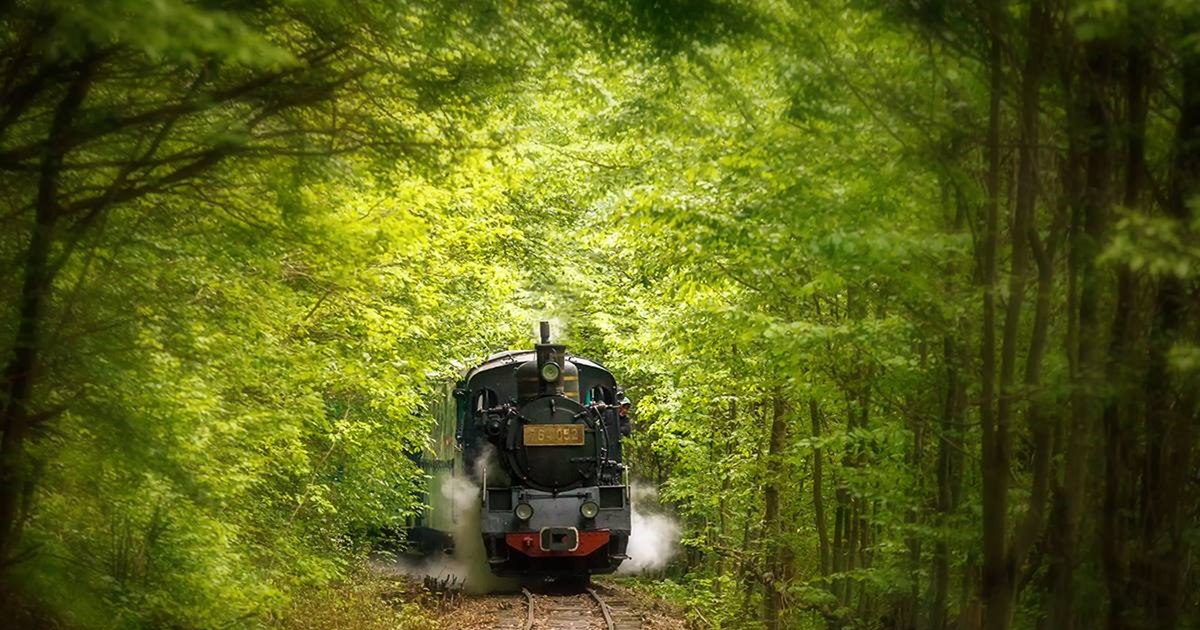
Mureș County could be proud of two mocănița: Mocănița Sovata, active and with scenic routes for over a century, which cross fairy-tale landscapes in unique lands, and Mocănița Transilvaniei, which, however, is being revitalized by the people of Bistrița, who propose another kind of unforgettable trips.
Mocănița de la Sovata and Mocănița Transilvaniei or Mocănița de la Teaca Colaj
Romania has many treasures – some natural, others man-made. The strange thing is that, unlike other countries, most of these treasures are too little exploited and valued. Examples include the mocanici, which today are too few in number compared to what they once were: only eight are still functional.
“Weekend Adevărul” proposes you to visit, with each of them, places for a magical autumn, where only the small steam train can take you.
In today’s edition, we board the legendary train and let ourselves be carried away through the charming landscapes of Mures and Bistri (SEE PHOTO GALLERY).
Image 1/9:
Mocănița Sovata from Mureș Photo Hamos Gyozo Facebook
THE MOTHER FROM THE RESORT WITH THREE WORLD RECORDS
Mocănița from Sovata – Mureș crosses a small portion of a route inaugurated more than a century ago, between Sovata and Câmpu Cetății. Every year he runs this route from April to October.
During the summer there are three races every day of the week, except Monday, and in autumn, two races a day only at the end of the week. Therefore, in summer it departs at 10:00, 13:30 and 17:00, from Gara Mică Sovata, if a minimum of 20 passengers gather, and in autumn at 10:00 and 13:30.
Between October 11 and 13, 2024, Mocănița Sovata invites you to “Pumpkin Festival”and between October 25 and 27, at the Halloween Train, an event where costumes are mandatory. The closing of the tourist season will take place this year between November 1 and 3.
The section of only 14 kilometers, round trip, is covered in about two hours: the maximum speed of the moped does not exceed 35 km/h, but on certain parts of the route it is even lower.
Transport rates with Mocănița Sovata
It is important to remember that, in case of bad weather, the journeys are cancelled, as well as in the case of technical faults, but also that people under the influence of alcoholic beverages are not allowed on the train. You can find out more details both on the mocanitasovata.ro website and on the dedicated Facebook page.
The price of a ticket is now 50 lei for children between 4 and 14 years old, 60 lei for pensioners over 65 years old and 70 lei for the 14-65 year old category. Tickets can only be purchased at the ticket office in Gara Mică Sovata, open every day from 8:00 am. They can be paid with cash, but also with a card, according to the information on the website of the restaurant.
Mocănița Sovata: woven in time – a railway history of over 100 years
The history of Mocănița de la Sovata is linked to the construction of the Târgu Mureș-Praid narrow gauge railway, which began in 1912. Three years later, the first set on this route would be put into operation. It circulated like this, uninterrupted, for more than seven decades, until 1988, when the restoration of the section between Târgu Mureș and Sovata began, a process that lasted until 1992. However, five years later, it was decided to close the entire section . The idea of putting the locomotive back on the rails was resumed in 2010 and it took less than a year to implement it for tourist purposes, until the summer of 2011, when the section between Sovata and Câmpu Cetății was rehabilitated.
The Mocănița from Sovata is part of the batch of 10 locomotives built in 1949 in Poland, two of which arrived in Romania, being preserved until 2011 in the Sibiu Depot. The steam locomotive runs on coal and hardwood. The set has five gondola cars, each between 11 and 12 meters long, the oldest being built in 1953 and the rest between 1985 and 1991.
From the largest heliothermal lake in the world to Salina Praid
From Bucharest you can reach Sovata via Ploiesti, Brașov and Odorheiu Secuiesc, and from Cluj-Napoca either via Turda or Reghin, while the route from Sibiu passes through Mediaș and Sângeorgiu de Pădure.
As attractions we would mention, first of all, the resort with the largest heliothermal lake in the world, Ursu, the only lake with salt water surrounded by a salt mountain with rich vegetation, thanks to the volcanic soil. In fact, Sovata and its lake hold three world records for this reason, the third being the fact that Lake Ursu is the only natural lake in the world whose appearance is known with precision for one minute – May 27, 1875, 11:00 am.
Other attractions in the area are: the 28-meter high Belvedere Tower, the Praid salt pan, the Black Lake with sapropelic mud, the Paraschiva Lake, the Tivoli Lake – artificial, with fresh water, the only one in Sovata where access by boat is allowed –, the Adventure Park Adrenaline Plus, Corund commune, 18 km from the resort.
THE MOTHER OF TRANSYLVANIA, STAGE AND FILMING SET
The idea to bring this little train back to life was born in 2014, at the initiative of an NGO from the neighboring county of Mureș – Bistrița-Năsăud, with whom the people of Mures share the route of the legendary train. Wanting to promote local culture, ecotourism and nature activities, by supporting local communities, Bistrita volunteers managed to reinvent this steam train, giving it a new identity
“Everything somehow started from a frustration, that look, we have a heritage asset that will end up as scrap metal and the first thing we wanted was not to be destroyed… We realized that the big the investor was actually a scrap metal dealer”the initiators of the project would tell later, in a documentary.
From glory to preservation – the little girl who stayed put
However, in comparison with the other cottages, Mocănița Transilvaniei or “the little train from Transylvania” / Mocănița de la Teaca is still not operational. It was used occasionally, to reach various places on the route that used to connect the city of Târgu Mureș (Mureș) with Lechința (Bistrița Năsăud), after which it stopped operating because the line was not safe. Therefore, Mocănița Transilvaniei stays more than it moves.
When they started the project, the volunteers wanted to promote the legendary steam train to get support, but also to find out the condition of the 70 km (100 km, according to other sources) of the railway entered into conservation. The trips organized in this regard, including the dresina, represented the chance for more than 100 people to explore the beauty of the Transylvanian Plain on rails. This is how a group of six volunteers from three counties came to create the Association “Mocanica of Transylvania”on the 100th anniversary of the commissioning of this narrow gauge railway in 1915.
What remains of the Austro-Hungarian railway heritage and ambitious plans
The Austro-Hungarian plans had aimed to build three narrow railway lines in the area, to connect Târgu Mureș with the surrounding towns, one of them being the one now destined for Mocănița Transilvania. It was thus desired that the salt from Praid, the wood from the forests of the Niraj Valley, as well as the cereals and animals from the Plains of Bandului, Miheşului and Tecii be transported to Transylvania, and further to Budapest and Vienna.
The first works started in 1912, but a year later the entire work was destroyed by floods. And the first transports, carried out between 1915 and 1919, were of a military nature: from troops to food and animals needed to support the Austro-Hungarian army.
Later, during the communist period, the moped carried the commuter workers to the two sugar factories in the region and the locals who needed to get to the market, in Târgu Mureș. A few years after December 1989, the whistle of the locomotive was no longer heard, as sections of the narrow-gauge railway were taken out of service for lack of economic profitability, left in disrepair and vandalized, as happened all over the country.
From splendor to reinvention with Mocănița de la Teaca
Bistrița volunteers have so far managed to purchase a locomotive, restore a depot, rehabilitate the stations on the route, one of which, the one in Teaca (Bistrița – Năsăud), turn it into a museum, the Rolling Museum Transylvanian: Mocănița Transilvaniei.
Many other highly appreciated and popular events are organized in the area, which have the legendary train as their central element, from festivals that brought together 10,000 people to workshops, sports competitions, cultural actions or to save historical monuments of on the route, such as the Teleki Castle, but also fundraising campaigns. An independent feature film that was filmed in Mureș and Bistrita-Năsăud counties, including Mocănița Transilvaniei, was awarded in the USA at several film festivals, attracting the attention of Hollywood.
For example, on Saturday, October 12, 2024, you are invited to attend “Mocănită Half Marathon” on Teleki domains. It is an open-air sports event organized on the hills around Teleki Castle, in Bistrita-Năsăud county, with the aim of promoting a healthy and active lifestyle, encouraging participants to explore the area of the mocănița and contributing financially to the restoration of the mocănița from the Sheath in operation.
You can find out more about the events organized in the area, as well as the state of the works, both on the dedicated website, mocănițansilvaniei.ro, and on the Facebook page of the Mocănița Transilvaniei Association.
35 kilometers, the link between the past and the future
The route for which the volunteers are still fighting to be brought back to life is between Teaca (Bistrita Năsăud) and Râciu (Mureș), 35 kilometers (out of the almost 200 km that existed in total on the three tracks from which the railway line effectively largely extinct) through areas where the tunnels are not man-made, but made by nature, with the help of trees.
Therefore, it is worth getting to the area when events are organized because they are unforgettable. The same are the attractions in the surroundings, such as the Teleki Castle in Pomuș, the Laleaua Pestriță Nature Reserve, the Schullerwald Forest in Bistrița, the Dogarilor Tower in Bistrița, the Lechința Winery, and further Sângeorz Bai, Tihuța Pass, Colibița Lake (in Bistrița-Năsăud), or in Mureș – Sighișoara, Sovata, Zau de Câmpie Steppe Peony Reserve, Mociar Forest, Mureș Gorge Natural Park, Târgu Mureș.
So, regardless of your preferences, the Mocănițele României are ready to offer you memorable adventures, kidnap you in fairytale landscapes and await you with unforgettable surprises and indelible memories.
