
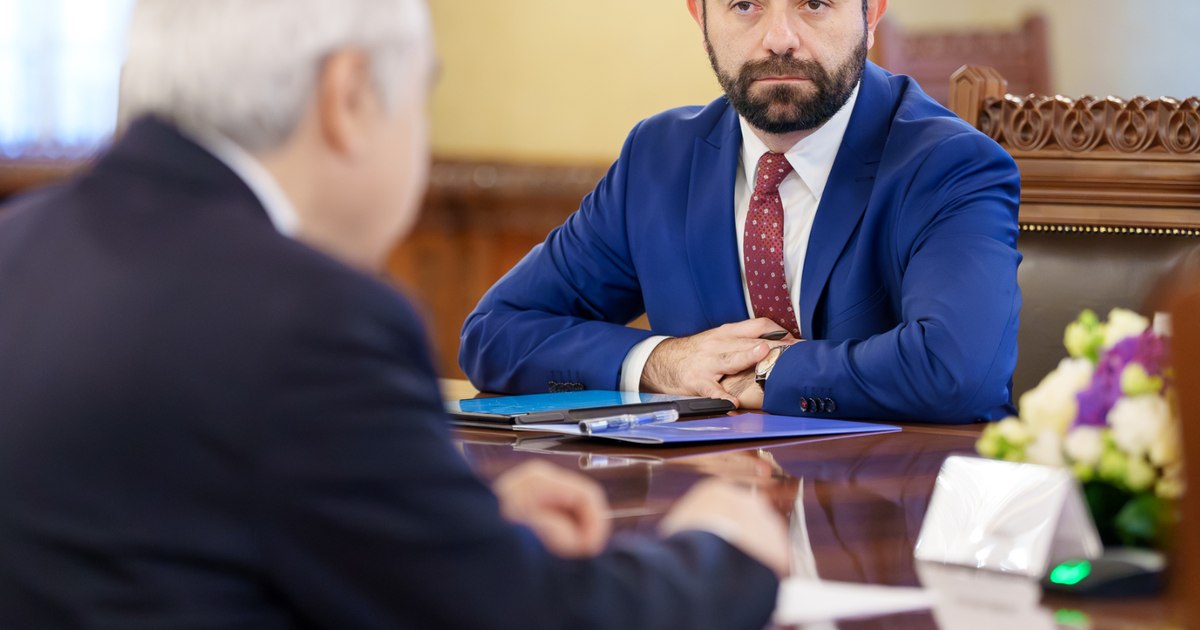
Presidential advisor Radu Burnete published a text after the Davos Economic Forum on Sunday, January 25, concluding that “the world after 1945 no longer exists. The world to come is not yet defined.”
Radu Burnete was present at Davos together with the Minister of Foreign Affairs, Oana Țoiu, the Minister of Investments and European Projects, Dragoș Pîslaru and the Minister of Energy, Bogdan Ivan.
Radu Burnete describes the collapse of the international order established after 1945 and the transition to a multipolar world dominated by uncertainty, mercantilism and brute force.
His analysis, based on discussions at Davos 2026, highlights the retreat of globalization and the emergence of new trade barriers, while automation and advanced robotics become the main solutions for economies facing declining immigration.
In this volatile context, the presidential adviser advocates a strategy of “institutional pessimism”arguing that Romania must abandon nostalgia for the past and strengthen its domestic resilience through deep administrative reforms, military power and a European unity capable of dealing as equals with global giants.
His conclusion is that the survival and prosperity of the country depends on the ability to build modern institutions on “the bricks” the old order, despite the extreme difficulty of bureaucratic transformation in relation to today’s technological ambitions.
“Economic Diplomacy”
Burnete points out that the country’s diplomacy must be reinvented, because “we live from a communist mythology when it is said that I was a great exporter”.
“We were exporting cheap and bad products at uncompetitive prices, to captive countries that had little choice. Today Romania exports goods worth about 93 billion euros annually (or 100 billion dollars), compared to about 11 billion dollars in 1989 — an increase of almost 10 times in nominal terms, but incomparably greater in added value and diversity“, he explains on his page.
The presidential adviser believes that Romania should be more present and commercially aggressive, as a true trade and investment agency is needed.
“We need an agency that can take Romanian companies to new markets and that can attract foreign investments programmed, calculated, where needed. There are models and it can be done in 1-2 years. It is caught in the government program and we are working on it.
The Chamber of Commerce of Romania must be helped (and it must help itself) to be more present in our main markets. Be there with people and resources. To do something that few have done: to cultivate a taste for international trade and expansion among our companies.
We are a very inventive and resourceful people, but we do not have commerce in our blood, nor the drive to conquer new markets. It is something that can be educated and here our economic schools have an important role to play. And they must prepare people for the new world“, he adds.
He points out that the Romanian embassies are currently underfunded and lack sufficient staff, a situation that must be corrected as soon as the budget balance allows.
Burnete offers the example of the Davos 2026 delegation as proof that politicians from different parties can collaborate effectively, but warns that the real challenge is to maintain this unity in Bucharest as well, where electoral pressures tend to fragment the state agenda.
“Stronger companies, private and public”
Also, Radu Burnete conveys that there is a need for more Romanian companies to invest outside the country, and private ones need financing and encouragement.
“With stronger diplomacy and more resources our companies will know they have someone to defend them if they run into complicated jurisdictions. It is worth a discussion whether a sovereign fund or a small part of the money saved in Pillar 2 can support this regional expansion of our companies.”
It is a discussion that is still being held in certain places, but which I will suggest to the Government and the Financial Supervisory Authority”emphasizes the presidential advisor.
Radu Burnete proposes a radical reform of state-owned companies, advocating for their transformation from “repeating” entities on the domestic market into performing players at the regional level.
Essential to this process is total depoliticization, through a political agreement to end party-based appointments and ensure the independence of management, so that these companies produce real influence and welfare for the country.
“Internal Cohesion”
Radu Burnete reveals that when he announced that he was going to Davos, the most messages he received were “criticisms, from the visceral and hateful to the benign and unnecessary’.
“We are too often self-destructive. Of course, democracy is noisy and always will be, but internal coherence means being a little more patient with each other.” he points out.
Burnete states that Romania’s internal coherence depends on a reformed judiciary that eliminates privileges and the reduction of social inequalities to combat the feeling of exclusion.
The modernization of the state requires quality public services, supported by administrative reform and accelerated digitization, with a focus on completing the electronic identity and digital signature ecosystem later this year.
Fiscally, the reduction of the budget deficit below the 3-4% threshold is vital for national security, as a political agreement is needed whereby the loans exclusively finance strategic investments and defense, not current expenditures, thus protecting the country from international volatility.
“Military Power”
The presidential adviser also wrote that Romania must strengthen its military power, considering the world that is becoming “more dangerous”, being “irresponsible to not be able to defend yourself“.
“Take the example of our Finnish neighbors that President Stubb highlighted in Davos. With a population of just over 5 million, Finland can mobilize 280,000 soldiers in a few weeks and has around 900,000 reservists. This culture of defense was born out of the trauma of the Winter War (1939-40), when 300,000 Finns held breast for months to more than 600,000 Soviet soldiers”he transmitted.
Next, he compares the GDP budget that Finland allocates to defense, compared to Romania. According to Radu Burnete, Finland spends 2.4% of GDP on defense, while Romania spends 2.25% (with a commitment to reach 5% in the coming years).
“But the mobilization capacity that Finland has — 280,000 out of 5.5 million — would mean for us about 1 million deployable people out of 19 million. A useful benchmark.” it continues.
The SAFE instrument is considered vital for national security, underlining the idea that Romania’s relevance in the European Union and within alliances depends directly on its military capacity.
“Education, Research, AI, Robotization”
Radu Burnete rejects “neo-grazing” and nostalgia for an idealized past, arguing that Romania’s economic prosperity depends on the adoption of cutting-edge technologies such as AI, robotics and reusable rockets.
“Don’t confuse this with legitimate concerns for the resilience of supply chains — which even Davos elites now embrace under the name of ‘strategic autonomy.’
The difference is between intelligent diversification of sources and nostalgia for an autarky that never existed. Was Musk still talking about how in the next decade we’ll have data centers in space thanks to reusable rockets and we’re glorifying an imaginary life like in the 19th century?”it transmits.
As a concrete solution, he proposes replicating the Finnish VTT model by merging Romanian research centers into a single ecosystem.
This innovation campus would integrate researchers, entrepreneurs and investment funds, transforming applied research into a real economic engine capable of meeting the current needs of society.
“Europe”
Last but not least, the presidential counselor points out that Romania must support the consolidation and unity of the European Union so that it can compete on an equal footing with the United States and China.
“We have a large population, technology, great companies, financial resources and a larger domestic market than the US. What Europe lacks is concerted action. Zelenskyy expressed this frustration frankly in Davos, calling the continent a fragmented kaleidoscope of small and medium powers.
If we listen to the nationalists, we will end up a Europe of pygmies that the US and China will manipulate as they please“, he adds.
He states that a strong and reformed European Union is the main security guarantee for Romania, while facilitating support for Ukraine and protection against external pressures.
However, Radu Burnete warns that deeper integration should not turn smaller states into simple executors of the decisions made in Brussels; therefore, Romania must move from a simple presence at the negotiating table to an active and influential participation in the definition of common policies.
“The world after 1945 no longer exists”
In the end, Radu Burnete appreciates that Romania has a geographical position at the intersection of three strategic spaces, an educated and adaptable population, but also a recent transition experience.
“I return to the image with which I started: the traveler through Rome who sees old bricks reused in new constructions. What “bricks” do we, Romanians, have that we can reuse in the new world order? We have a geographical position at the intersection of three strategic spaces. We have an educated (still) and adaptable population.
We have a recent transition experience—perhaps the most dramatic in Eastern Europe—that has taught us that change is possible, even if painful. We have the Danube, the Black Sea, agricultural land and energy resources. And we have, despite appearances, a capacity to reinvent ourselves when the context calls for it.
The world after 1945 no longer exists. The world to come is not yet defined. In this interval — which may last years or decades — the countries that will prosper are the ones that will use their old “bricks” to build something new, not the ones that will cry over the broken building. Romania has a choice”it transmits.
