
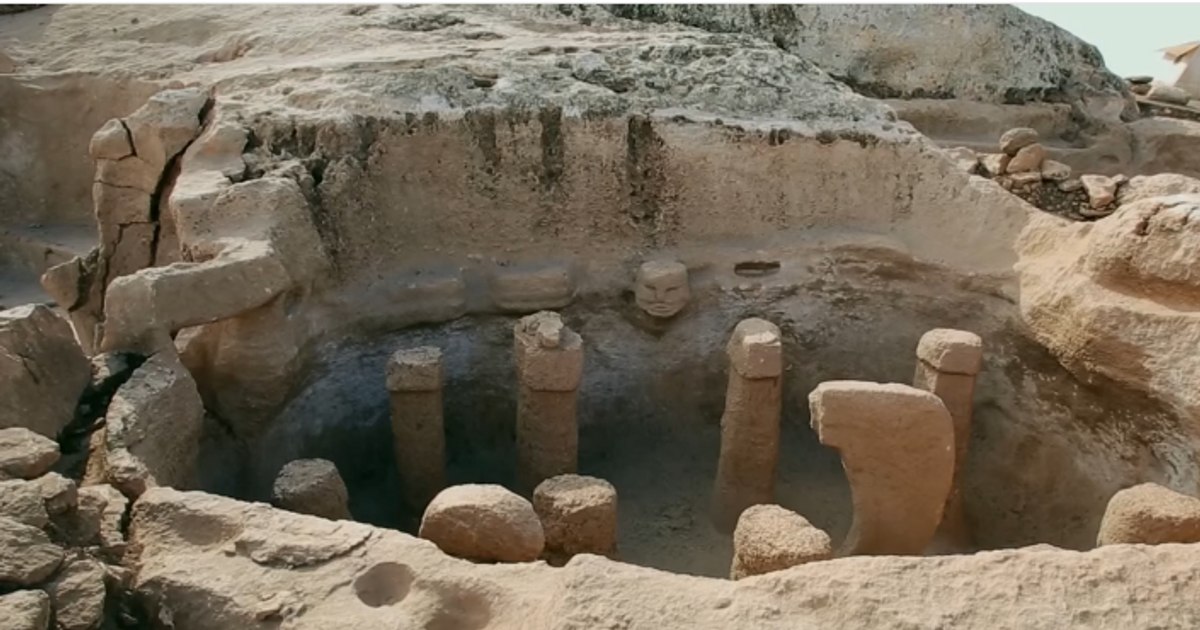
Carvings carved into a large stone pillar at Göbekli Tepe in Turkey nearly 13,000 years ago may be the world’s oldest seleno-solar calendar, according to a new study.
This calendar may have been carved to mark the catastrophic impact with a comet, according to Live Science, cited by Agerpres.
The study was published July 24 in the journal Time and Mind.
What scientists have discovered
Researchers analyzed the pillar from the archaeological site of Göbekli Tepe and noticed that it contained 365 V-shaped symbols.
Scientists believe that such a symbol represents a single day, and the entire calendar encompasses “12 months plus 10 extra days”according to a press release from the University of Edinburgh.
The researchers analyzed, in addition to the “V” shaped symbols, and a sculpture that represents “a bird-like animal” which has a “V” shaped symbol depicted around the neck.
The summer solstice constellation, transposed into a sculpture
The sculpture could represent “the summer solstice constellation of those times”according to the statement.
This group of sculptures, probably made around 10,850 BC. it is a representation of an impact with a comet that occurred during that period. They show that the people of that time “he could record his observations of the Sun, Moon and constellations in the form of a solar calendar”according to the statement.
“They were good sky watchers”
Scientists believe that the impact of a comet, which could have triggered an ice age, would have been enough to trigger a cultural change at Göbekli Tepe and perhaps even lead to the emergence “to a new cult or religions”according to the statement.
Carvings carved into a large stone pillar at Göbekli Tepe. PHOTO capture Science Channel
“It seems that the inhabitants of Göbekli Tepe were good observers of the sky, which is to be expected if we consider that their world was devastated by the impact of a comet”claims the author of this study, Martin Sweatman, from the University of Edinburgh.
“This event could have been at the origin of civilization because it could have initiated a new religion and because it could have motivated the production of new advances in agriculture to cope with the cold climate. Possibly their attempt to record what they saw represents the first steps in writing development which appeared thousands of years later”he added.
The carved figures are similar to those discovered in another archaeological site in Turkey, in the Urfa region, Live Science notes.
