
Destination Management Offices should transform Romanian tourism into a coordinated and efficient system, following the European model. In reality, many MDGs only work on paper, and the promotion of heritage and culture destinations remains dependent on isolated local initiatives.
Collage of some touristic objectives from Romania. PHOTO: Shutterstock
From 2022, Romania has an official procedure for the approval of Destination Management Organizations, and the relevant ministry publishes guidelines, statute models and the list of approved OMDs.
However, the reality on the ground shows different speeds. A few counties have moved to implementation and dedicated budgets, others are barely clarifying their status and funding. In parallel, a notorious case reached suspension and reorganization.
The legal and institutional framework
The approval procedure of the MDGs is established by Order no. 1293 of August 8, 2022, published in the Official Gazette no. 818 of August 19, 2022. The document defines the accreditation steps, the necessary documentation and the minimum conditions. The Ministry of Economy, Digitization, Entrepreneurship and Tourism manages the approvals, publishes the list of approved OMDs, status models and the OMD guide, and the National Tourism Strategy 2023, 2035 anchors the role of the OMD in public tourism policy.
Recent history, official milestones
The first approved county OMD was in Maramureș, announced by the ministry on February 16, 2023 and confirmed by the Maramureș County Council. The Ministry later communicated the approval of the first regional structure, OMD Bucovina, in May 2023.
Maramureș, from quick start to reorganization
OMD Maramureș was the first approved at the county level. In 2025, the activity was suspended for reorganization, after checks by the control body of the CJ that signaled unjustified expenses, the measure being publicly announced by the president of the CJ. The local press reported layoffs and debts, with the mention that the promotion of the county continues through an office of the CJ until clarification.
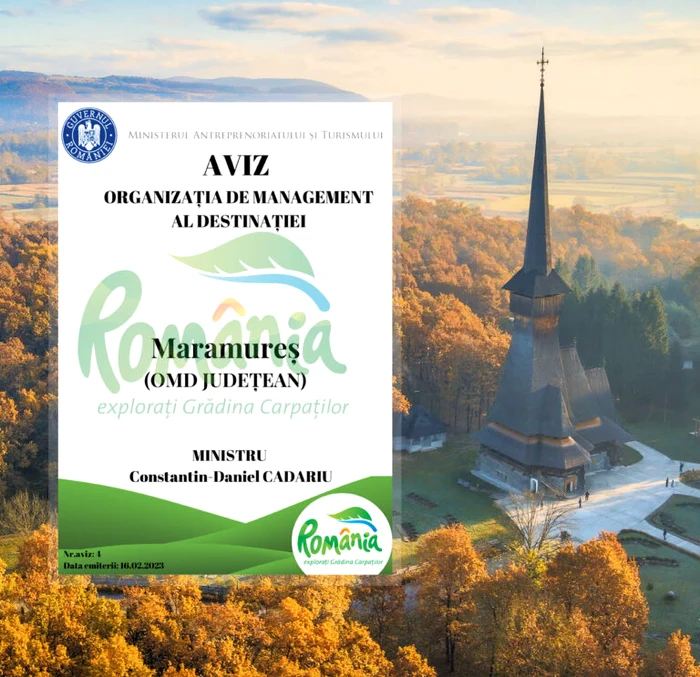
On February 16, 2023, the Ministry of Entrepreneurship and Tourism issued the first notice in Romania for the establishment of a Destination Management Organization at county level, OMD Maramureș. The official announcement was made through a press release from the ministry and confirmed by the Maramureș County Council, which coordinated the approach.
The founding members of the organization are: Maramureș County Council, Saorsa Turism SRL, Turist Șuior SRL and the Maramureș Entrepreneurs Association. According to the public document, the organization was to later include new members – private tourism operators and administrative-territorial units from the county.
The County Council announced, in parallel, complementary tourism infrastructure projects, such as:
- creating an aquapark in Baia Sprie,
- the development of ski areas and mountain areas,
- rehabilitation of tourist routes and modernization of the promotion network.
The relevant ministry, then headed by Constantin-Daniel Cadariu, welcomed the initiative, stating: “Tourist Romania needs real partnerships between administrations and the private sector. The fact that Maramureș is the first county to establish an OMD represents an example for the rest of the country.”
Brașov, institutional steps and explicit budget
OMD Brașov was established on August 13, 2025, after the County Council approved the statute and an annual fee of 500,000 lei. Local authorities publicly presented the administrative steps and objectives.
Iasi, establishment decision at the county level
On June 16, 2025, the Iași City Council approved the establishment of OMD Iași County and the statute of the association, with the attached documentation and legality notices.
Mamaia Constanța, documents and local funding sources
Constanța City Hall has made transparent the draft decision on the establishment of Mamaia Constanța OMD, with the complete binder, statute and contributions. In 2024, the City Council regulated a local tax to finance OMD activities, intended to increase the notoriety of the destination brand.
Mangalia, an active local OMD for the southern coast, with its own promotion strategy
On the Romanian coast, Mangalia was among the first cities to establish a local Destination Management Organization with concrete activity. Constituted by the Decision of the Mangalia Local Council from 2023 and approved by the Ministry of Economy, Digitalization, Entrepreneurship and Tourism in 2024, OMD Mangalia has as its main goal the unitary promotion of the destinations in the south of the coast: Mangalia, Saturn, Venus, Cap Aurora, Jupiter, Neptun and Olimp.
The structure functions as a public-private association, with Mangalia City Hall and private operators from the local hotel industry as founding members. The local leadership emphasized that the objective of the organization is “creating a common marketing strategy for all resorts managed by Mangalia and attracting investments in coastal tourism”.
However, the arrest of the mayor of Mangalia, Cristian Radu, in the fall of 2025, brought back into focus the problems of managing funds within OMD Mangalia. Prosecutors have opened files on alleged acts of corruption and misappropriation of public funds, and part of the financial investigations include the sums collected from the tourist taxes intended for the organization, according to the local press in Constanța.
Destination management practices, example Oradea
In Oradea, the local tourism management structure operates through the Visit Oradea association, which publishes annual activity and project execution reports, including budgets approved by HCL. Although the legal format is distinct from the OMD approval introduced in 2022, Oradea offers a landmark of transparency and planning.
What does the comparison between norms and practice show?
- There is a procedure, guide, statute models and list of approved entities, all public at the relevant ministry. The problem is uneven execution, from counties with budgets and teams, to structures still in the document stage.
- Some local authorities have defined clear sources of funding, including promotion fees dedicated to the MDGs. Others went on dues and annual allocations, with the risk of fluctuations.
- The Maramureș case confirms that without internal control and performance indicators, an approved structure can end up being suspended and reorganized.
What the industry is after, according to official documents
The national strategy 2023, 2035 and the MDG guide call for integrated destination management, market research, public-private partnerships, impact measurement and tourism product development. These must be reflected in statutes, budgets, reports and indicators, not just one-off campaigns.
NRDP and milestones for the MDGs
The operationalization of the MDGs was assumed as a milestone in the PNRR, the publicly announced deadline for defining the governance model being the end of September 2022. The statement belongs to the then prime minister, Nicolae Ciucă, recorded by Adevarul.ro.
In the same intervention, Ciucă specified a target for December 31, 2023, the establishment of 8 MDGs which, within two years of operationalization, would generate in the targeted counties a 20 percent increase in the number of foreign tourists compared to 2019.
On the implementation side, the competent ministry published the procedure for approval of the MDGs by Order no. 1293 of August 8, 2022, in the Official Gazette, and maintains a dedicated page with the list of approved OMDs, statute models and working materials.
Industry and decision-making voices
Alin Burcea, president of the National Association of Tourism Agencies (ANAT) and CEO of Paralela 45, declared during a press conference organized at the beginning of 2025, the following aspect related to Romania’s MDGs: “Today there are only 18 OMDs and, unfortunately, there is no Bucharest OMD and no national OMD, which should be the responsibility of the ministry. There are town halls that do not want to establish OMDs, in order not to divert the money collected from the tourist tax. It is shameful that in the Capital, which collects millions of euros annually, there is no such structure. Romania needs at least 2,000-3,000 OMDs for a effective destination promotion.”
Burcea proposes to amend the law to introduce a “punitive zones” to oblige local authorities to participate in the establishment of these organizations. He also emphasizes the need for a promotion budget of at least 20 million euros per year, compared to 4.4 million euros that Romania currently has, and notes the gap with Bulgaria, which, with 30 million euros, attracts over 13 million foreign tourists per year.
The publication FunkyTravel.ro described the launch in August 2025 “Guidance on the MDGs” as an image action without a solid financial and legal basis: “Tourism specialists were sharp: the guide is a formal construction, without funding and without the real involvement of the private sector. In short, a guide to failure. Out of eight promised regional MDGs, Romania ticked only one.”
The author, journalist Adrian Gorpin, pointed out at that time the contrast between specialists who demand solutions and politicians who “do PR with hashtags”concluding that Romanian tourism “he needs foundation, not just conference pictures.”
On the other hand, Andrei Plujar, deputy and member of the Commission for Entrepreneurship and Tourism, emphasized, in a parliamentary debate in November 2025, that “The MDGs must collaborate closely with local and regional authorities, so that the tourism promotion strategies are correlated with the development directions of the communities. Only through a joint effort can we transform tourism into a real engine of economic development.” He proposes the diversification of financing through European, governmental and private funds, the creation of a fund dedicated to sustainable tourism and a national data system to measure the performance of the MDGs.”
