
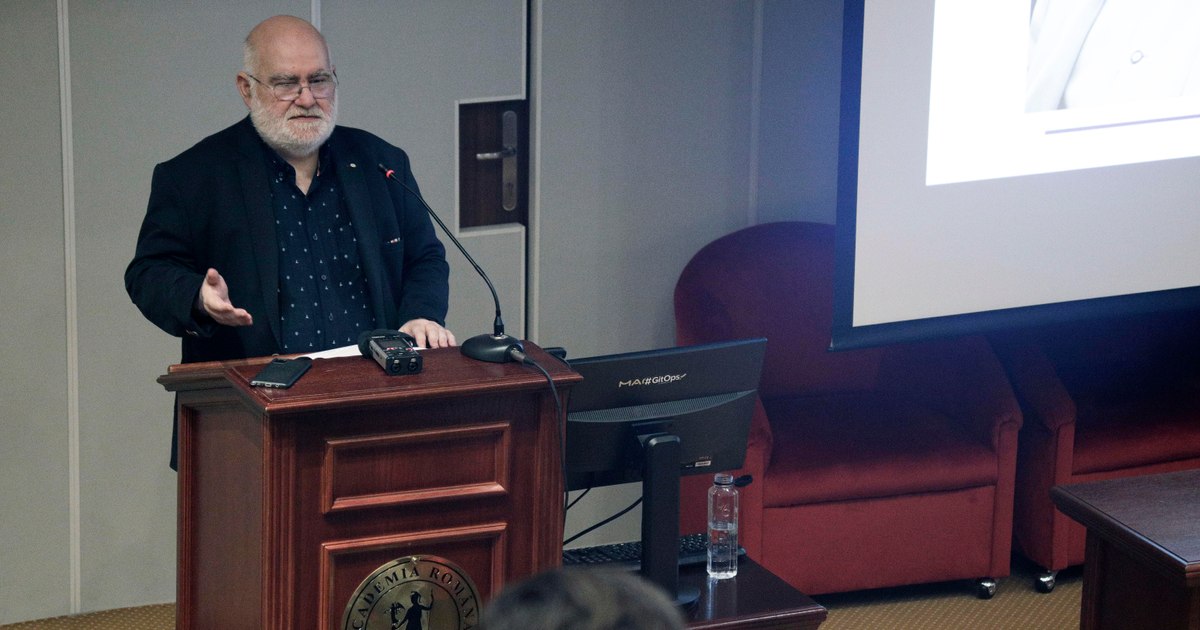
Romanian education is rocked by yet another scandal, shortly after a teacher from the “St. Sava” from the Capital was accused of rape and sexual assault on minors. This time, the protagonist is the sociologist Alfred Bulai, accused of harassing several female students. Psychiatrist Gabriel Diaconu spoke about the “Bulai case” and about “shades of gray” in a post published on Facebook.
Alfred Bulai PHOTO: INQUAM Photos/ Malina Norocea
We remind you that the sociologist Alfred Bulai, head of the Department of Sociology within the School of Political and Administrative Studies (SNSPA), is accused by several female students of sexual abuse and harassment. The young women told reporters of Snoop making advances on them and making them undress in front of him. Everything would have happened during the practice classes that the students, accompanied by the teacher, attended in different areas of the country. The teacher was suspended from his position, and the police opened an investigation on his behalf.
Psychiatrist Gabriel Diaconu mentioned in his post, which was published on Monday, July 29, that “sexual violence takes many forms’.
“The Bulai case. When victims speak, moral justice, the right to compensation, no prescription, shades of gray.
***
Before anything, a word of introduction. Sexual violence takes many forms. Sex crime, in any form, is a crime with intent. I tell «crime» using American terminology because I want to emphasize the extreme nature of the act. It does not always aim to suppress the victim, or directly threaten his life. But it attacks, by content and deliberation, the very soul of the person the aggressor assaults in one form or another. Through this, many times, the victim is condemned to live, later, with the wound of modified sexuality, of the sequelae that manifest in intimacy, the pain of feeling, to some forms of human closeness, a paradoxical reaction.
Instead of joy, force.
Instead of happiness, disgust.
Instead of fulfillment, agony.
***
Several former students of Alfred Bulai, professor of sociology, came out publicly today, some in video interviews, others / I understand/ in written interviews, to denounce the behavior of the teaching staff, a well-known pedagogue, but also a public figure, TV analyst, in – a certain period quite politically courted. Bulai, with whom I was invited several times in the same studios, is portrayed by the people who give these interviews as an individual with serious behavioral problems who, moreover, taking advantage of the authority, the ascendant, the influence he has and the discretion of the report one -one-on-one with the student,
He forced them to undress,
He made advances and sexual advances to them,
He touched them, unwanted, in a sexually explicit manner.
I was asked during the day why the victims waited so long to tell their experience.” it is shown in the post made on Facebook by the psychiatrist.
“The only thing the victim has is the story”
According to the psychiatrist, it sometimes takes some time before a victim of sexual assault meets another who has been subjected to such treatment by the same person. Moreover, Gabriel Diaconu specifies, in the same post, that in the case of the sociologist Alfred Bulai, it is not about “rape” in “the traditional meaning of the term”but of “forms of behavior comparable to sexual abuse”.
“There are several plausible answers. The first, and most important, is that the experience of the sexually assaulted person is, in a first phase, totally perceived. It isolates, not just singularizes. Sometimes it can be months, sometimes years, even decades, before a victim has a conversation with another victim of the same person.
The second, equally common, is that this was the time it took for the support system to bring victims to the point where they could reclaim their dignity, their uprightness, and talk publicly about their experience.
In Bulai’s case, we are not talking about rape in the traditional sense of the term, or the acceptable – currently – legal definition. We are talking about other forms of behavior similar to sexual abuse, some of which – with respect and courtesy to each victim – are deeply subjective.
And that’s because the aggressor, if we take the present case, did not openly, explicitly and directly coerce the victim. In other words, he did not directly threaten her life, or physical integrity, in order to elicit and obtain the sexual behavior. As a result, you can also propose – as a third party – that the symmetrical scenario in which the victims (hypothetically, I insist!) would actually have consented to the sexualized, and sexualizing report makes sense, however perverse it may seem.
In order not to risk more with the above explanation, the discussion is not from a psychiatric, or psychological, expert perspective. It is from a strictly legalistic perspective, where the prosecutor, the criminal investigation body, the judge must maintain impartiality, equidistance and look at the evidence.
Cynically speaking, the only thing the victim has is the story. There is no material evidence, there are no signs of an overt sexual crime,” the psychiatrist also explained.
The Larry Nassar case
What’s more, he offered as an example the case of Larry Nassar, the former doctor of the US gymnastics team, who was convicted of sexual assault and rape and served six decades in prison.
“From a number of victims who tell the same story and describe the same experience, the prosecutor can present a convincing indictment to the court. The case of Larry Nassar, the former doctor of the United States gymnastics team, convicted for both sexual assault and rape to 60 years in prison, is worth mentioning here. But that’s because American jurisprudence recognizes different evidentiary standards compared to the Romanian one.
It may be that today, through the Bulai case, we are looking at a Nassar case. I might. And the only reason I don’t use a thicker brush has to do with the benefit to an accused person of having the presumption of innocence pending a final and irrevocable court decision.
Shades of gray, in Romania, have to do with the nature of consent, the clear definition of coercion versus coercion, versus the coercive environment (or ecology). Legally, societally and culturally we continue to look at sexual crime through horse glasses, strictly through the filter of sexual contact and its forced nature.
Amendments to the law, in the sense of normality, we have when it comes to minor victims, where age or other arbitrary criteria elude the possibility of consent.
But as soon as a person turns 18, we confer on him certain responsibilities and qualities which, even if he has them in theory, do not give him immunity in practice.
“The personal truth does not always coincide with the legal truth”
The psychiatrist also drew attention to the case of Lajos Kristof, the “genius coach” who was caught red-handed by the Bucharest police while raping a 14-year-old child, after noting some comparisons with the Bulai case.
“What Bulai’s victims describe about him borders on sexual torture, keeping some vernacular landmarks of the term «torture». But the Bulai in their stories i) had a position of authority, ii) had a perverse pleasure in humiliating, dehumanizing, iii) deriving an aberrant form of sexual pleasure from the agony, tremors and terror of his victims under the rational appearance that «it was an exercise».
The particularities of this case, but also the possibility that we are talking about a large number of victims, could represent a historical, jurisprudential precedent in Romania.
I’ve seen various comments today comparing the Bulai case to the Kristoff caseor that of the teacher from Sava high school.
We are talking about similarities as far as the position of authority is concerned, but Bulai – from what has become public so far – did not have sexual relations with any of the victims.
That doesn’t make his actions any less serious, on the contrary. The time span, the behavioral pattern, but also the element of torment, mental torture and manipulation/intimidation using what is called «narcissistic black triad» it might give this file a special touch.
Bulai will defend himself in the only place he can: where he will plead that either the facts did not happen (using a quid pro quo) or that the report was consensual. To prove the lack of consensus, without an elaborate psychological expertise of the victims (and not a medico-legal psychiatric expertise!) becomes cardinal in this file, something for which Romania is still not sufficiently prepared.
But it is enough, for the prosecutors, if they can identify at least one case in which Bulai sexually exploited, that is, raped, a victim, and everything falls like a house of cards. From that moment the case is closed.
***
There are times when, after the long night of silence, a person who has endured a lot chooses to speak. She deserves respect, consideration and support for what she tells, because in her experience you find personal, lived truth.
The personal truth does not always coincide with the legal truth. As one of my trainers in forensic psychiatry told me, the basis for why you don’t have evidence is based on the premise that it didn’t happen. But my trainer also told me that, using systematic psychological documentation tools, here the Istanbul protocol, you can overcome this shortcoming.
A systematic assessment, both psychiatric and psychological, of the ordeal of the victims could give the judge a comprehensive picture of what all these women experienced. And to bring the personal truth closer to the legal one. And their voice not only counts in court, but also as evidence beyond mere testimony.
So that the predator gets what he deserves: a fair trial, and an appropriate sentence.” the psychiatrist also explained.
