
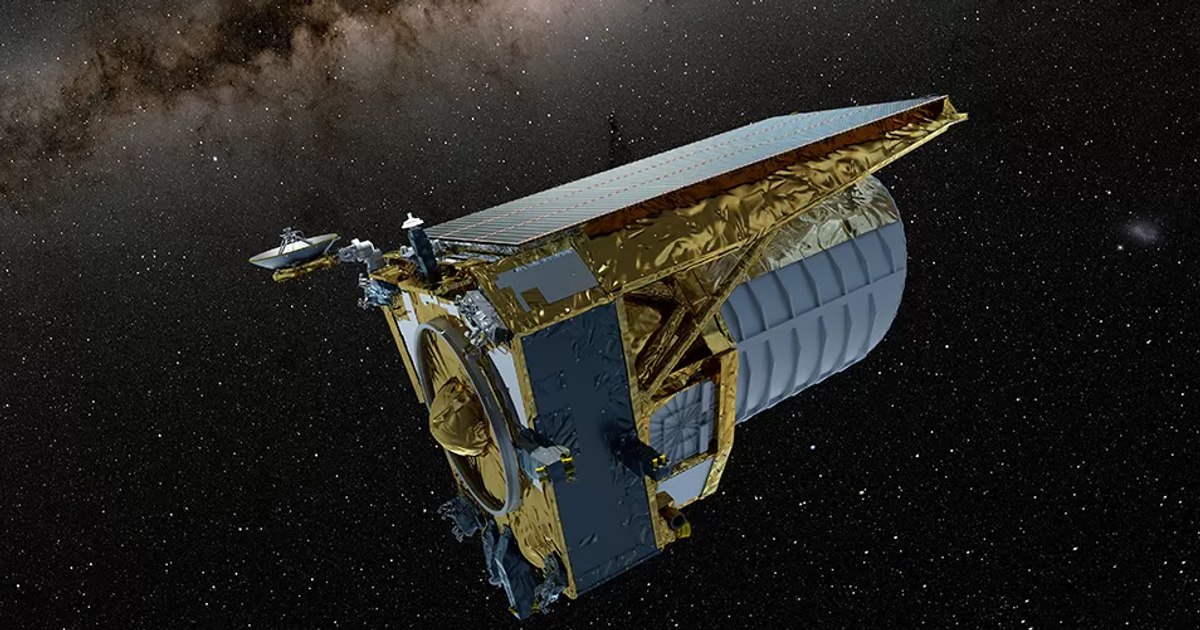
The Euclid space telescope, launched by the European Space Agency (ESA), detected a rare cosmic phenomenon, known as Einstein’s ring, near our cosmic.
EUCLID PHOTO ESA space telescope
The Einstein ring, an extremely rare phenomenon, has proven to be hidden in a not very distant galaxy. Galaxy, called NGC 6505, is about 590 million light years, a relatively small distance in cosmic terms. This is the first time that the light ring surrounding its center is detected, due to the high resolution tools of the Euclid telescope, writes the European Space Agency (ESA).
“An Einstein ring is an example of a strong gravitational lens. All strong lenses are special, because they are so rare and incredibly scientifically useful. This is particularly special, because it is so close to the earth, and the alignment makes it very beautiful ”, explains Conor O’Riordan, from the Max Planck Institute for Astrophysics in Germany and the main author of the first scientific work analyzing the ring.
Albert Einstein’s general theory of relativity stipulates that the light will be curved around the objects in the space, so they focus the light as a huge lens. This gravitational lens effect is greater for more massive objects – galaxies and galaxic swarms. This means that sometimes we can see the light from the distant galaxies that would otherwise be hidden.
If the alignment is perfect, the light from the distant source galaxy is curved to form a spectacular ring around the foreground object. Studying the gravitational effects of Einstein rings can help us learn about the expansion of the universe, to detect the effects of darkness and invisible dark energy and to investigate the background source whose light is curved by the dark matter between us and the source.
“I find it very intriguing that this ring was observed in a well-known galaxy, which was first discovered in 1884. The galaxy is known by astronomers for a long time. And yet, this ring has never been observed before. This demonstrates how strong Euclid is, finding new things even in places we thought we knew well. This discovery is very encouraging for the future of the Euclid mission and demonstrates its fantastic capabilities”Says Valeria Pettorino, scientist of the Euclid Esa project.
Euclid was launched in July 2023 with the mission to explore the dark universe, but started his detailed study on February 14, 2024 and gradually creates the largest 3D map of the universe so far. The telescope will detect galaxies at distances of up to 10 billion light-years, helping scientists to understand the distribution of dark matter and the influence of dark energy, the mysterious force that accelerates the expansion of the universe.
So far, astronomers have identified less than 1,000 such strong gravitational lenses, and Euclid could discover about 100,000 in the coming years. This remarkable image already confirms its unique ability to reveal the secrets of the universe.
