
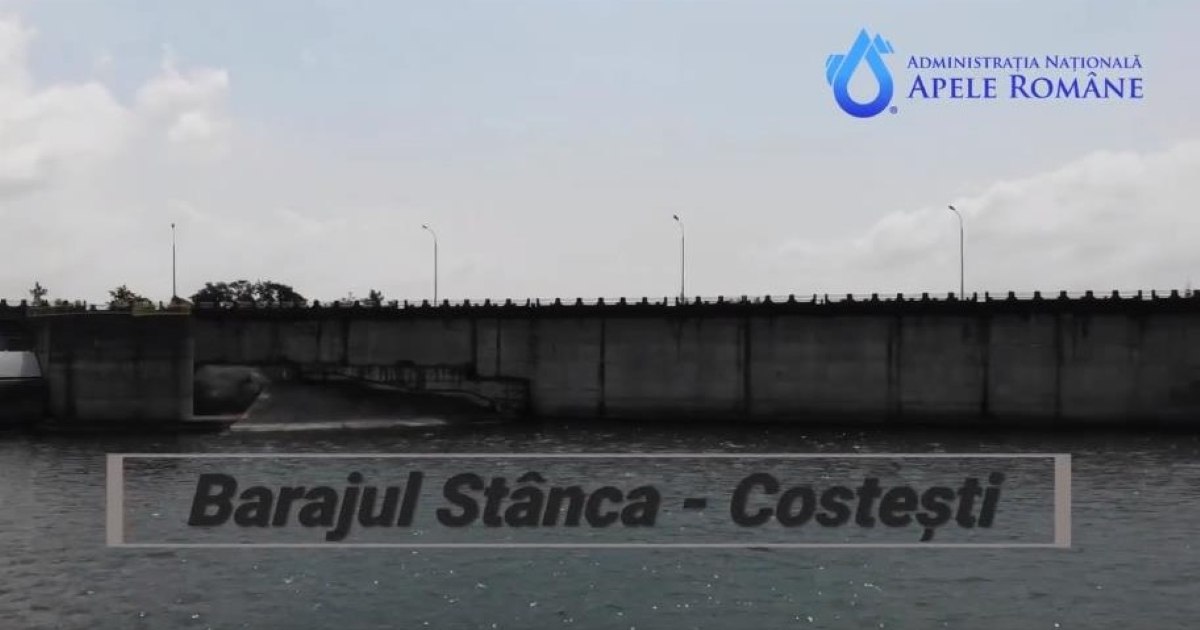
The heat wave and the prolonged drought have created difficulties for drinking water distribution companies in several regions of the country, where the reserves are almost exhausted and where water is supplied with portions, so the help of the Moldovan brothers was requested.
Increasing the flow rate at the Stânca-Costeşti Dam could help restore reserves. Photo: ANAR
On Friday, the Romanian National Water Administration (ANAR) announced that Romania asked the Republic of Moldova to approve the increase in the flow of water released from the Stânca-Costeşti Dam, from 38 mc/s to about 60 mc/s, for a period of 7 days.
“Following the request of the Romanian side, the technical operative group from the Stânca-Costeşti reservoir approved and implemented the increase of the flow discharged from the reservoir, from 38 mc/s to about 60 mc/s for a period of 7 days. The Romanian side and the one from the Republic of Moldova will monitor the situation of the tributary flows (which enter the accumulation) in order to prepare the subsequent maneuvers”, the Romanian Waters National Administration transmitted on Friday.
Also, ANAR says that the Institution specifies that the repair work on the pipeline from the reserve outlet at the Stânca-Costeşti dam has been completed, so that the water resources are ensured both for the water supply from this source for Botoşani county, as well as for the irrigation uses served by it.
“Situated on the Prut River, Stânca-Costeşti is the second most important dam in our country after Iron Gates I and the third in Europe, if we do not take into account the eastern regions of Russia. Administered together with the Republic of Moldova, all decisions are taken jointly by the representatives of the two parties, according to the dam’s operating regulations. On the part of Romania, the work is being exploited in safe conditions by our colleagues from the Stânca-Costeşti Complex Mining”, ANAR also sent.
We remind you that, against the background of the prolonged drought and the cause of almost exhausted reserves, in almost 300 localities in Romania, restrictions were imposed on the supply of drinking water.
