
2025 is the year in which Romanians must also learn to selectively collect waste from textile materials, because a new law obliges us to do this more civilized and in accordance with European law.
Moreover, from now on the local public authorities, especially the town halls, will have to give the citizens the opportunity to submit their old clothes and other unnecessary textiles in the house, and which they no longer use in specially created containers for collecting textile clothes, which are located for this purpose.
There are also other methods of collection, such as roads, in schools or Door to Door (from door to door). However, the best and realistic effective method remains the collection in special containers. What is important to remember by the population, is the fact that no confusion between the selective collection of prices, paper, glass and metals with that of textile materials should not be created, nor should the collection of textile materials with other types of waste be done, they must remain dry and uncontaminated by food or drinks, otherwise they can not be processed.
Why is this new directive coming? Well, did you know that the textile industry is one of the most polluting industries in the world?
Statistics show that, a European citizen uses on average 26 kg of textiles over a whole year, of which he throws at least 10-11 kg, of which, only 1% of what is thrown into new clothes!
Therefore, the new laws say that in Romania we should see more and more special containers to allow us to submit clothes and other textiles that we do not need, so that the specialized companies in collecting and processing these textiles can intervene so that we enjoy a much healthier and pleasant environment for us!
Why should we selectively collect the clothes and textile materials?
The new legislation in the field shows that the territorial administrative units (UATs or in other words may have been made available to people from the beginning of the year for the collection of textile waste, but this has not effectively put into practice. If we remember how the selective collection of plastic, metallic and household waste started, we will realize that the implementation of such procedures can even be lasting.
The specialists repeatedly stated that only at the end of 2025 if a materialization in practice of these obligations in most cities will be seen.
However, there are quite a lot of locations where Romanians can already selectively collect the textiles.
Leaving the law aside, we present the main ecological and social reasons for which we cannot overlook the need to recycle textile materials.
You knew that ….
Is 10,000 liters of water for a single kg of cotton?
But we, people, love cotton clothes and always seek them to have them in the wardrobe, so we should not overlook even the possible recycling of parts that we no longer want to wear.
Does the polyester used for clothing and textile generally come from the oil area?
Almost 50% of the composition of a piece of clothing is made of this material, which has a fantastic high impact on the level of production from the perspective of carbon dioxide emissions.
Is it vital to think about the environment in which we plan to live with our long -term children and grandchildren, so what would it be to reuse or recycle those clothes and textiles that we can no longer enjoy!?
Why throw the textile waste at the trash pit, when they can regain their initial glow and reach people again? Why not reduce carbon emissions or water consumption in literally industrial quantities just because we have to make a minimum effort to move with the bag of unnecessary clothes at the nearest container?
What happens if we make a minimum effort and we selectively collect textile waste and clothing?
When we get rid of the closet from the useless clothes for us, practically in addition to saving energy and resources for the mother planet, we contribute to the new life of the respective piece. But how?
The textile waste collected separately (like the stains, bottles, paper …) will also be treated separately. They are deposited in separate containers, without being affected by moisture, fat (oils or fats in food). Basically, when we throw the clothes, they should be as clean as possible and possibly pack them in a plastic bag, so that when they come in contact with other contaminated textures or food scraps, they will not be affected and become completely useless.
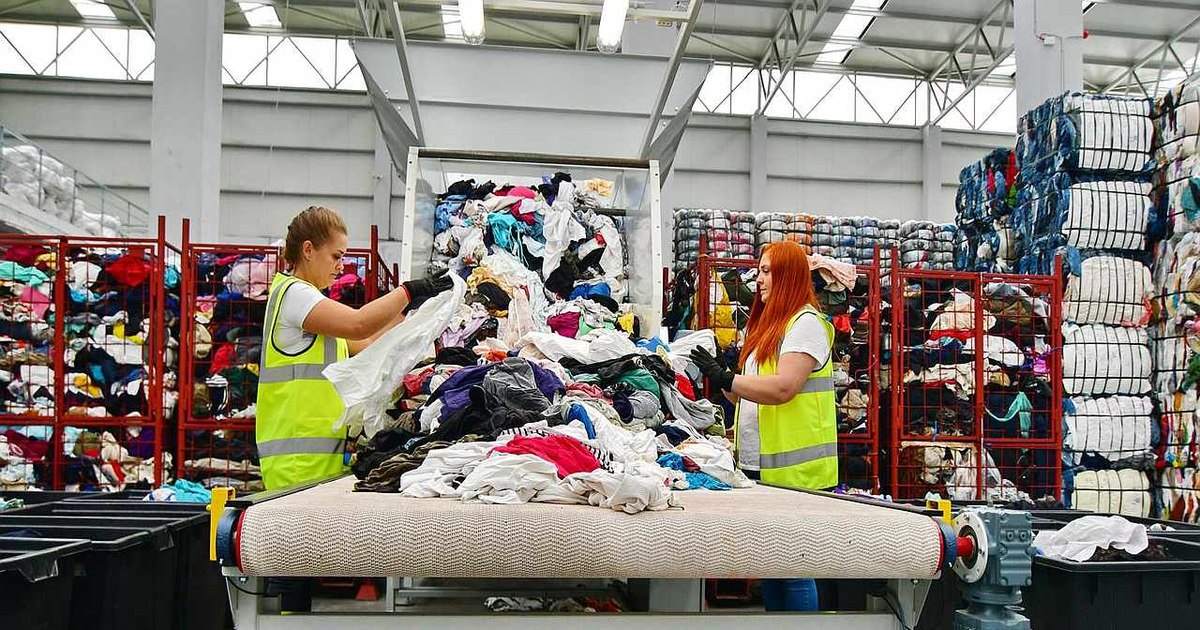
The life of these textiles can be saved! In the first phase, the processing companies of the textile waste will proceed to sort them, then everything that can be saved for reuse (by passing them through a disinfection, disinsection and cleaning procedure), will be able to arrive again for marketing or for donation, so that that coat is again wearing. In this way, the life of textile products is prolonged.
If they cannot be reused, they will be recycled, and if this is no longer possible due to the degree of damage, the textiles will be energy (ie they will be reused as raw materials to enter the composition of new materials) or reach the trash. According to GEO 92/2021, we can identify a hierarchy of textile wastewhich applies priority in this order:
1. Prevention of waste production,
2. Preparation for reuse
3. Preparing
4. Energy recovery (as is the energy)
5. And, if none of these steps can be traveled with a textile waste, their removal remains.
Of course, the energy recovery is the step that all the town halls and UATs prefer to the detriment of their elimination, but it is ideal to succeed in the first variants so that the waste can be reused or recycled, so surrounding the best and efficient environment.
The town halls are obliged to proceed with this selective collection of the textile waste because the final goal is that about 75% of these waste can be processed (recycled or reused) and 25% to reach the pit or energy used.
We are one step by one for many years in the field of textile recycling, before the law effectively imposes this, managing 94% of the textile waste taken from the existing collection points, to process them, and only the remaining 6% to use them energetically.
There are solutions for mayors, but also for citizens!
Currently the existing infrastructure for the town halls presents many gaps, because while some mayors in cities and municipalities have sanitation contracts that allow them selective collection, many of the big UATs and small cities or communes, the villages, I still do not know how to proceed.
We have a vast experience in the field of textiles and recycling, we come up with a smart solution, economics and targeted for society.
The company can provide a system of selective collection of textile waste, responding to needs in an efficient and responsible way through different forms of collaboration with public institutions.
This could be a solution for any institution, because the management of the waste collected separately, including the textile and clothing waste, will not be done only within a single contract of the sanitation service.
Their collection and processing separately offers the possibility of reintroducing recyclable waste into the economic circuit as a raw material, necessary for the production of goods or the preparation for reuse.
The advantages offered by textile waste processing companies?
– Ensuring an efficient and profitable management for the City Hall of the selective collection system of municipal waste
– Full realization of the recycling and preparation target for reuse of municipal waste and the annual reduction objective
– It will allow the City Hall to transform the challenges related to waste into project opportunities.
– will allow the maximization of the selective collection process and the attainment of the objective “zero municipal waste eliminated by storage” in the future
– Ensuring a selective collection, which will reduce the costs of the City Hall with the necessary spaces for the separate waste collection and equip them
– Ensuring a high accuracy report of the quantities of textile waste collected separately from the radius of the administrative-territorial unit
– Ensuring the selective collection according to the applicable laws in the field, through specially designed and metal -made containers and zinc plated, painted in electrostatic field to ensure the necessary conditions for textiles submitted.
Currently primeUmRiors really collect textile waste, but unfortunately they cannot take other steps to get processed according to real needs, because there are no suitable connections and collaborations for the cycle to go further and not be blocked. It is a real need for the intervention of the companies that take over to sort and process these waste to reduce the percentage of materials that reach the trash pit and increase the chance to play the life of the clothes that was once a valuable piece in someone’s wardrobe.
Why collaborate with our companyUm In this endeavor?
Over the years, our company has developed valuable relationships and partnerships both with public authorities (town halls)-as strategic partners in order to selectively collect waste and intercommunity development associations (ADIs)-the latter being specialized in waste management to integrate selective textiles into the local infrastructure
These partnerships led to the development of the trend in terms of textile waste, but also in the education of people on the needs of society from an economic point of view and that of environmental protection.
Our company continues to offer its contribution to the community to support the reuse and recycling of textile waste in a percentage as close to 100%, and for a successful partnership it requires an opening and communication. Details about the Recycling Textile Project can be found here
