
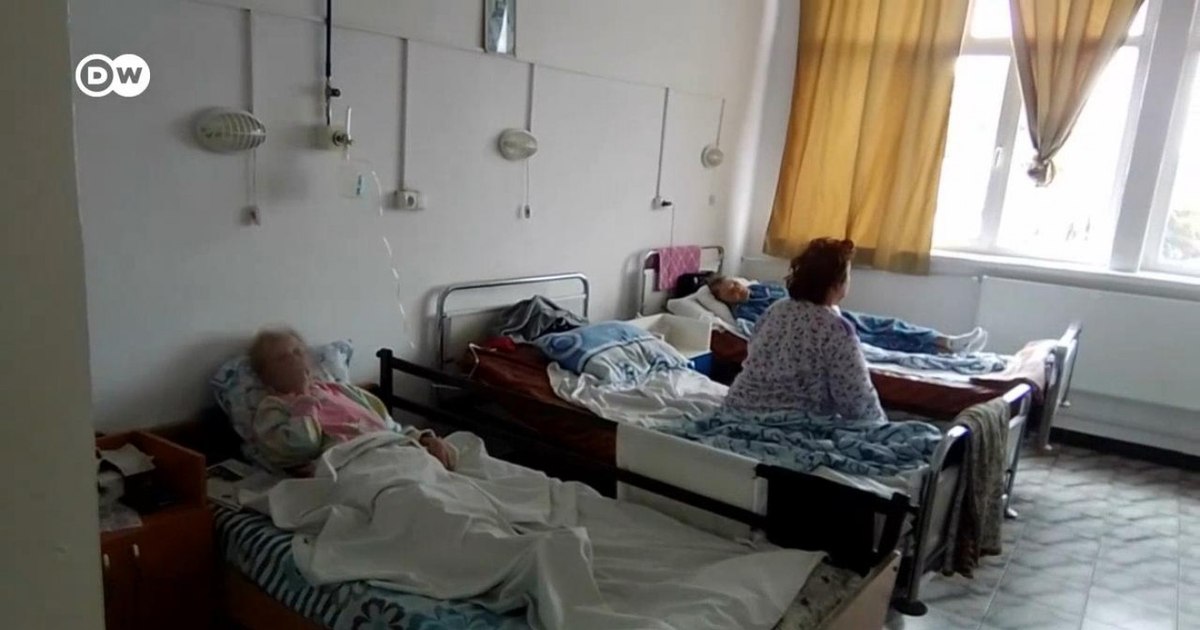
Compared to the European Union average, three times more patients die in Romania due to treatable diseases, and healthy life expectancy is among the lowest. With an average of 57.8 healthy years, we rank 22 out of 27 EU countries. Moreover, even though Romania has the most hospital beds in Europe, we are doing very poorly in terms of prevention. These are just some of the conclusions of the annual report “Health at a Glance: Europe 2024. State of Health in the EU Cycle”, recently published by the European Commission and the OECD.
Romania, the European champion in deaths from preventable and treatable causes. Archive
According to the same report, in Romania the health expenditure per capita remains the lowest among the EU countries. For example, two years ago, our country spent an average of 1,632 euros on health per capita, which is less than half of the European average of 3,533 euros per capita. Likewise, our country continues to allocate among the least money for health expenses in relation to GDP: 5.7%. Obviously, the underfunding of the health system is reflected in the health problems faced by Romanians. According to the report, Romania is very bad in the chapter of deaths from treatable causes, where we occupy the last place, but also in the chapter of deaths caused by preventable causes, where we rank penultimate in the EU,
The main causes of deaths from treatable causes, for which Romania ranks first in Europe, are ischemic heart diseases (21%), colorectal cancer (14%), breast cancer (10%), stroke (10%), pneumonia (8%), hypertension (5%) and diabetes (4%). Regarding deaths from preventable causes, in 2021 the number one cause was COVID-19 (24%), followed by lung cancer (16%), ischemic heart disease (10%), alcohol consumption (6%), stroke (5%), accidents (5%), COPD – chronic obstructive pulmonary disease (4%) and suicide (4%).
Romania vs European countries: thousands of light years separate us
There are data and information that no longer surprise anyone. It is no secret that the sanitary system in Romania has been collapsing for a long time. And from the clinical death into which he slipped, it seems that no one and nothing will wake him up. “This data will not change anytime soon. Maybe in 10, 20 years we would see something if and only if now, at this moment, some programs were implemented that would work”, commented for “Adevărul” Radu Gănescu, president of the Chronic Patients Association.
He made a comparison between the Romanian health system and how it is thought in Western countries. And the differences are huge. “When we talk about colon cancer, breast cancer, when we talk about cardiovascular diseases, the vast majority of European countries have screening programs implemented many years ago. In the Netherlands, for example, or Belgium there are more private health homes than public health homes. These private health homes offer service packages that also include screening for various conditions. If the beneficiaries of these service packages do not do the respective screenings, their risk increases and then, automatically, the costs also increase. There the whole point is to keep you healthy. And that’s why people have higher life expectancy, lower mortality from preventable diseases. Because the system there makes it possible for you not to become patient“, explains Radu Gănescu.
Patient: “Nobody asks us about our health”
In Romania, on the other hand, the situation is totally different. It was only a few years ago that the screening programs appeared, but they are limited-term, as the allocated money comes and goes. “In the last three years, hepatitis, tuberculosis, colon, breast, and cervical cancer were screened. And all these programs were carried out through European funds. Now prostate cancer screening and lung cancer screening will come in. There were screening programs that took place during the 2020-2023 funding period, which closed on December 31, 2023. I am referring to those with European funds. But as you can see, they have a period of implementation. The indefinite ones are those implemented by the Ministry of Health. But, at the moment, we only have two: cervical cancer and breast cancer”, Radu Gănescu also explained.
Radu Gănescu stated that Romanians go to the doctor many times when it is too late or when the disease has advanced so much that a complex treatment is needed. The reason? Lack of education and information. “First of all, the population must be informed and educated, to know that they have the opportunity to perform free screening. Someone needs to tell them that. Then someone has to actually call them to the doctor for preventive purposes. But no one asks us about our health. If I go look for myself, fine. If not, no one calls me.”
Another reason why we are at the bottom of Europe in terms of health is the fact that rural Romania does not have access to sometimes basic medical services. We lack family doctors from the villages, but also doctors from the outpatient clinic. Then, on the one hand, the population is aging, on the other hand, we also have many chronically ill people with low life expectancy. “Because no one diagnosed him in time, because they did not follow programs to prevent these diseases. Now, in order for us to have had some better figures, prevention and screening programs should have been implemented since 2005 – 2010. Because the evolution is observed over time, in 10, 15 years. As an idea: In 2008, when we first implemented HPV vaccination, it was also implemented in Australia. It was a resounding failure for us. Not with them. And now Australia has no cervical cancer at all.” Radu Gănescu also pointed out that Romanians must change their mentality and go to the doctor not only when they can no longer, but before the disease has set in.
“You can’t do prevention with 100 lei and stop when the money runs out”
On the other hand, the money available to the health system should be distributed differently, more rationally. “If we only treat with the money we have, then it won’t be enough for prevention. It would be effective if we invested in prevention, the person would no longer get sick, would not remain disabled, would continue to go to work, would pay taxes and duties to the state. And the state would no longer offer him a disability pension, would no longer pay his medical leave. And everyone would only win.”
The President of the Association of Chronic Patients believes that we are in a vicious circle, and the rescue would come through a well-designed strategy that will run indefinitely, regardless of how often ministers or Governments change. “Let’s think of a policy, implement it and continue it for the long term. And the funding should be long-term, not interrupted. You can’t do prevention programs and say I only have 100 lei. And to stop it when you run out of money”.
There needs to be continuity and predictability in health policies to really work. “During the pandemic, for example, when we needed peace and stability more than ever, we changed I don’t know how many ministers!”, the patient also scored.
