
Although astrophysics are not part of the school syllabus, for many years, students and high school students excel in this field, obtaining prestigious results at international Olympics.
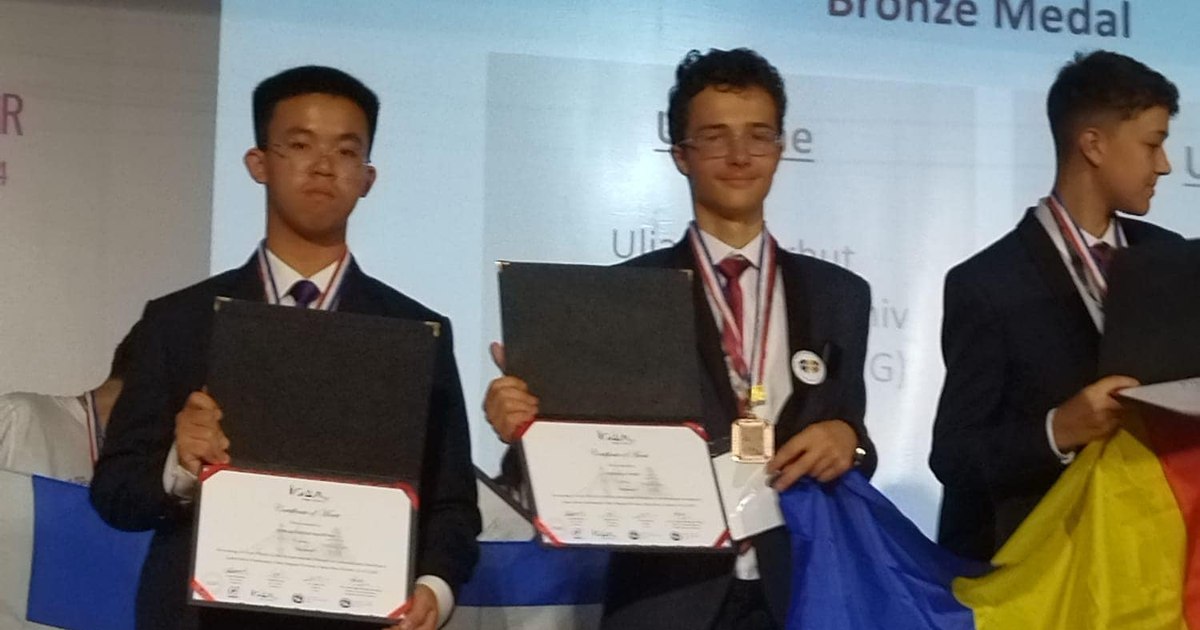
Matei Butnaru (in the center) at the International Olympiad in Katmandu PHOTO School Number 7 Botosani
Botosani County is known as a real place of geniuses, especially since in this area at the end of Romania, over 200 brand personalities were born in all fields, among them great scientists-it is enough to remind Dimitrie Pompeiu, Octav Onicescu, Dimitrie Negreanu, Mihai Ciucă and Elie Radu. This effervescence of scientific genius was consumed in a period of about a century, that is, from around 1850 until 1945. After 1990, the tradition of these enlightened minds that opened new horizons in science and in Romanian and world education is continued by a plethora of students with remarkable results in national competitions and especially international competitions.
Children manage to impress at the international science and, more recently, an area that is not even found in the school syllabus. Students and teachers work with an incredible passion, not so much to achieve results, but especially for the sake of finding out and pushing the limits of science. “It is not about medals or competitions, but about the pleasure of discovering, always learning new things, explaining phenomena. I think it is what guides us ”says for “Weekend Adevărul” Matei Butnaru, one of the international Olympians in Astrophysics in Botosani.
Performance in the science of the future
As the specialists say, astrophysics is that branch of astronomy that research through certain physical methods the structure and movement of the stars, but especially is a science loved by the general public due to the themes that seem detached from the SF novels, but as real as possible, such as the origin and fate of the universe, the possibility of traveling in time, if the study of the holes, if the study of the holes, the study of the holes. In addition, astrophysics is considered an extremely complex science precisely because it combines several conventional sciences, such as physics, mathematics, astronomy and chemistry. In short, the one who wants to perform in this field must be a multipurpose in the field of science, and at a rather high level. “It is a mixture of mathematics, physics and chemistry. That is, you have to master all these subjects because you need them in many applications, calculations. Why is astronomy and astrophysics say? Because astronomy is generally the movement of heavenly bodies and their presence. And astrophysics represent the laws of physics that are used in the study of astronomical objects and bodies, so to speak. You need an important knowledge baggage for this ”says Alin Lungu, a doctor in physics at the “Mihai Eminescu” National College in Botosani.
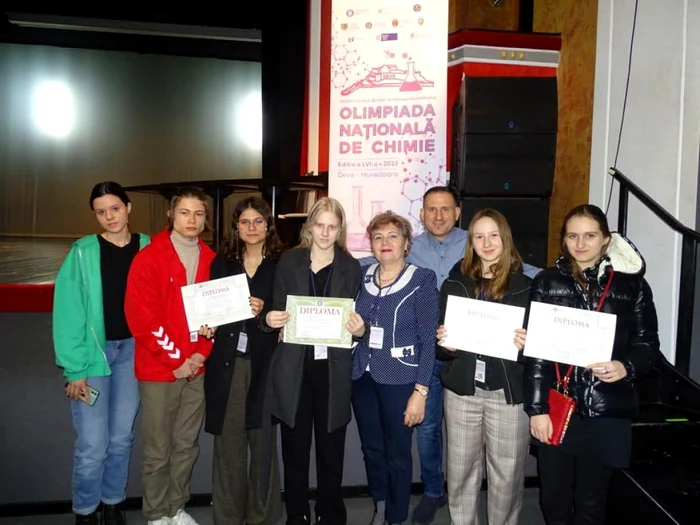
Teodora Gavrileț (the one with glasses) at the National Photo Chemistry Olympiad ISJ Botosani
In this science of the future he excels, about four to five years, more and more students from Botosani County, with an “epicenter” at the “Mihai Eminescu” National College, one of the most important elite schools in Moldova. Dozens of students dedicate themselves to the intensive study of physics, chemistry, mathematics and astronomy, eventually reaching this top formula in the world of science, astrophysics. Many of them begin the study of sciences from an early age, and at the astrophysics usually reach the general school when they become “disciples”.
All students involved in astrophysics performance are already Olympic in other scientific disciplines. The special value, which increases from year to year, in the nursery of astrophysicians from Botosani could be observed on the occasion of the National Camp of Physics, Astronomy and Astrophysics “Marin Dacian Bica”, organized earlier this year, in Suceava, through a collaboration with the Ministry of Education and the “Cygnus”. At this event were present three Botosani students with incredible results at national and international level, true spearheads of Romania, at the level of juniors, in the field of astrophysics. “Important results appear in recent years every time with participants in the national Olympiad and culminating with the International Olympics”says Professor Alin Lungu, one of those who deal with the performance in astrophysics, in Botosani.
On the way of sciences, from kindergarten
One of these students is Matei Butnaru, who became an international Olympic at astrophysics at only 15 years old. Matei is a student in the 9th grade at the National College “Mihai Eminescu” and managed to obtain, last year, the bronze medal and the third place at the International Astronomy and Astrophysics Olympiad in Kathmandu, Nepal. Matei says he is passionate about kindergarten sciences-more precisely, he fell in love with mathematics from the age of 5 and then continued with the other sciences that helped him perform astrophysics. “I was passionate about science. I liked to know different information about the surrounding world, to explain certain phenomena. I was passionate about 5 years old. Then I continued with sciences discovering physics and chemistry, first at school, as study subjects, then individually, finding information or realizing the projects that were interested. Astrophysics combines them and I think this is, for the moment, my road “says the high school student for “Weekend Adevărul”. Matthew is also Olympic in mathematics, but also in physics, obtaining numerous medals at national level, during the gymnasium. Also, two years ago, at the National Scientific Creativity Olympiad, in the category of applied sciences, the student obtained the bronze medal with the work “Seismograph”. Matthew was only 13 years old.
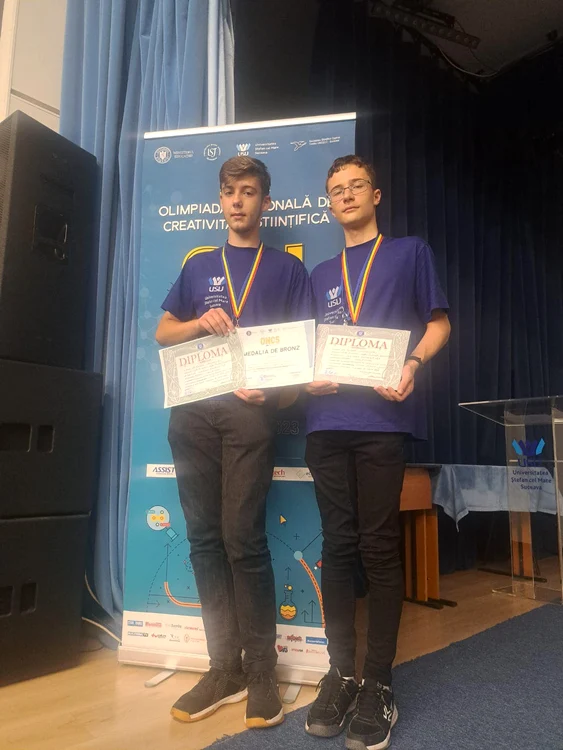
Matei Butnaru at the National Scientific Creativity Olympiad PHOTO School Number 7 Botosani
Also from Botosani is Teodora Gavrileț, a 12th grade student, who owns the silver and mention medal from the Ministry of National Education to the Senior 2 category. Theodora began by this area because she was always passionate about science, but she did not know what branch to focus. It is also a national Olympic in chemistry, having a special mention. “I have always been passionate about the exact sciences. But I always had a problem in deciding what branch I should choose, what to focus on. Astrophysics came as an answer, because it combines many of them and is the perfect choice for me ”says the high school student who is preparing for the baccalaureate exam. Also from the “scientific crucible” from Botosani in the field of astrophysics, Gabriel Popescu, another 9th grade student, distinguished by the Ministry of National Education with the mention, in the senior category 1.
Curiosity works wonders
The exceptional results obtained in astrophysics, in a northern corner of Romania, are the fruit of the students’ passion and work together with their teachers, although this discipline is not included in the school syllabus. It is, however, an area that satisfies the thirst for knowledge of some curious and very intellectually equipped students. “Astrophysics are not in the common trunk of the school program, but it is very important because students develop their thinking and gives them an important knowledge bag. We hope to become a study discipline at school. Students and teachers make astrophysical passion here in Botosani. Our time, as teachers, is very limited to work with them – because we teach in different disciplines, I in physics, I have colleagues in mathematics – and the results and all this effervescence around astrophysics in Botosani are due only to students. They are passionate about science and are eager to go to the Olympics, especially to discover new challenges. For them it is a very attractive field ”confesses Professor Alin Lungu, who, together with other teachers, including Aurelian Pintilei, coordinates the Olympians from Botosani.
Cristina Bălăucă, physics teacher, deputy school inspector at ISJ Botosani, as well as the mother of one of our Olympians in the field of the last decade, Stefan Bălăucă, speaks about the passion for science.
“Science is all that surrounds us, and we transmit to children that it is good that we know as much as possible about everything life is. Often, they look for answers and discover them with teachers. It is a common effort, but everything starts from the passion for this field, from the child’s curiosity. No one forces them, no one pushes them from behind. They are actually passionate about what they do. My son was eager to know as a child. He was always asking questions, looking for explanations. And we were trying to satisfy this thirst for knowledge. And in the case of all the children who perform the same story: they are curious, they are eager to know, and here are dedicated teachers who satisfy this need and help them perform “says Cristina Bălăucă for “Weekend Adevărul”.
The tradition of performance
The Astrophysician nursery from Botosani is only a continuation of the scientific phenomenon in the elite high schools of Botosani, the North-Moldavian county being for at least ten years a true nest of special performances in the world of science. One of them is Stefan Bălăucă, now 25 years old, a graduate of two faculties and postgraduate studies. Former student of the National College “Mihai Eminescu”, the young man went to the Olympics and school competitions since the fourth grade, and in the high school years he obtained no less than six medals at the International Science Olympics, plus others in Olympics in Mathematics, Linguistics and Physics. These include a gold medal at the International Earth Sciences Olympiad in France, a gold medal at the International Physics Olympiad, as well as a bronze at the International Linguistics Olympiad in Ireland.
Also from Botosani and also at the National College “Mihai Eminescu”, Daniel Malanca, another Olympic with special results in the field of science, also learned. The most important result obtained in 2023, the gold medal at the International Earth Sciences Olympiad. At the same time, in 2022, Casian Niculăeasa, another student of the same Botosani college, obtained the bronze medal at the International Junior Sciences in Colombia.
