

In the middle of the year, the dental field in Romania is increasingly feeling the pressure of socio-economic instability. The more expensive life of life and the uncertainty generated by the increase of taxes determines Romanians to give up or postpone the complex interventions, a specialized analysis shows.
The oral health of the Romanians, increasingly shabby due to the increase of living. Photo Istock
According to the analysis, Romania has only 35 public dental offices for a total of over 17,000. In a context in which the costs of life, but also of the treatments grow, fewer Romanians allow their basic oral care. Future dentists support the need for equity, but the system remains inaccessible to many. The only viable long -term solution is the sustained prevention.
“The dental health of the Romanians will be increasingly shabby if they do not have constant care through prevention treatments, in the context in which the cost of life is increasingly expensive and many people cannot afford to restore their tooth. Patients postpone interventions that they do not perceive as emergencies and reach the dentist only when the pain has this pain. waiting behavior, dictated by the daily economic realities ”, explained the dentist Narcisa Calotă, founder of CEC Dental Clinic, specifying that he began to increase the number of visits for prevention, some Romanians realizing that it is cheaper to prevent than reconstructing the tooth..
Romanians lose their teeth from 40 due to precarious hygiene
Teeth washing is essential, but it is not enough to prevent damage to the tooth, gingivitis, periodontal diseases and other oral health problems. In the absence of visits to the dentist for prevention, Romanians lose their teeth much earlier than the European average, mainly due to poor oral hygiene and lack of health education. Studies show that most Romanian adults begin to lose teeth around the age of 40, and a significant percentage reach partial or total edentation before retirement.
This early oral degradation attracts major risks to general health: untreated infections can affect the heart, lungs and digestive tract, and defective chewing can lead to nutritional eating and nutritional imbalances. In addition, the loss of teeth affects self -esteem, speech and quality of social and professional life.
How much does the annual prevention versus the tooth reconstruction by dental implants
Even if the dentistry is not considered essential in times of crisis, prevention seems to gradually become an anchor of balance.
Complex procedures for a premium dental implant costs around 2,000 euros, and the rehabilitation of maxillary through the latest treatments can reach 30,000 euros. By comparison, prevention treatments through regular visits to the dentist 2-3 times a year, evaluation of the general state of teeth and gums and procedures such as descaling, professional brushing, airflow, professional fluoridation, can cost between 100 and 300 euros per year.
Specifically, a dental implant can be up to 10 times more expensive than an annual prevention treatment, and dental reconstruction can be up to 150 times more expensive than annual prevention.
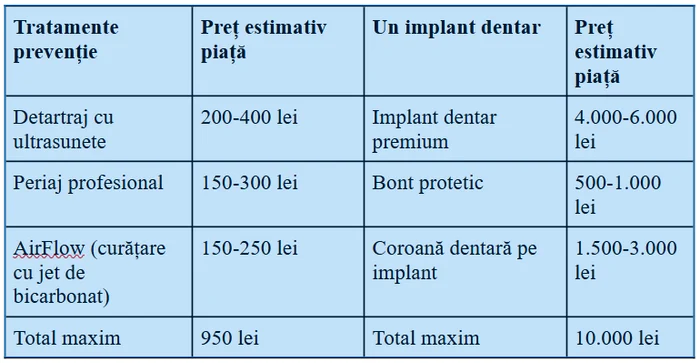
As we can see, prevention is much more accessible than a dental implant and is the only way accessible to the population at this time. It costs less, lasts less and greatly reduces the risk of serious oral health problems. And this should be an alarm signal. Romanians should no longer have to make rates for teeth, but to invest in time in regular checks and hygiene. It is much simpler, healthier and more long -term. In addition, tooth loss not only affects aesthetics or chewing – it can also lead to digestive disorders, postural imbalances and even cardiovascular disease, if oral infections are chronic.
Modern technology becomes indispensable in 2025
Technological advances require a continuous adaptation for dental offices. Integration of modern equipment, such as digital scanners, 3D prints, transparency traceability systems or software for clinic management, is an essential competitive advantage.
Therefore, the market for dentistry services in 2025 will be characterized by dynamism, economic challenges and increasing requirements from patients. Cabinets that will emphasize quality, prevention and technology will have the chance to prosper in a market in a fierce competition.
Who can benefit from free
Anyone has the right to dental treatments settled by the state, but with some important conditions. First of all, not all cabinets work with the Insurance House, and those that do it have a limited monthly budget. This means that if the ceiling allocated is already consumed, the treatments can no longer be offered for free in that month.
According to the specialists consulted by “Adevărul”, the best supported are the children between 0 and 18 years, who are entitled to two free consultations per year and most treatments at no cost. Young people between 18 and 26 years old can also benefit from total free, if there are students, students or doctoral students and have no work. Insured adults are entitled to a free consultation a year and partially settled treatments – such as plumbs, channel treatments or extractions. The remaining difference is paid out of pocket. For uninsured people, the only free interventions are emergency – when pain or infection occurs.
“It is good to know that each cabinet has the freedom to decide whether or not they conclude a contract with CNAS. Therefore, it is important for patients to be informed before programming, especially if they want to benefit from settled services. And the best decision remains the prevention: A year control is free and can avoid complicated and expensive treatments later“Calotă explained.
