
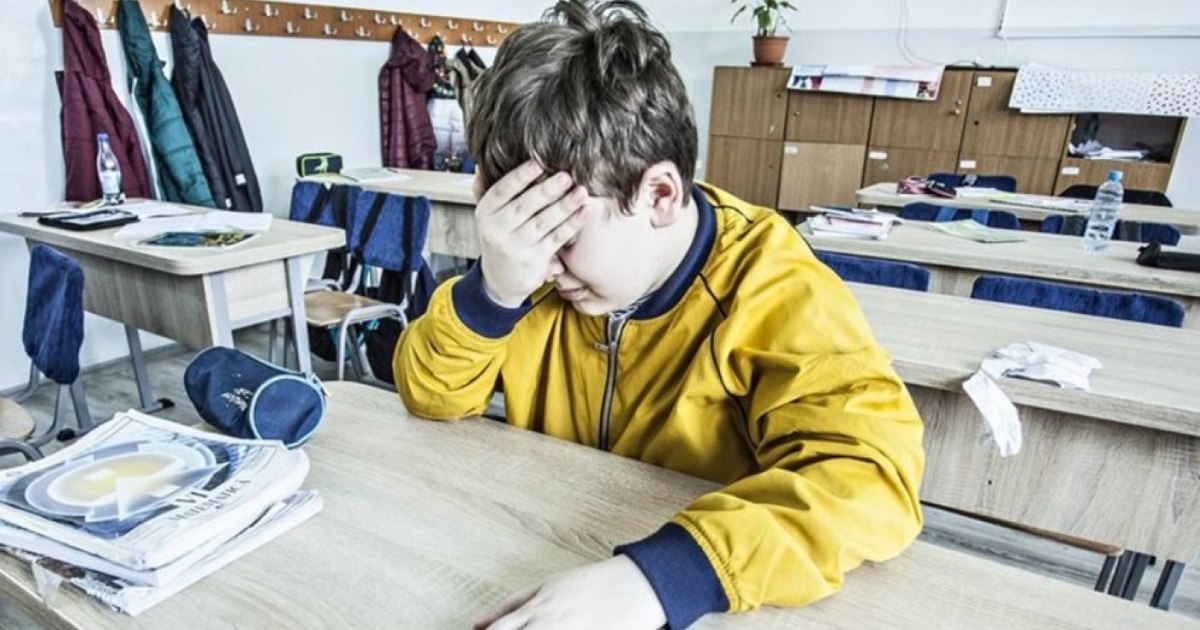
Although more than three weeks have passed since the start of the new school year, there are many students who are hardly convinced to return to the banks. But there are also much more serious situations, when children refuse to go to class. The reason? Maybe the fear of the unknown, the fear of failure, maybe the difficulty of “breaking away” from parents. Whatever it is, such behavior should give adults food for thought. Because in these situations we are not talking about a fad of the little ones but about a real school phobia.
School phobia is not a child’s fad, but a child’s suffering. Photo source: archive
What are the signs that a child has school phobia and what should parents do? The situation is very delicate, because adults, out of the desire to help the child overcome this moment, could do worse. “Many parents and educators have understood this fear, especially for children who are starting kindergarten for the first time or at the beginning of each school year at a young age,” states the psychologist Mihai Copăceanu. “But forcing them to go to school under any circumstances only makes things worse.” continues the specialist.
How to recognize school phobia
School phobia, he explains, is a term used when a child systematically refuses to go to school. “These kids absolutely refuse to attend classes and are always making up reasons why they shouldn’t go. They complain of feeling unwell, cite vague, unexplained symptoms over which they have no conscious control, and find it difficult to say what is causing this discomfort. There are children who cannot speak in public, they feel anxious in their school, in their class, in an environment with many people around. There are those children who felt very good in the online school when they did not have to speak in front of the class, when they participated in the lessons with the video camera closed”, says the psychologist.
At the same time, there are children for whom the school environment becomes hostile due to daily harassment by colleagues or teachers, in various forms.
“There are students who are afraid of a new day at school, students who feel this fear because they are threatened daily by some teachers or peers, or even worse, students who have suffered bullying at school, and some physical violence. The school regulations provide for the students’ obligations regarding their school conduct, but there are no specifications regarding the importance of mental health and the specific measures in the case of these students, the possibility that a student who suffers from school phobia and is absent from school, their absences are motivated”.
And although there are effective recommendations by which these children can be helped to overcome school phobia, often both parents and educators categorize anxiety states as a child’s fad, a treat, something demonstrative. They judge the student’s episode or episodes of rebellion on a “let it go” basis.
Therefore, parents adopt strategies by which they force the child to stay at school in any conditions, sending messages lacking empathy that do nothing but accentuate the child’s stress, the psychologist also emphasizes. “Unfortunately, in this way, parents and educators only intensify the school phobia, despite a suffering expressed at the same time as fear, anguish and the feeling of abandonment”.
Tips for parents. What words to never say to our children
The psychologist has some advice for parents whose children refuse to go to school. First of all, parents should take their children at their word when they say and express what they feel, they should take these fears and anxieties seriously. Not to reject and cancel them. “To think maturely and act responsibly to identify the explanations for school phobia. Parents are responsible for knowing the school context and what psychological valences their child’s school activity has, how he emotionally perceives every day at school.”explains the specialist. This means talking openly with our children, asking them how they feel, why they feel that way, what needs they have, what problems they face. And let’s try to help them, not corner them and point the finger at them. You are lazy, you are naughty, you lie..these are just some of the words that no parent should ever say in front of their child. What adults need to realize is that such behavior hides behind it a terrible suffering, with which the child struggles every day.
The psychologist advises parents to collaborate with the school to identify the best solutions, but not from the position of an enemy of the school, an accuser, but a partner. “Last but not least, adults should maintain an even stronger emotional relationship during this time when the child needs a protective and understanding parent,” says Mihai Copăceanu.
Psychologist: “Teachers should show patience, wisdom and empathy”
The situation of these children who have transformed the school in their minds into a dragon with seven heads must be looked at, analyzed with great attention and sensitivity by the teachers. First of all, teachers must first understand the phobia and recognize it. “They should read about school phobia and ask themselves if there might be a child with these characteristics in any of the classes they teach.” the psychologist believes. Once you know the problem, once you identify it, you can come up with a plan to solve it.
Teachers should see beyond the child’s statements, pay attention to his non-verbal language, to the trembling of his voice when he answers, to the fear of answering, to the embarrassment and refusal to speak in public. The teacher should also avoid making fun of the student in any way. “Not to encourage with completely inappropriate statements when a student expresses his psycho-emotional sensitivity.”
Psychologist Mihai Copăceanu appeals to the teacher’s patience and wisdom, but also to his empathy. “To be patient and wise with the student, to create classroom management based on empathy and peer support, to instruct other students on how to deal with a student who suffers from school phobia, and to create contexts that are conducive not only to learning , as for a collaboration through compassion”.
