
To treat diseases such as dementia, Parkinson’s or Alzheimer’s, for which medical science has no cure, a team of researchers studied and mapped the brain of a fly. They made incredible discoveries.
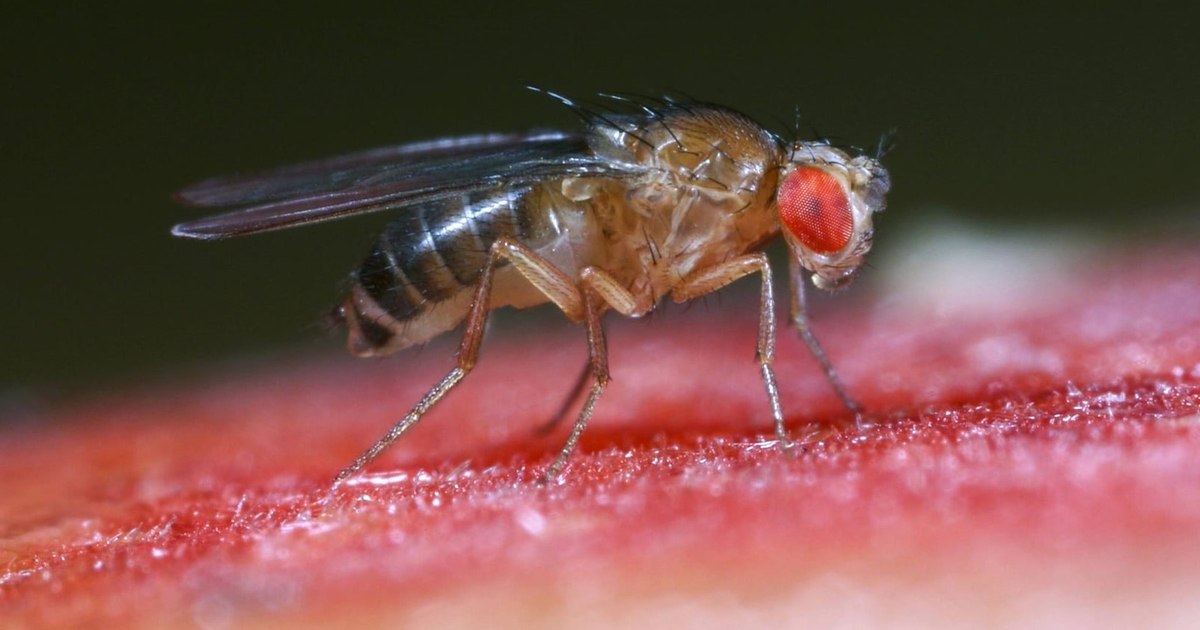
Fruit fly Photo: BioChemTech
The human brain, with its billions of neurons connected by a hundred trillion synapses, is very complex. That’s why ‘FlyWire’, a team of scientists and science enthusiasts led by Princeton University (USA), has now taken an important step towards understanding the human brain by building a roadmap, neuron by neuron and synapse by synapse, through the brain of an adult fruit fly (Drosophila melanogaster).
The FlyWire Consortium includes members from more than 146 laboratories at 122 institutions, with major contributions from teams at the University of Cambridge and the University of Vermont.
“Any brain we really understand tells us something about all brains,” said Sebastian Seung, professor of neuroscience and professor of computer science at Princeton. “With the fly wiring diagram, we have the potential for unprecedented, detailed and deep understanding“, he added.
Thus, the brain of an adult fruit fly has, according to researchers, 140 thousand neurons and over 50 million synapses, that is, the connections between nerve cells.
It is the most detailed analysis of the brain of an adult animal ever made. “This is a major achievement,” said Mala Murthy, director of the Princeton Neuroscience Institute and, along with Seung, a leader of the research team.
The results of their work are presented in a special issue of the journal “Nature” on transformational research in the brain of a fruit fly, according to Princeton University.
“How the brain works depends critically on which neurons connect to which other neurons and the strength of their connectionsMurthy said.
Brain map of a fly
Sven Dorkenwald, lead author of the landmark paper in the journal Nature, led the FlyWire team that mapped the fly’s brain. “What we have built is in many ways an atlasDorkenwald said.
“Just like you wouldn’t want to drive somewhere new without Google Maps, you don’t want to explore your brain without a map. What we did was build a brain atlas and add annotations for all the businesses, buildings and street names. With this, researchers are now equipped to carefully navigate the brain as we try to understand it.“, explained the researcher.
The map was built from 21 million images taken from a fly’s brain by a team of scientists. Using an artificial intelligence model built in Seung’s lab, the images were transformed into a three-dimensional map made by the FlyWire consortium.
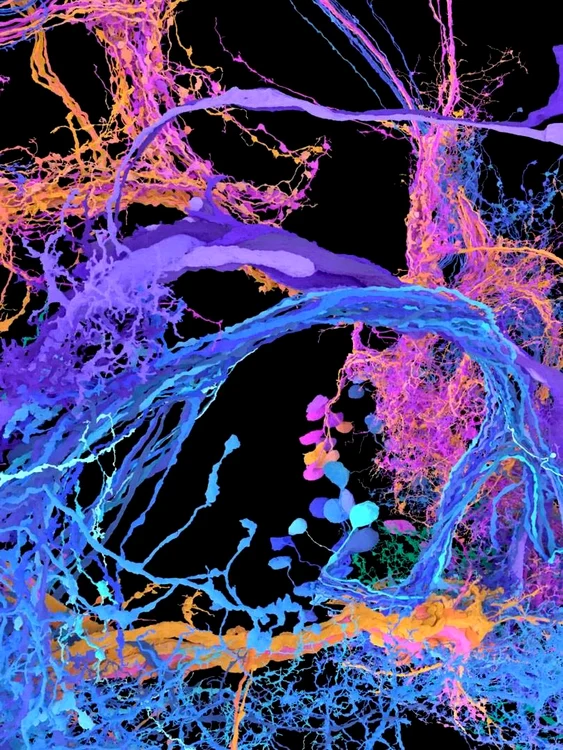
Brain cells in the auditory circuits of a fruit fly Photo: Princeton
The result was a map of each of the fruit fly’s 139,255 neurons and their 50 million synaptic connections. Most neurons look a bit like a tree, with a trunk, branches, roots and twigs. Just as a tree affects its neighbors, its roots connecting with surrounding organisms and its branches fighting for sunlight, neurons connect to each other through synapses. But an entire brain is even more connected than a forest, because neurons can touch each other over relatively large distances.
A fly’s brain is smaller than a poppy seed
“It might surprise people that flies have brains, but they doSebastian Seung said. “And their brains have neurons. Although their neurons don’t look exactly like ours, they more or less look like trees. It’s amazing. Our last common ancestor would have been half a billion years ago, and yet fruit flies have recognizable neurons and the same neurotransmitters we have: glutamate, acetylcholine, dopamine.“, he added.
Most of us don’t think about fruit flies until they’re buzzing around us. With an entire body that’s practically a blob, their brain is almost incomprehensible – about 750 microns long, 350 microns high and 250 microns deep. It’s significantly smaller than a poppy seed, researchers say.
Male fruit flies perform love songs to woo their mates
This tiny insect has many behaviors that our larger, more complex bodies share. They can be complicated actions, such as communicating with romantic partners, to the simplest, such as moving quickly, navigating, searching for food, avoiding predators, responding to light and dark.
“Fruit flies are a wonderful model organism because they are quite small, but at the same time have very complex behaviors“, Dorkenwald also said.
Males may even perform love songs to woo their mates.
“As humans, we can relate to the way male fruit flies sing to females, the way they court and follow them, and the competition between themDorkenwald added.
The behavior and physiology of these insects have been studied extensively for more than a century.
Why we should care about fruit flies
Princeton University researchers have provided more details about the lives of fruit flies and their connection to humans.
Fruit fly brains solve many of the same problems we have. For example: how to navigate from point A to B, detecting smells in nature and determining how objects move in their environment.
Fruit flies share 60% of human DNA, including genes for learning, Down syndrome and jet lag, also known as jet lag.
Also, three out of four human genetic diseases have a parallel in fruit flies.
Fruit fly research is responsible for six Nobel Prizes, including one won by Princetonm’s Eric Wieschaus in 1995, who discovered genes that control embryonic development in fruit flies and later proved important in cancer research.
These insects age like humans, they can get drunk, coffee has the same effect on them, and they can sing to win over mates.
NASA sent fruit flies into space in 1947 – and they came back alive, paving the way for all astronauts.
