
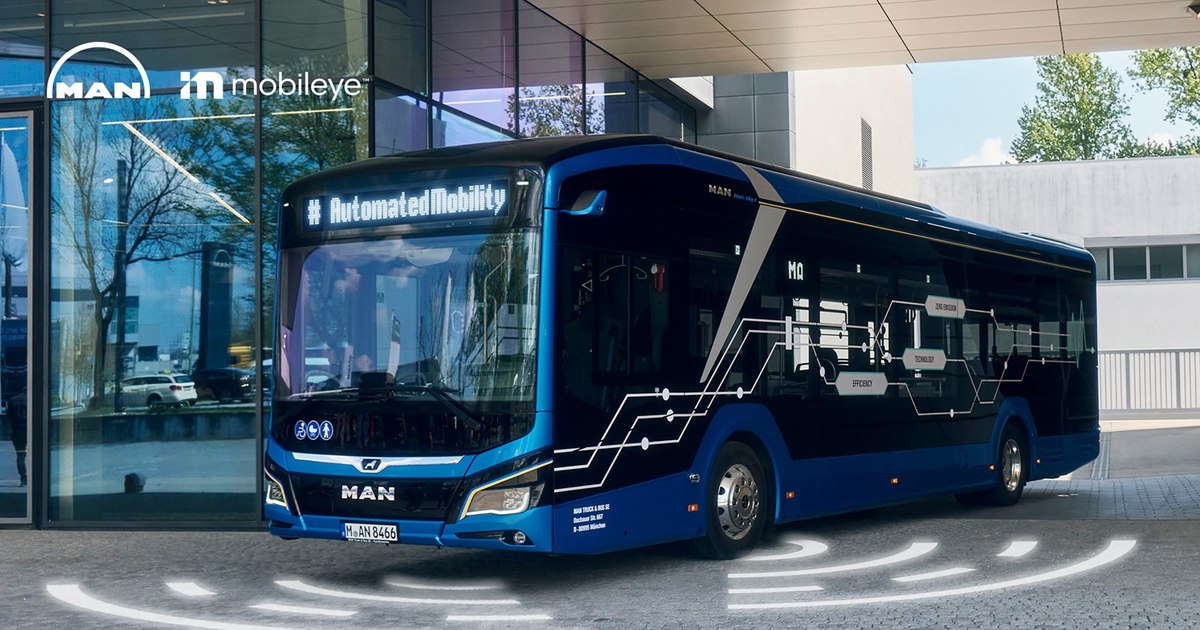
A city in Romania is preparing a pilot project that it would implement in the coming years – the purchase of autonomous, driverless buses that will circulate on the streets in the central area. However, there is a serious obstacle, the Highway Code, which should be adapted.
The driverless bus produced by the Germans at MAN. PHOTO: Sustainable Bus
Cluj will be the first city in Romania to buy autonomous, driverless buses that will circulate in the central area of the city. Previously, Cluj was the first city in Romania to purchase electric buses, as early as 2018. The plans of Cluj-Napoca City Hall and Cluj Public Transport Company are big. In addition to trams, trolleybuses and electric and diesel buses, 40 hydrogen buses would appear on the city’s streets, at least in a first phase. They should enter the fleet of the Cluj Public Transport Company by 2026, if the tender does not encounter problems.
“It’s a clear signal that the city maintains a green, non-polluting direction, but also with an artificial intelligence component, which in Cluj has the ingredients for success thanks to the class of innovation talents we have. It is a favorable climate for innovation, IT, artificial intelligence. This is where the high paying jobs of the future will come from“, said the mayor Emil Boc.
Cluj also included in the budget for 2024 the amount needed for the first autonomous buses, 33.5 million lei. However, the money could not be used for a simple reason: at the moment, the legislation does not allow the circulation of driverless buses in Romania. However, the Highway Code can be modified to keep up with European legislation. Until then, Cluj-Napoca City Hall signed a contract with the Technical University of Cluj-Napoca (UTCN) for consulting services. The university provides consultancy in the development of specifications, selection criteria and evaluation factors for the procurement of autonomous electric buses.
In fact, such buses have been running in Europe for several years. Paris, Lyon and Vienna have implemented these buses in public transport, and other European countries are tempted to do the same. On other continents, autonomous buses and other driverless vehicles have become increasingly popular. The best examples of this are the United States of America, Canada, South Korea, China and Singapore.
Driverless buses, increasingly popular in Europe as well
However, some European countries are also coming behind. If France and Austria have already implemented the autonomous bus system with some success, Scotland is at the beginning, and countries like Germany, Norway and Turkey have started such projects. The most ambitious European project is the one in Hamburg, but the capital Berlin is also coming strong.
Some of the most important bus manufacturers in Europe, Volvo, MAN, Scania and Iveco have such projects. According to Sustainable Bus, Volvo Buses presented its first autonomous bus concept in Singapore back in March 2019. The Germans from MAN started the “BeIntelli” project in Berlin this year. Developed together with the Technical University of Berlin and IAV GmbH, the program introduced intelligent traffic systems with autonomous vehicles in the city center. Also on the list is the Turks from Karsan, who have already delivered driverless buses for Norway.
