
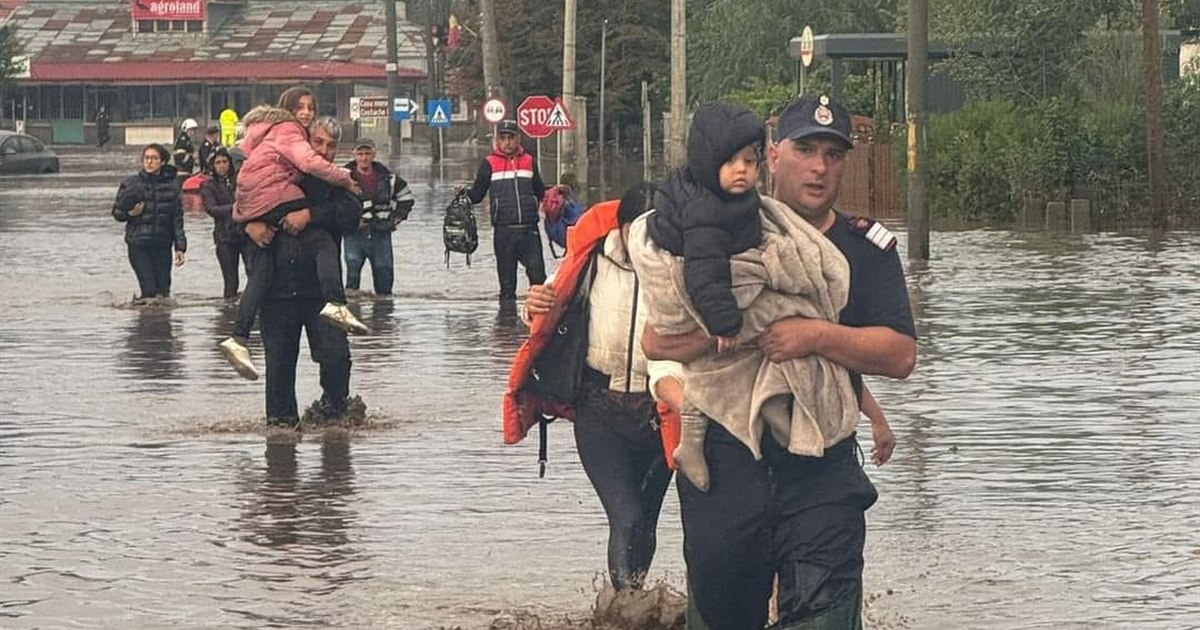
Marius-Lucian Botoș, teaching staff at the Technical University of Cluj-Napoca, analyzed the solutions for reducing the effects of floods in Romania. The authorities were stuck during the period when the solution was only represented by the dam and the dykes, without the hydrographic works being maintained.
Floods in Slobozia Conachii, Galati county. PHOTO: ISU Galati
Torrential rains that have fallen since Saturday on central and eastern Europe portend floods that could reach “unprecedented scale”, warned scientists specializing in hydrology and climate.
The counties of Galați, Vaslui, Iași and Timiș are the most affected by the floods caused by Cyclone Boris in Romania. The death toll has reached seven.
Marius-Lucian Botoș, teaching staff at the Technical University of Cluj-Napoca, specializing in “Hydrotechnical planning and construction”, spoke to “Adevărul” about possible solutions to reduce the effects of floods.
“Recent hydrological events bring back to the fore a problem that has been neglected in recent years. Their overlap with this year’s electoral company can put in a hopefully fair light this ongoing risk in which riparian communities must survive“, the teaching staff claimed.
Hydrological cycles (about 7 years) repeat themselves, as they always have, but lately in a non-stationary manner. “Dry years are drier and warmer, and precipitation occurs in a completely uneven manner (heavy and concentrated rains). Like it or not, climate change is here and we have to adapt”specified the specialist.
He explained why this autumn’s floods are “totally and totally special”: “The precipitation fell on a completely dry ground, the vegetation was dry. There was zero infiltration, all the runoff occurred on the surface and ended up with plant debris and excess sediment in the streambed, which obviously didn’t cope.”
“The events of last week were the result of a combination of unfavorable conditions. We have no way of avoiding them and they could not be avoided, but the magnitude of the effects could be lessened by manual preventive measures”said the specialist.
The dam and levees, the solution to all problems?
“Usually, the floods for which we are prepared (with landscaping and regularization works) are those in May and June, when the precipitation comes on a saturated soil (following the melting of the snow), the vegetation is developed enough to interact with the currents of water, relatively low flows mean that we have relatively high levelsi”, says the teaching staff.
He claims that the responsible administration in the field (National Romanian Water Administration) remains “stuck in the ‘glorious’ past where the solution to everything is the DAM and DIKES”.
During this time, the teacher points out some important problems: “Bridge crossings are often undersized or neglected, minor riverbed maintenance, vegetation control and illegal riverbed constructions are overlooked. The truth is that we like to have works and investments in big infrastructure and according to “God have mercy”. Zero maintenance. Investments must have immediate visibility and impact. The “pamblica” must be cut.”
Solutions for mitigating the effects of floods
Marius-Lucian Botoș also spoke about solving the problems caused by floods. “Most of the time, the solution is achieved by applying non-structural measures: maintenance and operation (if we have functional flood mitigation works). Maintenance of minor riverbeds, maintenance of hydrographic basins, release of the minor riverbed from temporary or permanent works, control of vegetation in the riverbed, control of forestry operations in the basin based on the hydrological impact, etc.”, it specifies.
He emphasizes that the exploitation of flood mitigation works must be done according to exploitation regulations updated to the new hydrological and ground realities.
“Bridges and footbridges must be treated with the utmost seriousness because they are critical bridges in the formation of flood water levels both upstream and downstream”explains the specialist.
Botoș talks about the very important concern, lately, about the impact of works on the environment: “The Ministry of the Environment manages the hydrotechnical field. I agree with this leaning. As long as this “leaning” is not taken to excess. Just as I don’t agree with excessive hydrotechnical works: canalized, concreted watercourses or you’d be surprised what improvised solutions.”
“The hydrotechnical field seems to be in clinical death”
The professor claims that in many parts of the country, daily activity is not disturbed by rain or drought due to hydrotechnical works to regulate flows (see Cluj, Timișoara, Bucharest): “The vast majority only find out they exist when they don’t work properly. The vast majority believe that this almost daily comfort belongs to us and we don’t have to do anything. The hydrotechnical field seems to be in clinical death. We have works, but not enough specialists to exploit them. One of the biggest tragedies of this field is its excessive politicization, a subject I will not develop here.”
Botoș recalls that in Cluj, within the Technical University, there is, since 2008, a specialization that trains engineers in the field: “And we are fighting for it to be supported and attractive to students. I think we are on the right track. We have the support of several companies that sponsor and employ students”.
Regarding solutions to reduce the effects of floods, Botoș concludes: “The events of last week are inevitable. They can be mitigated as an impact by proactive measures (which do not characterize responsible administration), which must be implemented in the form of correct watershed policies and which do not remain only on paper….”
