
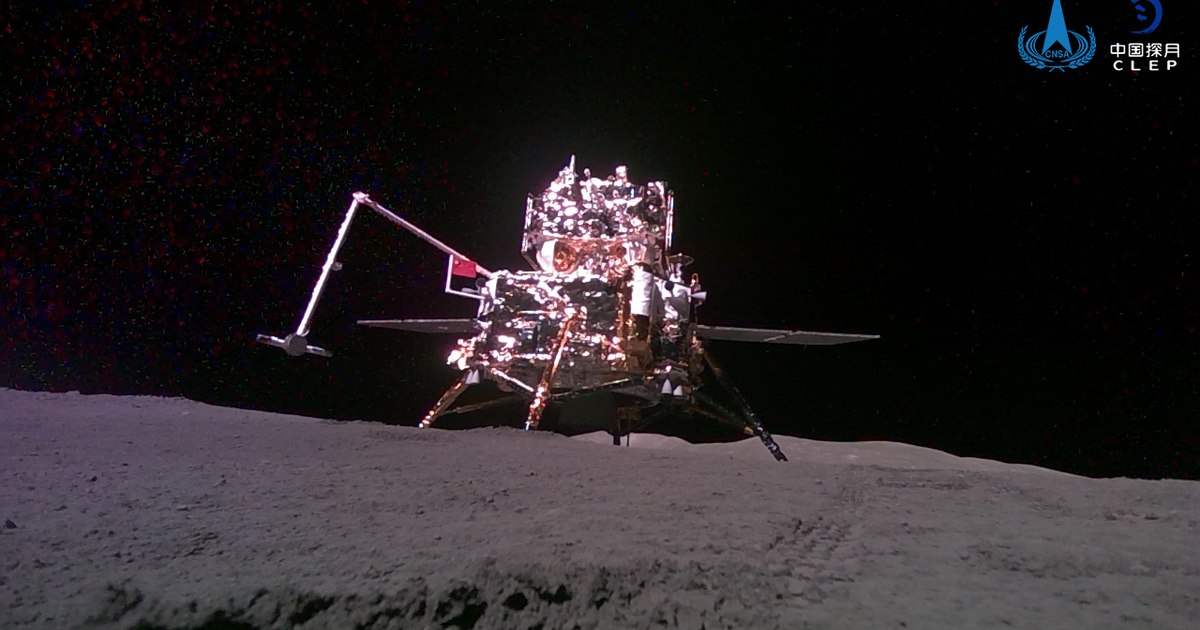
The Chang'e 6 probe, the first space mission to collect samples from the unseen side of the night star, headed back to Earth yesterday after collecting about 2 kilograms of lunar rocks and dust for two days.
The lunar module's robotic arm collected soil samples. Photo: profimedia
A probe launched by China in early May landed on the far side of the moon to collect samples, a step forward for the country's ambitious program, China's Xinhua news agency reported, citing AFP. The landing took place on Sunday, at 6:23 a.m. China time (1:23 a.m. Romanian time).
The Chang'e 6 probe lifted off from the Wenchang Space Launch Center on the southern tropical island of Hainan, and the probe's Lander touched down on the lunar surface as planned in the huge South Pole – Aitken Basin, one of the largest known impact craters in the solar system, the agency said, citing the China Space Administration. This 53-day mission, launched on May 3, aims to take the first samples on the far side of the Moon, a region of the Earth's satellite rarely explored.
Looking for water on the moon
The Lander Module of the Chang'e 6 probe deposited a mini-rover on the Moon “until now secret”. The rover's mission is to support the analysis of the composition of the lunar surface by investigating the presence of water in the lunar soil using an infrared spectrometer. The robot also performed other experiments in its selenization zone, but mostly collected lunar material, using the drilling device to take samples from below the surface, as well as the robotic arm to grab the material and deposit it in a special container.
The objective of the mission was to collect about 2 kilograms of lunar dust – the so-called regolith – and lunar rocks, in the sealed container that, at the end, the robot transferred to the board of the Ascending Unit. The trial lasted two days, and after the successful collection of evidence, “a Chinese national flag carried by the Landing Module was installed on the far side of the Moon for the first timei”, reported Xinhua. After this “celebratory” moment, Chang'e 6 prepared for departure.
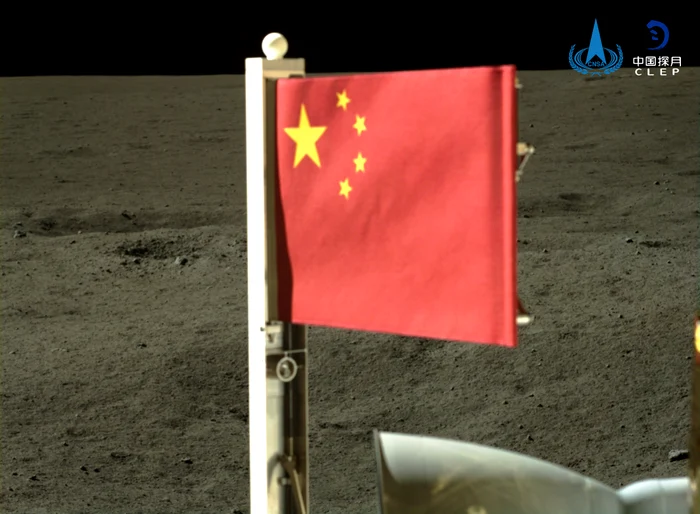
The robot planted a Chinese flag on the dark side of the moon. Photo: profimedia
Ascension Unit of “China's Chang'e 6 probe lifted off from the lunar surface Tuesday morning carrying samples collected from the far side of the moon, an unprecedented achievement in the history of human lunar exploration“, Xinhua indicated, citing the China Space Administration.
After liftoff, the Ascension Unit docked in lunar orbit to the Return Vehicle, to which it transferred the container. The vehicle is coupled to the Service Module, which carries it back to Earth orbit. Here, the Return Vehicle will be released to the ground for a parachute landing, scheduled to land on June 25 in Inner Mongolia.
Scientists believe that the dark side of the Moon – so called because it is invisible from Earth and not because it never catches the Sun's rays – is very promising for research because its craters are less covered by ancient lava flows than those of on the near and visible side.
Therefore, it might be easier to collect samples there to better understand how the Moon formed. “The samples collected by Chang'e 6 will have a geological age of about four billion years”said Ge Ping, deputy director of the Lunar Exploration and Space Engineering Center of China.
An extremely rare mission
Missions to the dark side of the Moon have been extremely rare until now, with the visible side being much easier to explore. In any case, China is the only country that has so far managed to carry out controlled landings on the dark side of the Moon. Historically speaking, NASA's Ranger 4 module was the first to reach the dark side of the Moon in 1962, but there was a forced landing, a near-crash, and the probe could not transmit data to Earth, writes space.com. As far as the Chinese are concerned, this is the second successful lunar landing on the dark side of the Moon, after the Chang'e 4 mission took a rover to the unseen lunar region in January 2019. The Chang'e missions were named after the moon goddess in Chinese mythology.
The Americans do not have the upper hand when it comes to images from space with the hidden face of the Moon. The first images of the dark side of the Moon, rather blurry, were taken by the Soviet space probe Luna 3 in 1959. However, the Americans set a first in 1968, when the astronauts of the Apollo 8 mission were the first people to see the face with the naked eye dark of the moon. Also on the same occasion, astronaut William Anders was the first to film the hidden face of the night star.
The Chinese have big plans
China has significantly expanded its space programs under President Xi Jinping, who has invested billions of dollars in the sector to catch up with American and Russian leaders. Chang'e 6 will soon be followed by other lunar missions.
The Chang'e 7 mission is scheduled to launch next year to the lunar South Pole region in search of frozen water deposits. Chang'e 8 will be launched in 2028 to test the possibilities of using the resources that Chang'e 7 will discover and assess how mankind can benefit from lunar exploration. One of the tests planned for Chang'e 7 is the use of a 3D print to make, from lunar dust, some bricks that could be used for a lunar base, reports the BBC.
All of this is just a preview of the China National Space Administration's (CNSA) grand plan to send humans to the moon by 2030.
