
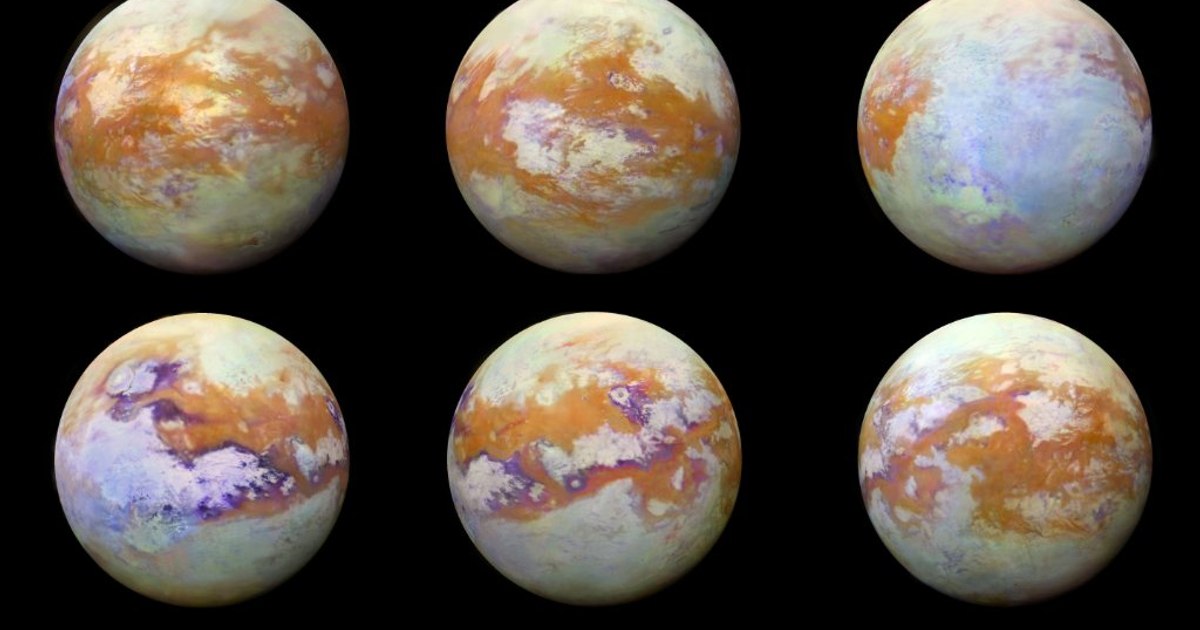
The James Webb space telescope has confirmed that Titan, Saturn’s largest month, has a climatic cycle similar to that of the Earth, with clouds that can bring rain on its surface.
Titan, Saturn’s largest month, has a climatic cycle similar to that of the photo: x
Scientists have long suspected that Titan could have a climate that resembles that of the Earth, with clouds that bring rainfall on rough terrain. If this hypothesis is true, Titan would become the only other world in the solar system that shares this feature with our planet.
Using the James Webb space telescope and the Keck II telescope in Hawaii, astronomers first observed clouds floating above Titan’s northern hemisphere, the area where most of the lakes and seas of methane and Ethan, reports Mashable.
Conor Nixon, a scientific researcher at NASA and the main author of the study published in Nature Astronomy magazine, explained: “I could see Metan clouds evolving and changing near the North Pole of Titan over several days, in the region where the Cassini space probe also discovered seas and large methane lakes”.
A climatic cycle similar to that of the Earth
This discovery confirms the theory that the methane and ethane lakes are fed through the rain, similar to the summer storms on Earth. Unlike our planet, where these substances are gases, on titanium they are liquid, due to very low temperatures, about -160 ° C.
The clouds on the titan rises much higher than on Earth, up to 45 kilometers, due to the smaller gravity of the Moon.
Mysterious atmosphere and life on Titan
Titan has a dense atmosphere, composed largely of nitrogen, wrapped in a yellow smog. This, together with the presence of organic ingredients, makes the moon an important candidate for the search for extraterrestrial life.
Nixon emphasized an important aspect of methane: “It is possible that (methane) be constantly replenished and evaporate from bark and interior over billions of years. If not, in the end it will disappear altogether, and Titan will become a world largely without air, made up of dust and dunes. ”
Mysterious molecules and chemical reactions in the atmosphere
Webb also detected an ephemeral molecule called radically methyl in the atmosphere of Titan, a sign that there are complex chemical reactions, similar to those associated with the origin of life on Earth.
Stefanie Milam, co -author of the study, explained: “It is for the first time we can see the “chemical cake” while growing in the oven, not just the initial ingredients of flour and sugar, then the final decorated cake. “
Although the clouds indicated by the telescope suggest that it could rain on the titan, no rainfall has been observed. The team of researchers will continue to monitor to better understand how the weather changes, especially after the recent equinox.
