
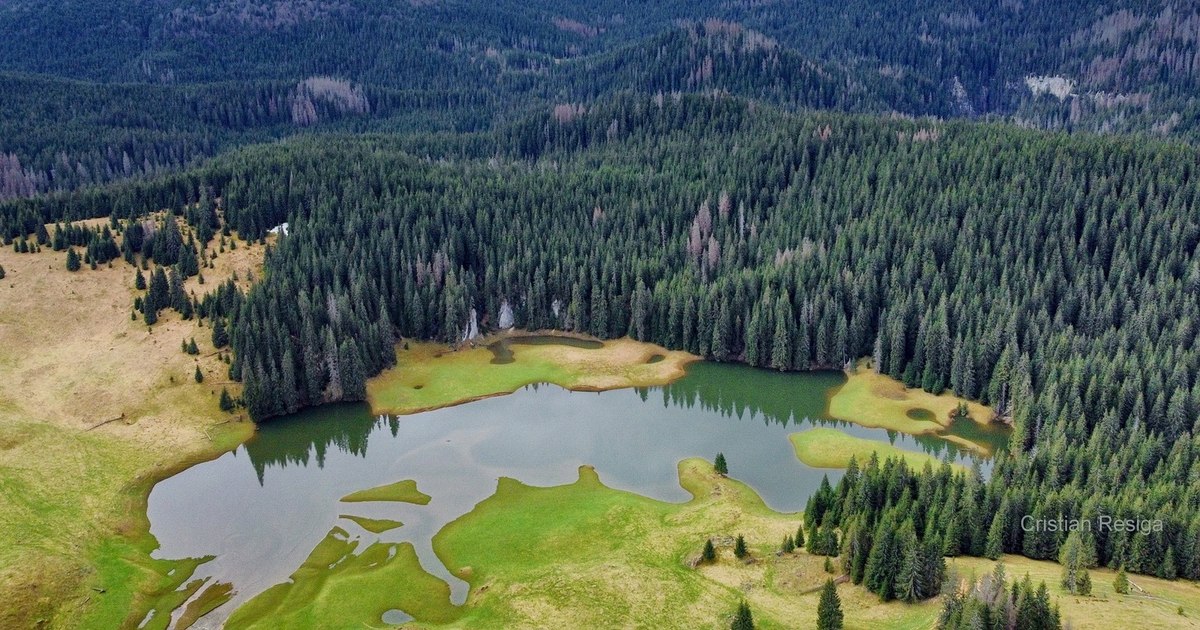
Poiana Ponor in Apuseni (Bihor county) attracts many tourists from all corners of Romania. Here, in the heart of the mountains, a temporary lake that usually forms in the spring, offers a rare sight in its beauty.
The Ponor clearing. Photo: Cristian Resiga.
Cristian Resiga, a photographer from Deva, captured in images one of the most spectacular places in the Apuseni Mountains. In the spring, Poiana Ponor from Apuseni (photo – Cristian Resiga) is flooded by the waters brought by melting snow and precipitation, forming a spectacular lake, bordered by mountains and forests.
Spectacular phenomenon in the Apuseni Mountains
“In a natural picture, the lake rests like a pearl wrapped in greenery. The tall trees lean gently towards the waters, like guardians of nature. In the middle of the forest, some rocks stand proud, like ancient guardians of hidden secrets. And everything is sprinkled with sunlight, which dances on the leaves and the waters, creating a symphony of stillnessi”, writes Cristian Resiga, the author of the photos, on his Facebook page.
Poiana Ponor, a closed depression (polie) in the Apuseni Natural Park, is located in the Padiș tourist area, in Bihor county, accessible on the Ștei-Padiș road. Tourists reach the glade by going down from Padiş, on the marked path on Valea Brădetului or from Glăvoi Glade, on a forest road that crosses the slopes.
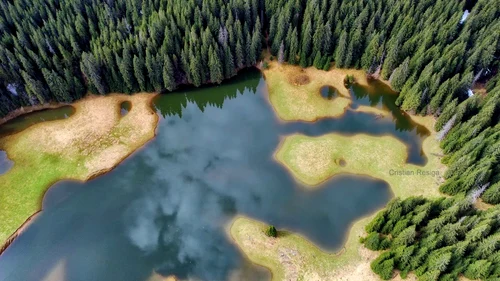
Image 1/6:
Poiana Glade Photo Cristian Resiga (9) jpg
The Padiș tourist area is also known for its sinkholes, at least 10, places where surface water drains underground. A similar karst phenomenon is also visible in the Șureanu Mountains, where there are more than 50 sinkholes, the most famous being Fundătura Ponorului and Lunca Ponorici from Hunedoara.
Poiana Ponor in Apuseni has its origin in a strong outburst (a place where an underground river springs strongly), located at the foot of a high limestone rock, where there is also a cave.
The underground waters from the Padiș Plateau come to the surface through Izbucul Ponor, form a stream that bathes the clearing, and after another 300 meters, they disappear into the ground again through several sips.
“At the end of this glade, the water of the Ponorului disappears into the ground, drained through several sipes and we find it underground after a kilometer, in the Cetățile Ponorului, springing from a strong eruption of the Citadel. Poiana Poorului is a typical field for the Apuseni Mountains. In seasons with heavy rainfall, the large amounts of water cannot be drained by the sorbs, they accumulate turning the depression into a vast lake. The hiker who captures this strange and rare transformation of the Ponor Glade must go around the lake on the northern shore to meet the marker again at the end of the glade, above the sorbs. showed the explorer Lucia Ghertler, in the Almanach turistic magazine (1986).
Poiana Ponor is the only field in Romania, fulfilling the double condition of having both the supply and the underground drainage through karst channels, informs the Apuseni Natural Park.
The Apuseni Mountains, the spectacle of nature in the heart of Transylvania
Located in the heart of Transylvania, the Apuseni Mountains offer travelers countless reasons for satisfaction.
They stretch over almost 20,000 square kilometers, over the counties of Arad, Bihor, Cluj, Alba and Hunedoara, and in the center of this land are the patriarchal settlements of the Moti – people of the mountain and forest who are said to be one of the most old populations from the territory of Romania.
The Apuseni lands are rough and less suitable for agriculture and animal husbandry, and the forests have always represented the great wealth of the region. In the basement of the mountains, gold, silver, copper and other precious and rare metals make Apuseni the richest region in mineral resources in Romania.
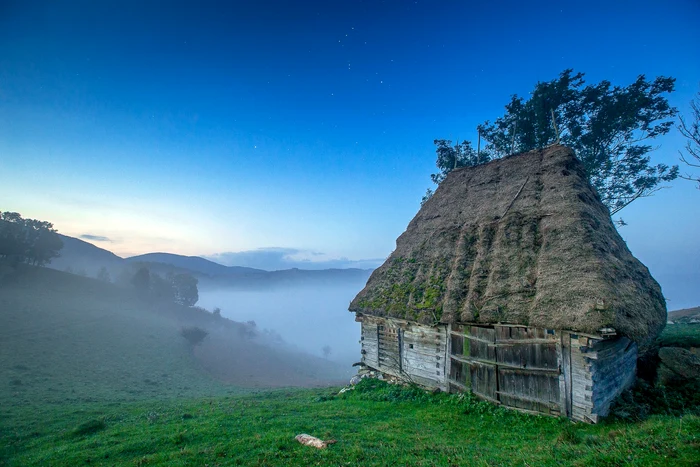
Westerners. Photo: Marius Turc.
The diversity of landscapes and the numerous natural monuments of the Apuseni Mountains have made them increasingly popular as tourist attractions.
The Apuseni Mountains are criss-crossed by a dense network of roads, which run along the valleys of rivers such as Ariesul or Crișurile or “ride” on the ridges where the Moti built their isolated settlements.
One of the “highways” of the mountains is the national road that crosses them in the East-West direction, between Turda and Beiuș, then going down to the municipality of Brad and the Metaliferi mountains.
The second way to enter the heart of the Apuseni is on the North-South direction, starting from Huedin, then continuing along the Aries valley in the country of the moti, to Câmpeni and Abrud, and going down to Brad, in the Crișului Alb valley, at the foot of Mount Vulcan, between Hunedoara and Alba counties.
