
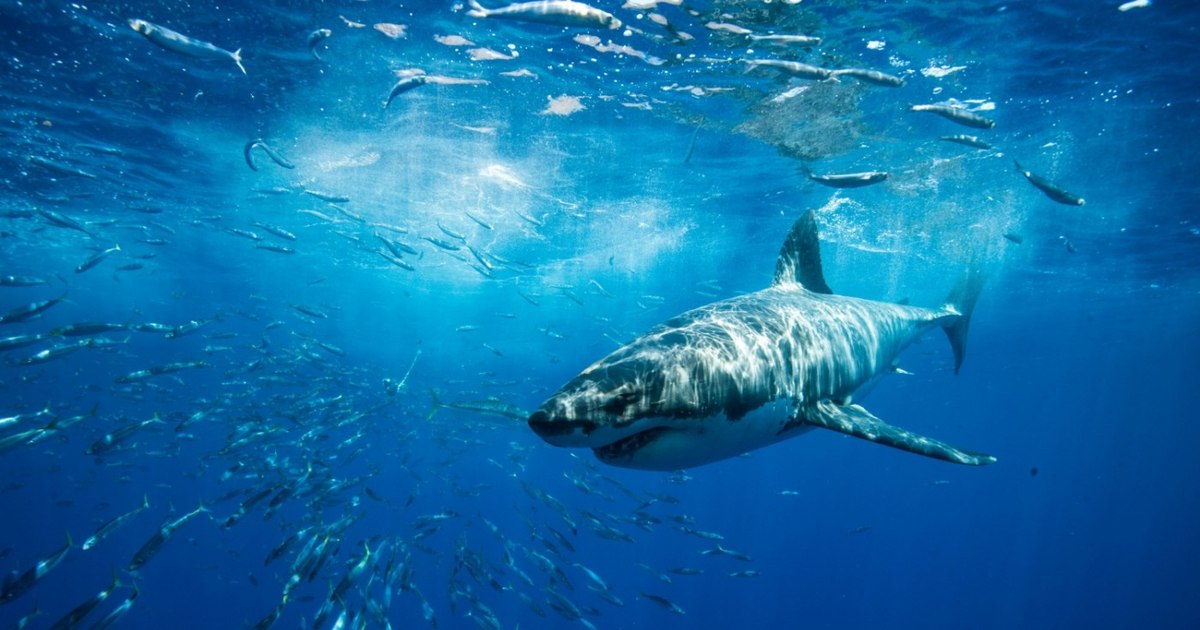
Scientists have recorded the world’s first known case of a porbeagle shark being eaten by a mystery predator offshore southwest of Bermuda. It is about a pregnant female, originally from the Atlantic Ocean, that was killed.
Females give birth, on average, to only four cubs every year or two. PHOTO Shutterstock (Archive)
The findings, published Tuesday in the journal Frontiers in Marine Science, if verified and proven to be true, could be important for the conservation of the endangered species, researchers say, according to the Independent.
Porbeagle sharks live in the Atlantic and South Pacific oceans, as well as the Mediterranean Sea, becoming powerful creatures that measure approximately 4 m in length and weigh up to 230 kg.
Although known to live up to 30 or even 65 years, females of this species do not reproduce until about 13 years of age.
Females give birth, on average, to only four cubs every year or two, after a gestation period of eight to nine months.
To study this vulnerable species, scientists captured and released porbeagle sharks off Cape Cod in Massachusetts in 2020 and 2022 after fitting them with satellite tags.
These devices transmitted their current location to satellites. One of the sharks that had such a device was a pregnant female porbeagle that was about 2.2m long.
The researchers hoped to track the female and gain information to identify important habitats for mother porbeagle sharks and their newborns.
The only explanation
But to their dismay, the female shark’s device began transmitting off Bermuda five months after its release.
The data recovered by the scientists suggests that during the five months the shark swam at a depth of about 100-200m at night and 600-800m during the day, confirming that it was swimming underwater most of the time.
But suddenly, starting on March 24, 2021, for about four days, the shark seems to have remained constantly at a depth between 150 and 600m.
“Only one explanation was possible: that day, the unfortunate shark was hunted and eaten by a larger predator“said the scientists.
In this area, researchers say only two predators are large enough to attack mature porbeagle sharks: the great white shark and the mako shark.
Scientists believe that the great white shark is behind this attack, as the mako shark dives to greater depths during the day.
“We often think of large sharks as apex predators. But thanks to advances in technology, we are beginning to discover that interactions between large predators may be even more complex than previously thought.said Brooke Anderson, co-author of the study.
“We need to continue to study predator interactions to estimate how often large sharks prey on each other.”he added.
