
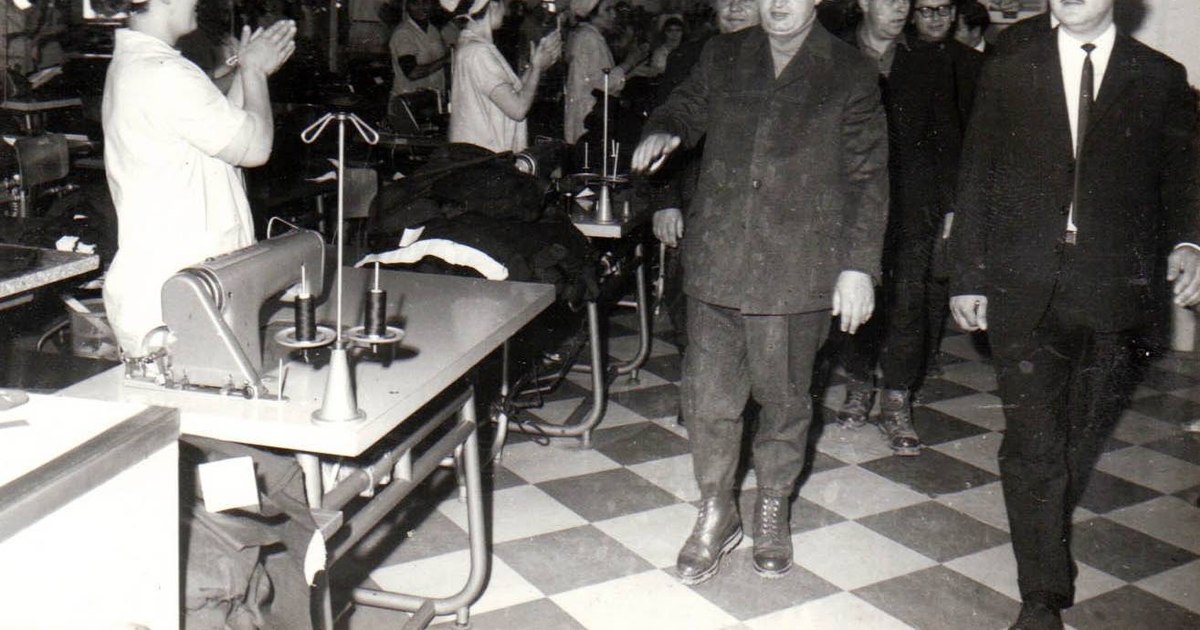
Education has been, from its beginning, calibrated to form workers in factories and factories. With the post-industrial age, a reform of education is also needed, but it is dangerous to remove the school subjects, citizenship, collective morality, says the analyst Hari Bucur-Marcu.
The school was preparing the future worker in the industrial era. Photo: Getty Images
Hari Bucur Marcu, an international expert in issues of national defense policies, analyzed how the adaptation of national education to the post-industrial era affects the feeling of belonging to people. “Nowadays and especially in the following, most of the young graduates of state schools do not understand why they would be good citizens and defenders of a place in the globe that nothing binds them, at least from a material perspective ”says the expert.
The idea that the subjects and subjects of school subjects no longer need to be needed about the nation, citizenship, collective morality, he writes on Facebook.
Education Form workers in factories
In the context of the discussions about the education reform, Hari Bucur Marcu, an international expert in the issues of the building of defense institutions, defense policies and military alliances, explains that public and free public education has been since its beginnings for industrial society, or at least for the company with industrialization aspirations.
“I consider not only the content of the school program, but also the format of the process, with the infrastructure included, as well as the principles of learning and training of young. work, machinery, tools, machines, a certain ergonomics and especially of horizontal and vertical surveillance of their work process. he detailed.
At the same time, the students learned how it is with the signing of the condition (the presence at hours), with the imposed breaks, with the approval for any individual gesture, apart from the common instructions from that moment and so on. Just like at the workplace later – continues the expert.
“The children at school were also learned and as it is with hierarchy, both between social categories and between them, according to school performance, or extra curricular skills. So, once they arrive in an industrial job they are already accustomed to the idea of hierarchy and knowledge of each one in a collective.”he explains.
The subjects were also calibrated to form graduates of high school and high school courses that no longer had to be passed through forms of general theoretical training, by the employers who had already received them theoretically, even though the new employees had not seen in their lives a job as the one they were going to occupy.
“The state complete the program with consecrated subjects through which students became good citizens”
In addition to the education for the industrial society, subjects that targeted the civic spirit of the students were introduced in the school syllabus:
“And, if all the children were coming to the State School, necessarily, then the state that organized that form of education, for the dual benefit of the future employee and the future employer, more completed the program or with subjects of the consecrated subjects, through which the students will become good citizens.”
In the context, the sunset of the industrial era, not necessarily by closing the factories and factories, but by automation, robotization, by re -energizing (from the energy of the energy from the ion batteries), by miniaturization and especially by digitalization (which digitization flows into AI – artificial intelligence), and the school program must be updated.
“With this post-industrialization (the employment occupied in the industry has continuously decreased as a share in total labor, in the last two generations, from 60-70 percent in industrial developed countries to 25-15 percent, with further decrease).” Other strategic transformations have occurred. “explains Bucur Mark.
Industrial capital has lost its share in total investments. The richest individual or collective capitalists of the most economically developed nations of the globe are no longer the industrialists, but the holders of the new technologies, post-industrial. And immediately after them, in the hierarchy of the rich world are the ones who provide services (the share of services currently holding the majority, in the total employment). And of course, in the third place in the hierarchy we find the funds handlers, says the specialist.
“The mandatory military service was also specific to the industrial era, era that appeared in all developed states, from all continents, starting two generations ago and reaching servers this century, of which a quarter has already passed.”details the expert.
He believes that apart from small nations numerically (from 2 to 10 million inhabitants, with the preference of maximum performance to those between 3 and 5 million), who allowed a revolutionary approach to public education, which depended (and continue) not only the performance of the working class, but even the existence of those more modest nations, all the other nations, had all the other nations. national at the express requirements of the post-industrial era.
“The mold of teachers everywhere is that they have the right to teach in the classroom what they know and not what would be useful to students to learn”
“The highest resistance to new came from the teacher’s part, with teachers who had exactly the same attitude that the workers of the first generations of industrialized, when the elements of automation and robotization, appeared, which made them unnecessarily the role of proletarians, in the industry. Not because they would have been made available, but because they refused to recall in order to employ specific jobs, robotization and digitization. The mold of teachers everywhere is that they have the right to teach in the classroom what they know and not what would be useful to the students to learn ”, shows the specialist.
Then they opposed and still resistance to the change to the post-industrial era of national education, all those who invested in the parallel industries of the class education act, from school builders to paper editors, passing through those who deal with transport, security, sports infrastructure and so on.
“But the greatest and most serious problem in the recalibration of national education in any state of the world is given by the fact that, with the disappearance of the majority need to go to the factory, where to find the car to operate, in order to win the daily living, that is, the need to be related to a specific place, and to the service, they will be good citizens and defenders of a place in the globe that nothing binds them, at least from the material perspective”, Is the expert of opinion.
From the idea of globalization, with the unrestricted mobility of the labor, according to Bucur Mark and the idea that “nu would also need the subjects and subjects of the school subjects about the nation, citizenship, collective morals (preceding relations between personal and collective) and the like. But here are the popisms, and the sovereigns, and the xenophobes, and the exceptionalisms, all and each of them, and each of them taking place left in education, in the training but also in the culture of young people as citizens of the post-industrial era. “
There are few exceptions to these situations, unfortunately.
“The above statements are not valid in some of the more modest demographic nations (I would quote only Finland and Singapore, and only as parables), who have the feeling of belonging to the fortress, at the nation much more developed and especially more oriented towards the future that depends essentially on the degree of education, of formation and of the culture of each citizens.”, Concluded the specialist.
Who is Hari Bucur Marcu
Hari Bucur Marcu was Associate Senior Fellow for the Defense Policy at the Geneva Center for the Democratic Control of Armed Forces (DCAF), counselor in the Ministry of Foreign Affairs for the establishment of the post-conflict reconstruction center, the academic coordinator of the NATO Study Center in Bucharest, officer responsible for the Miliar and the Romanian
Since the transition into reserve in the spring of 2003, Hari Bucur-Marcu has strengthened its reputation as an international expert in the issues of the building of defense institutions, defense policies and military alliances, especially NATO, as well as the reform of the Security Sector.
He organized courses and seminars and contributed to conferences, seminars and workshops in Armenia, Azerbaijan, Belgium, Bulgaria, Croatia, Georgia, Germany, Republic of Moldova, Romania, Slovakia, Switzerland, Turkey, Ukraine, United Kingdom, United Arab Emirates and United States. He was part of teams of international experts who visited Armenia, Azerbaijan, Republic of Moldova and Ukraine and counseled the armies of these states, including the Ukrainian.
