
Vocational/technological education is being reorganized in the country, starting from the 2026-2027 school year. Vocational classes are disappearing, instead students who will integrate into the workforce can still do so after three years, when they acquire the 3rd qualification level.
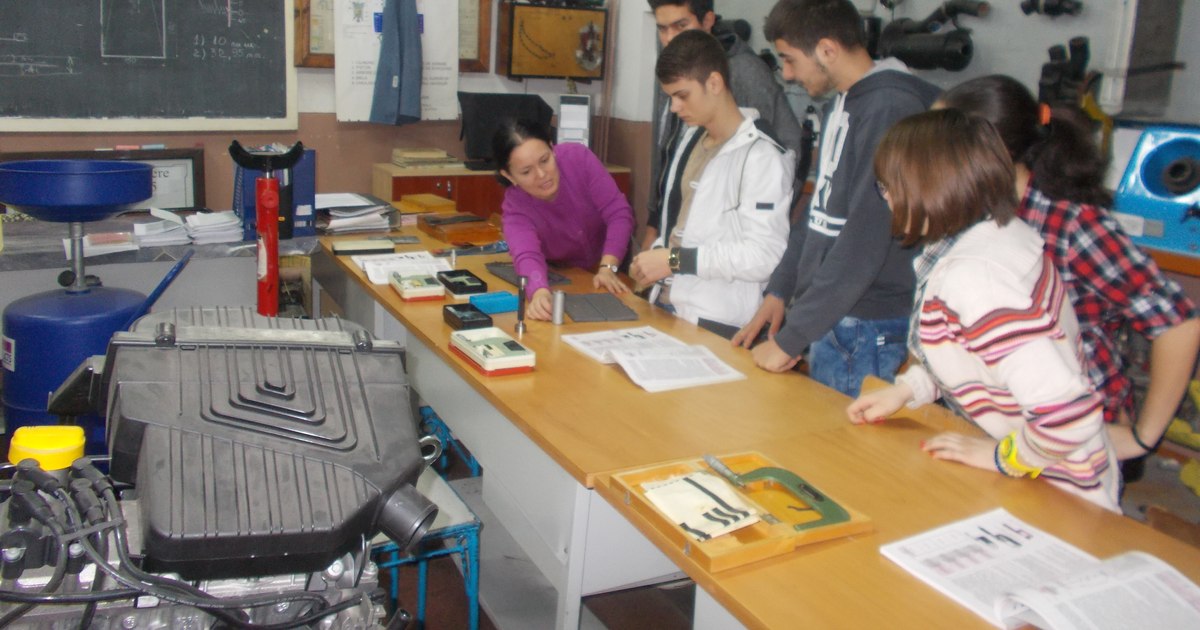
Internships can be organized either at the employer or in the school’s workshop PHOTO: A.Mitran
The 3-year vocational education classes existing at this moment will be reorganized, starting next fall, within the technological high schools. Thus, the vocational school as we know it today disappears, but not the possibility of integration into the labor field after three years of high school on the technological route. Ministerial orders regulating the reorganization of technological/vocational education have been signed and will become official.
“I expect that in the technological sector we will have attractive programs in close relation with the socioeconomic environment, up to the dual option, the old model of “professional schools” being thus replaced by this new model, which has all the advantages of the old one, but brings extra options for students. Through it, students will be able to obtain the level 3 qualification only on the technological stream, after the 11th grade, with or without the dual framework. Some of them will quickly enter the labor market, considering their completed compulsory education. Others, in parallel or without yet entering the labor market, will continue their high school studies, obtaining qualification level 4 or 5 (in post-secondary or tertiary non-university studies), after the baccalaureate being also eligible for university studies. For a logical and articulated approach, we also encourage and support dual education at the university level”recently transmitted the Minister of Education and Research, Daniel David.
There are counties in the country where the minister’s orders have circulated and been debated among teachers in technological high schools since the project phase, so there are fewer questions and concerns, while in other counties the news is new and comes with fears. What happens to those schools where there are no high school classes, but students are educated only at the vocational school level? The teachers are wondering how the vocational classes will be integrated into the technological high school here, and they are afraid that the problem of joining schools or other “artificial devices” in order to comply with the law could arise again. Others think even further and fear that their right to train students after secondary school will be withdrawn. “If the problem arises that we will no longer be allowed, it will not be good, neither for us nor for the children, because mostly those who do not have the opportunity to go to high school in the urban environment remain here. Maybe not all, but among them there will be those who drop out.” says a teacher from a school in the countryside where the unit was no longer allowed to establish high school classes due to the low rate of passing the baccalaureate, so high school students are only educated in the evening.
In another school, in a similar situation, the novelty was interpreted differently. The school is accredited for high school, albeit evening, so it will not be a problem for the vocational school to continue from next fall as a high school class. “This is how I think, at a first reading of the orders, that it will not be a problem to continue, because we have accreditation for level 4, that is, for high school. The problem, ours and other schools in the countryside, is the decreasing number of students, because the villages are getting older, depopulating”emphasizes another teacher.
High schools that do not have the necessary approvals/credentials still have time to obtain them before the new tuition figure is requested.
“First of all, he no longer calls her professional, which some people run away from as…”
The unanimous opinion of the teachers with whom the “Adevărul” reporter spoke is that the new changes are auspicious. The biggest gain is considered to be the fact that there is no more talk of the vocational school, considered the Cinderella of education. “First of all, it is no longer called professional, which some people run away from… We think, we hope, that there will also be that psychological effect. Because some parents, even if they are convinced that it would be best for the child, do not send him, because
Technological education in the dual system remains an option
Students will be admitted, from the 2026-2027 school year, to technological education only at high school. At the end of the 11th grade, they will receive the level 3 qualification, and if they want to integrate into the workforce, as was the case after graduating from vocational school, they can still do so. In this case, they either finish their studies here, or they can continue high school in a reduced frequency form, in which case the high school education will last 5 years. Even for young people who are 5 years older than their class age, there are solutions, the order foreseeing the possibility for them to attend high school courses within the “Second Chance” program.
For those who continue full-time courses after the 11th grade, when they graduate from the 12th grade, they take an exam and depending on the result, they receive a new qualification, level 4. If they choose to take the baccalaureate as well, the grade obtained in this exam can be equated, representing the grade on test E of the baccalaureate (if it is at least 5). And if they don’t pass the baccalaureate, they can continue their education by enrolling in post-secondary school.
Even if the vocational school disappears, dual education can still be organized in the already known system in which the economic agent supports the students, doubling the technological scholarship (according to the order, the technological scholarship will continue to be awarded) and ensuring practical training, with all that it entails. The economic agent can also support meal expenses, accommodation, insurance, etc.
Normative acts also provide for the possibility of consortia, in order to support the high school, economic agents, public institutions or other educational units (state or private) may be attracted.
Technological education can also be organized in the languages of national minorities.
In the legislation on the organization of technological education also appears “student’s educational portfolio”which will centralize all relevant information, including for the adoption of intervention measures, if necessary, to prevent school dropout, referring to this portfolio.
Graduates of the twelfth grade who did not pass the baccalaureate will be able to benefit from a training session. Free training will also be available to students who have passed the exam and are aiming for college admission.
For the hours at the students’ decision from the school’s offer, the educational unit will provide options established together with the economic agents and the institutions with which it collaborates, these hours being realized during the internships.
Teachers will have the obligation to draw up individual learning plans, which will be part of the student’s portfolio. High schools will be able to organize “School after school” or “Remedial learning” programs to support students.
Upon completion of their studies, graduates will necessarily receive a recommendation from the school counselor, either to continue their studies or for employment, this recommendation having an advisory role.
The tuition figure for technological education will be established with the consultation of the Local Social Partnership Development Committee (CLDPS) and will reflect the need on the labor market.
No special places for students with SEN in classes where there are additional tests
For admission to technological education, post-established education units, together with economic agents, including taking additional tests, as is currently done for vocational education (and how it could also be done for admission to dual professional education). For the classes for which additional tests are organized, additional places for students with special educational needs (CES) and places for Roma students are no longer granted.
In the twelfth grade, according to the normative acts, mixed classes can also be organized (technological education and dual technological education), taking into account that not all students who choose the technological high school will want to continue their high school studies in full-time education.
“The big problem is that the employer has no leverage to retain the students they supported”
Despite the beneficial elements that teachers mention in the reorganization of technological education, one problem still remains unsolved: the certainty that the students that employers support will truly constitute the well-trained workforce that the local market needs.
“The big problem with the technological high school and with the employer is that from our experience, and from what I’ve heard around, the employer, even if he does a dual class, is in no way sure that those students he finances for three or four years will stay in the company for a number of years. It has no leverage whatsoever. Moreover, they may not go at all, take the path of foreignness, and we actually prepare them for it, as is still the case today. In our country, you say they go into agriculture, build their own farms, here it’s different. There is no lost money here, so to speak, it shows one way or another. But in other high schools, upon graduation, the young man can tell the employer: I’m sorry, I’ve changed my mind, I’m going to Spain”, a teacher pointed out another problem that makes employers increasingly avoid getting actively involved in the qualification of the school workforce.
What the teachers of the technological high schools would also like to make very clear is what the ministry really wants to train in these school units.
“We don’t have to hide anymore: there are problems. If you expect the person who builds cars, who pulls washers or plows with a tractor to know Eminescu, Creangă and Cărtărescu in the same way as the one who is about to enter Literature, it is a bit difficult. It’s kind of hard. And there was also this pressure from society, I tell you honestly, with the Baccalaureate. Well, they didn’t take the Baccalaureate, we’re going to die of hunger! We are not starving, because everyone has a job. The real problem is how do we keep all these young people in the country, because there are jobs, but everywhere you look there are workers from Asia, ours are leaving.” said a teacher from a technological high school.
