
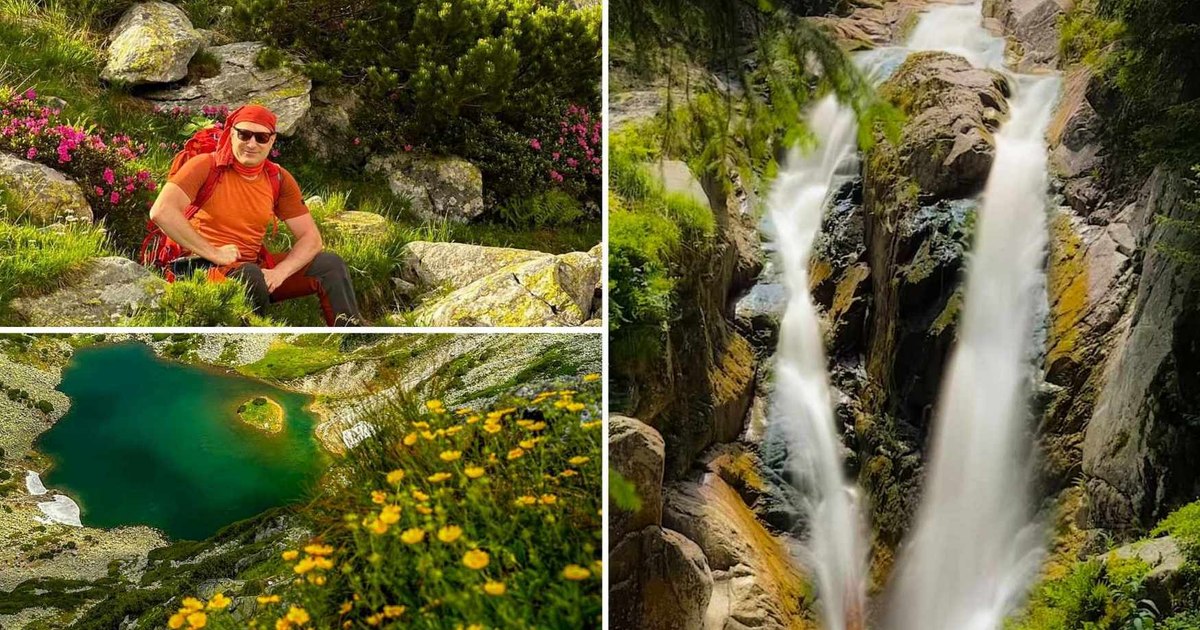
Retezat National Park looks like a real corner of heaven. Some mountain trails are difficult, but the effort of the hikers is fully rewarded. Marius Popa told the story of his experience on one of the most beautiful trails in Retezat.
Lolaia waterfall and Tăul Tăpului from Retezat. Photo: Marius Popa.
Passionate about mountain hiking, Marius Popa explored one of the most beautiful routes in the Retezat Mountains, which goes up from the Pietrele valley, from the Gențiana cabin to the Retezat glacial lakes.
The traveler shared his intense experience on the 17.5 kilometer route, which he covered in 10 hours, without breaks and another four hours, including stops.
The route chosen by Marius Popa was Cabana Gențiana (1670 meters altitude) – Tăul Dintre Brazi (about 1710 meters) – Galeș Lake (about 1990 meters) – Vârfului Mare Saddle (2370 meters) – Portile Encise (about 2280 meters) – Păpușa Saddle ( 2370 meters) – Păpușa Peak (2508 meters) – Pelegii Saddle (2285 meters) – Peleaga Peak (2509 meters) – Bucura Lake (2041 meters) – Bucurei Saddle (2206 meters) – Tăul Pietrele (1990 meters) – Gențiana Hut (1670 meters).
The road to the heights of Retezat started from the Pietrele valley (video), where the Cârnic refuge is the place from where tourists have to continue their ascent on foot, towards the Pietrele or Gențiana cabins.
“I arrived on Saturday, June 22 at 12 o’clock sharp in Cârnic, where I left the car in a parking lot for a fee (it can also be left on the side of the forest road, but after three days you will find it white from dust). We set off on the blue lane marking towards Gențiana Hut. After about a kilometer of forest road we turned to the Lolaia Waterfall, a beautiful and very accessible waterfall.
After another two kilometers of forest road full of stones and a bit difficult to walk on it, we left it on the left side crossing the Stânișoara Stream on two bridges. From here the mountain climb really begins through a forest full of moss and fern that cannot fail to impress you”writes Marius Popa, on his Facebook page.
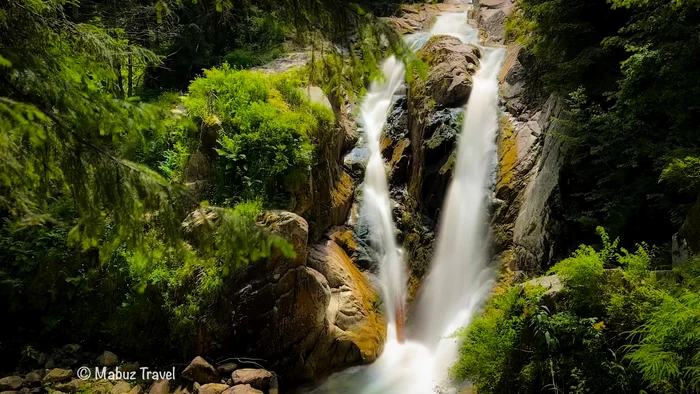
Lolaia waterfall. Photo: Marius Popa
Pietrele Valley that forms the Lolaia waterfall from Retezat (video), collects the springs of four large former glaciers: Stânișoara, Pietrele, Valea Rea and Galeșul.
“Their water, collected in the red bed of stone, cuts a gorge finished at about 1,000 meters altitude, with a threshold of 15 meters above which the water breaks into two strips with a thunderous noise”informs the geographer Nae Popescu, in the volume “Retezat Mountains” (1973).
Maria Magdalena waterfall from Retezat
After the Lolaia waterfall in Retezat, the second waterfall presented on the hiking path was the Maria Magdalena Waterfall in Retezat, so named in memory of the “queen of the mountains”, a capable and fearless local woman whose name was Maria Magdalena Hamz, who became a true legend of Retezat.
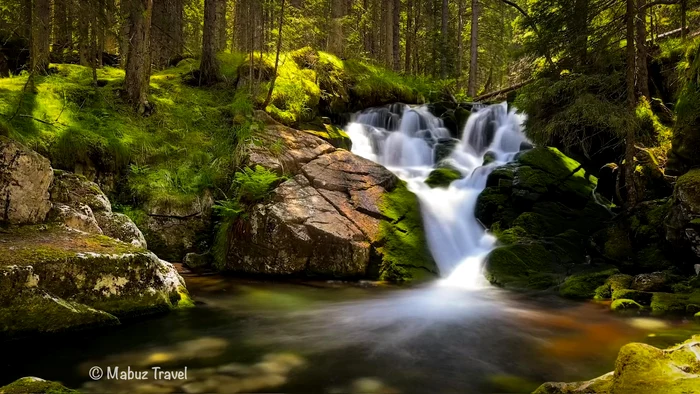
Maria Magdalena waterfall. Photo: Marius Popa
In the 1930s and 1940s, Maria Magdalena from Retezat took care of the Pietrele cabin and was a guide for travelers through Retezat, but she was also known as a hunter and trout fisherman in the rapid mountain waters.
“The path goes along the Pietrele water line, a clear and crystalline water. After about 20 minutes from the footbridges, we reach the Maria Magdalena Waterfall in Retezat, located at about 1500 meters above sea level, a waterfall that I like very much. From here you can reach the Gențiana cabin in Retezat immediately. In front of the cabin is Mount Stânișoara and behind it Mount Pietrele”, said the traveler.
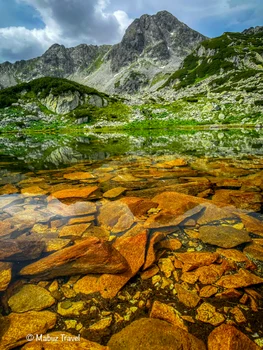
Image 1/13:
Retezat National Park Photo Marius Popa travel bus (13) jpg
“One night’s accommodation at the cottage costs 50 lei, it’s at the prices. There are 24 stalls downstairs, plus others up in the attic. No food is served, only drinks (beer, tea, coffee) or some sweets. There are no bathrooms to take a shower. Izvor is near the cottage. The Gențiana cottage in Retezat is warm and welcoming, just like the owners. There are solar panels, so you can charge your devices. The signal is but weaker; no internet, very hard to catch an internet signal. It takes about 3 hours from Cârnic to the Gențiana cabin in Retezat“, writes Marius Popa.
Tăul Tăpului from Retezat, the lake with the islet
Along with the nearby Pietrele cabin, the Gențiana cabin in Retezat is one of the places from which tourists set off towards the ridges that rise to 2,500 meters and the glacial lakes at their foot.
The calf of the goat from Retezat. Photo: Marius Popa.
“The next day at 6:30 we started on the route to Tăul dienre Brazi. (…) From here we continued to the left on the red dot marking, crossed a footbridge over Valea Galeșu and immediately intersected with the red triangle marking that leads to the fourth largest lake in Retezat, Lake Galeș. It takes about an hour, an hour and a half from Tăul dienre Brazi to this wonderful lake. From here we continued on the red triangle marking among the clumps of rhododendrons to Saua Vârful Mare”, adds the traveler.
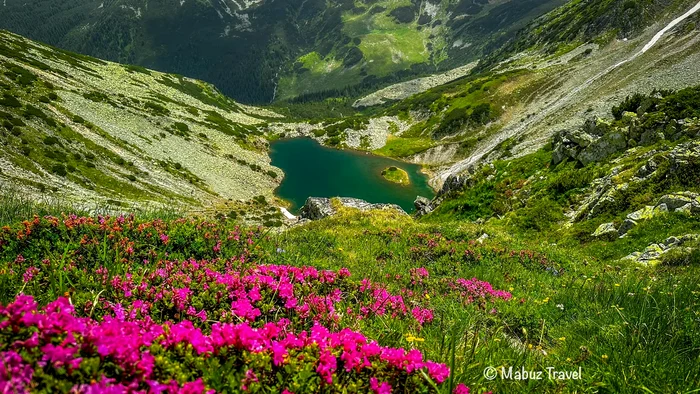
“From here you can also go to the peak with the same name, but we didn’t find it interesting and, besides, clouds had appeared and we didn’t want to get to the fine points and not see anything. From the saddle begins a ridge route through the Closed Gates on the red band marking where extra attention is required. From this ridge we can admire in all its splendor Tăul Țapului, probably the most beautiful glacial lake in the country”Marius Popa shows.
Tăul Ţapului in Retezat, located at over 2,000 meters above sea level, under the Closed Gates of Retezat, between the rocks, is distinguished by its grassy islet, formed following an avalanche and becoming an attraction of the 2.3 hectare lake.
Tăul Tăpului from Retezat is fed by four springs and snow avalanches. It has a maximum depth of six meters, and its waters flow downhill, giving birth to a waterfall. The lake was populated in 1977 with trout, and marmots can sometimes be seen around the lake (video – Claudia Danău, Retezat National Park).
The route continued towards the Peleaga and Păpușa ridges, the highest peaks in Retezat, which exceed 2,500 meters altitude, then the descent to Lake Bucura and to the Gențiana cabin in Retezat.
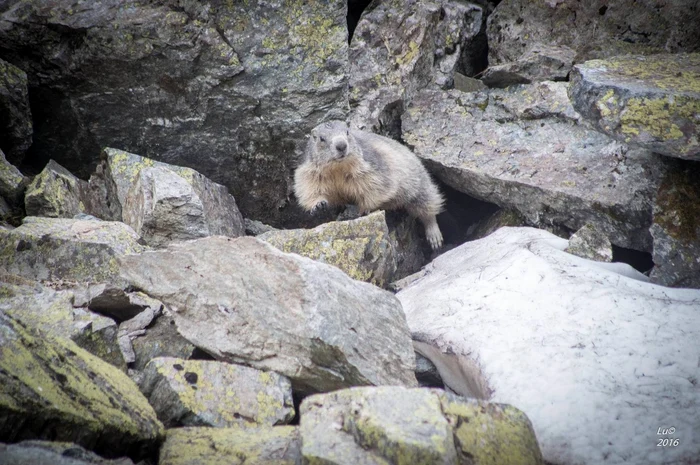
Marmots in Retezat. Photo: Lucian Ignat.
“I arrived at the Gențiana cabin in Retezat, in the light of headlights and in the light of lightning in the distance, at 10:30 p.m. Fortunately, the rain avoided us and we had great visibility and scenery. It is a difficult but magnificent route; everywhere there are landscapes that take your breath away. Crystal clear waters where you can see the colored stones, clumps of rhododendron among the green stones, green moss on which the sun rays are reflected, waterfalls and glacial lakes without number, streams and springs everywhere“, writes Marius Popa.
Retezat is an extremely beautiful mountain, but those who climb it must be used to walking on the mountain, have a good physical condition and do not have altitude sickness (in our case we are talking about the Closed Gates), adds the author of the photos.
“They go up and down on gravel or big boulders, so pay attention to the phones too; if one falls among the boulders you can say goodbye to it. It is not necessary to take a lot of water with you because you can find water everywhere up to 2,100 meters altitude”reports photographer Marius Popa.
Retezat National Park, the first nature reserve in Romania
The Retezat National Park, the first scientific reserve in Romania, was established in the mid-1930s, following the efforts made by scientists Alexandru Borza and Emil Racoviţă.
The reserve, located in the southwest of the country, in Hunedoara county, has an area of over 38,000 hectares, of which 19,988 hectares are forests, 9,893 hectares being in strict or integral protection zones.
The Retezat National Park ensures a balance of fauna, here there are large predators, such as the bear, wolf or lynx, but also herbivorous animals, including the black goat, deer and deer or omnivores, such as the wild boar.
185 bird species live here and 1,190 plant species can be found, of which 90 are endemic species. The Retezat National Park is home to 55 species of mammals, twice the number known at the beginning of the 1990s.
There are 80 lakes and lakes within the park, including Lake Bucura, the largest glacial lake in the country, and Lake Zănoaga, the deepest glacial lake in Romania.
