
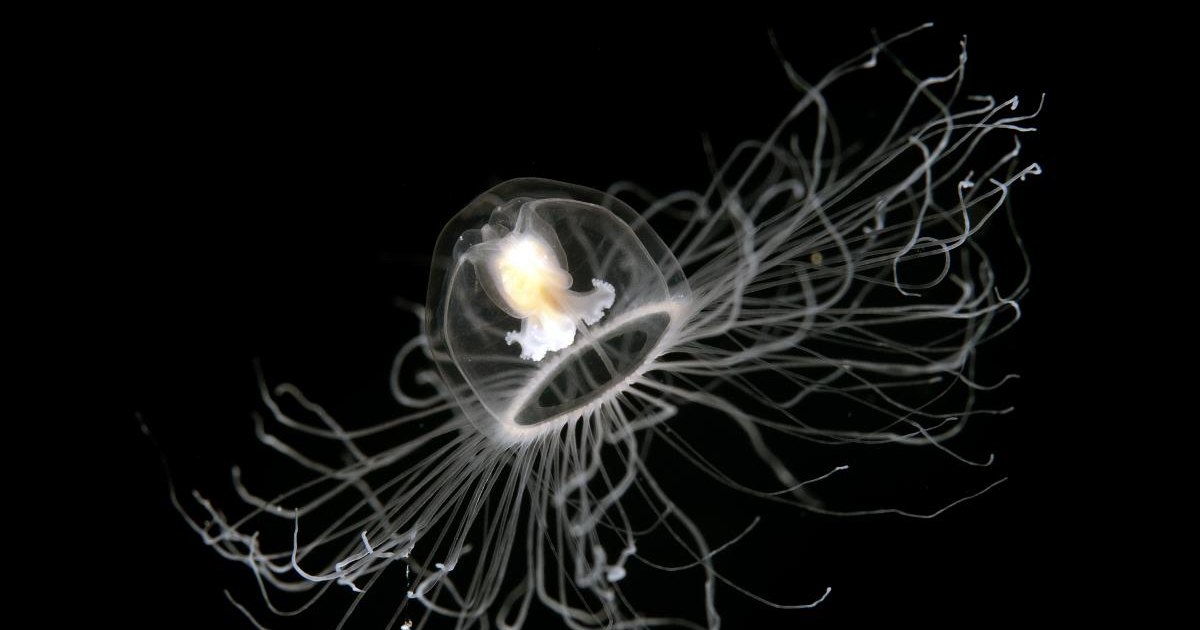
Most creatures age in one direction. But not in the case of the sea urchin, a mango-sized comb jellyfish native to the eastern Atlantic Ocean.
Black Sea creature that rejuvenates when stressed PHOTO Archive
When things turn bad, the translucent invertebrate rejuvenates, regressing to a tentacled larva state. When conditions improve, it matures back into an adult, researchers reported in a preprint published on bioRxiv last week, according to science.org.
This amazing ability may explain how Mnemiopsis leidyi, a comb jellyfish, survived captive ocean voyages in ships’ ballast for weeks on end with little food to become an invasive nuisance, first in the Black Sea and then in parts of Europe and Asia.
And this invader could help academics better understand aging.
“The study is proof of how much we can still learn from invertebrates,” says Maria Miglietta, a marine biologist at Texas A&M University. She studies the so-called immortal jellyfish Turritopsis dohrnii, which was the first—and long considered the only—species discovered to age in reverse.
Six years ago, marine biologist Joan Soto-Angel and evolutionary biologist Pawel Burkhardt were struggling to keep specimens of M. leidyi thriving in their lab at the University of Bergen. “When (comb jellyfish) have a bad day, they basically disintegrate,” recalls Soto-Angel.
Eventually, the researchers discovered the ideal housing configurations and temperature ranges for keeping the animals. After successfully completing preliminary investigations into the species’ neurological system, the researchers began testing the animal by denying it food or amputating the lobes of gelatinous tissue that surround its mouth and make up much of its 2-foot-long adult body centimeters.
Wounded or starved creatures did not perish; instead, they shrunk to the size of a tiny droplet of a few millimeters. A few of them revived when the two started feeding them again. Thirteen of the sixty-five species examined developed two tentacles, an attribute shared by the animal’s larval stages. According to Soto-Angel and Burkhardt, the revived animals used their appendages to hunt microscopic drifting plankton.
The authors note that it is possible – although this needs to be tested – that the larval stage animal has an advantage when it comes to obtaining food resources, which could explain its success as an invasive species. Eventually, the comb jellyfish regained their lobes and even began to reproduce if given enough food.
Although both immortal and comb jellyfish have the ability to rejuvenate themselves, the animals do so in different ways. Jellyfish have distinct life stages: a free-floating, sexually reproducing bell-shaped jellyfish and a “polyp” stationary that resembles a sea anemone and can generate multiple polyps. As it ages in reverse, its cells lose their identity and merge into a “cyst” which redifferentiates into a polyp. “It’s not exactly the same specimen that transforms back into the previous stage”says Soto-Angel.
