
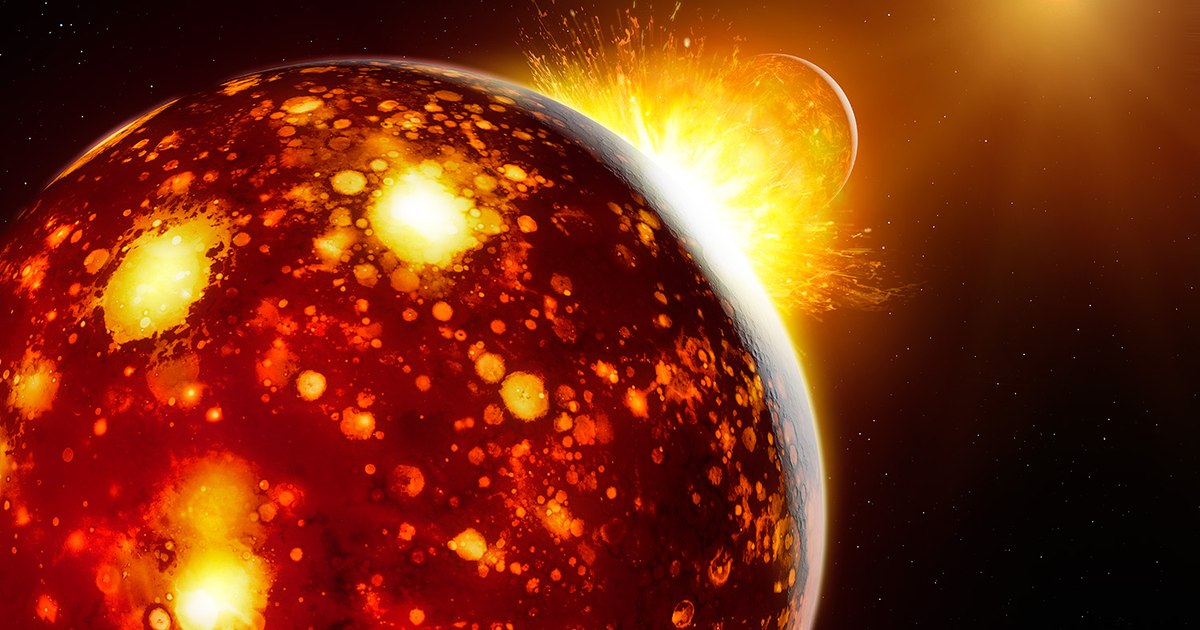
About 4.5 billion years ago, our planet experienced a critical moment for its existence. A huge celestial body, christened Theia, collided with the Earth, throwing matter into space that remained in orbit and would form our natural satellite, the Moon.
Planet Theia PHOTO: X
The circumstances of the collision and what followed are difficult to reconstruct because the remains of Theia are now part of the composition of Earth. However, there is evidence that the size, composition and orbit of our planet changed as a result of that impact.
Now, a study published in the journal Science allows a clearer understanding of the intruder that changed the history of our world. Researchers from the Max Planck Institute for Solar System Research and the University of Chicago analyzed isotopic traces in lunar and terrestrial rocks to identify “ingredients” of Theia and to locate its origin, according to El Espanol.
According to these conclusions, the impactor Theia, a Mars-sized protoplanet, formed closer to the Sun than to Earth before the cataclysmic collision. The collision would have occurred a hundred million years after the formation of the Solar System, at a time when it was still young and unstable.
The moon, made up of materials that belonged to the planet Theia?
Most models related to this process suggest that the Moon is made up mostly of material that originally belonged to Theia. If this body had a different isotopic composition than Earth, the difference should also have been found in the lunar samples.
Differences between iron isotopes, variants of the same element that differ in the number of neutrons in the atomic nucleus, can show in which region of the Solar System a planetary body formed. Typically, values are higher near the Sun and lower in peripheral areas.
However, analysis shows that the Moon and Earth are nearly identical in isotopic composition for many elements. Although various models have attempted to explain this similarity, the lack of clear isotopic differences and uncertainty over the processes that produced this proximity have made it difficult to determine where Theia originally formed.
In this study, Timo Hopp and his colleagues performed high-precision isotopic analyzes of iron in lunar samples, terrestrial rocks and meteorites that represent isotopic deposits from the material from which Theia and the proto-Earth may have formed.
The moon might be older than we thought
According to the analysis, the Earth and Moon have identical iron isotopic compositions, and both fall into the category of non-carbonate meteorites, which are believed to represent material formed in the inner Solar System.
Integrating these results with previous isotopic data for other elements and performing mass balance calculations for Theia and the proto-Earth, Hopp and his collaborators conclude that Theia likely formed in the inner Solar System and was born even closer to the Sun than the proto-Earth.
The most compelling scenario is that most “the ingredients” from which Earth and Theia formed originated in the inner Solar System. Earth and Theia were most likely neighboring planets, Hopp concludes.
