
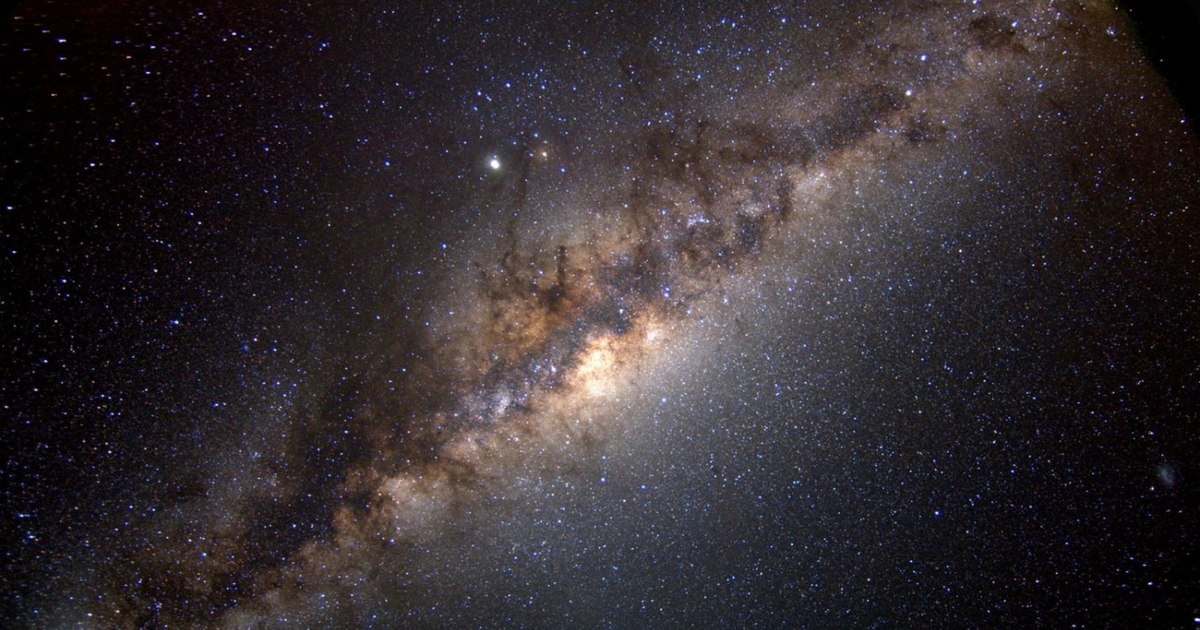
The Milky Way may have already collided with a neighboring galaxy – and scientists say this could send the Solar System into deep space, according to The Sun.
Earth would be blasted into deep space. Photo: Archive
The galaxy is classified as a barred spiral, with bands of stars, gas and dust running through its center.
All galaxies are surrounded by a thin veil of gas known as the circumgalactic medium, which fills the gaps between While analyzing this ubiquitous structure, scientists discovered evidence that the Milky Way is moving toward Andromeda.
Astronomers in Australia and the United States used the Keck Cosmic Web Imager to capture snapshots of IRAS08, a small spiral galaxy about 270 million light-years away.
They analyzed changes in the circumgalactic environment 90,000 light-years beyond the edge of the galaxy. Their findings were published in Nature.
Some images showed a streak of hydrogen gas connecting IRAS08 to a smaller neighboring galaxy, but this is not unusual.
The universe is connected by a vast network of gaseous filaments and threads of dark matter, forming what is called the cosmic web.
Galaxies could be bigger
However, the unexpected element was the discovery of hydrogen that had been stripped of its electrons as it mixed with oxygen.
Atoms have two sources of heating in space: starlight from distant galaxies and encounters with other particles.
Scientists can use these parameters to calculate an expected ionization pattern from a mixture of hydrogen and oxygen.
The researchers mapped changes in ionization density over several thousand light-years and found that the starlight in IRAS08 was losing its influence.
“In the CGM, the gas is heated by something other than the typical conditions inside galaxies, this probably includes heating from diffuse emission of collective galaxies in the Universe, and possibly some contribution due to shocks”said lead author Nikole Nielsen.
“This interesting change is important and provides some answers to the question of where a galaxy ends”.
In short: galaxies might be bigger than astronomers thought.
These findings may apply to the Milky Way more generally, meaning that its stars may already be mixing with Andromeda’s bright halo.
Andromeda is another barred spiral located about 2.5 million light-years away, making it our closest neighbor.
The new findings have given rise to two theories. First, it is possible that the boundaries of the Milky Way are larger than previously thought.
But a second, more sinister theory suggests that the long-awaited collision with Andromeda has already begun.
When galaxies collide, their gravitational fields interact, changing the alignment of the stars and distorting their appearance.
When the collision will occur
Andromeda and the Milky Way are expected to merge into a giant elliptical galaxy, dubbed “Milkdromeda”, although it is not yet known what effect it will have on our solar system.
According to 2007 calculations, there is a 50% chance that the solar system will be three times more distant from the galactic core than the current distance.
Other researchers put the odds of the solar system being blasted into deep space at about 12 percent.
NASA claims that Earth and the other planets will survive, although they may have new coordinates. At that point it will no longer matter because the Earth will no longer have the capacity to support terrestrial life.
By the time the galaxies actually collide, the surface of our planet will be far too hot to host water.
The Sun’s brightness increases by about 10% every billion years due to the hydrogen burning in its core. At some point in the distant future, it is predicted that the water on Earth’s surface will evaporate completely.
However, the planet will still be caught in the middle of this intergalactic merger.
The collision between the Milky Way and Andromeda is expected to occur in about 4.5 billion years.
