
Ion Iliescu was the first president in the history of Romania. He had a turbulent childhood, was educated in the USSR, was protected by Anna Pauker and tried to overthrow Ceaușescu five years before the Revolution. He served two terms as president and two as senator.
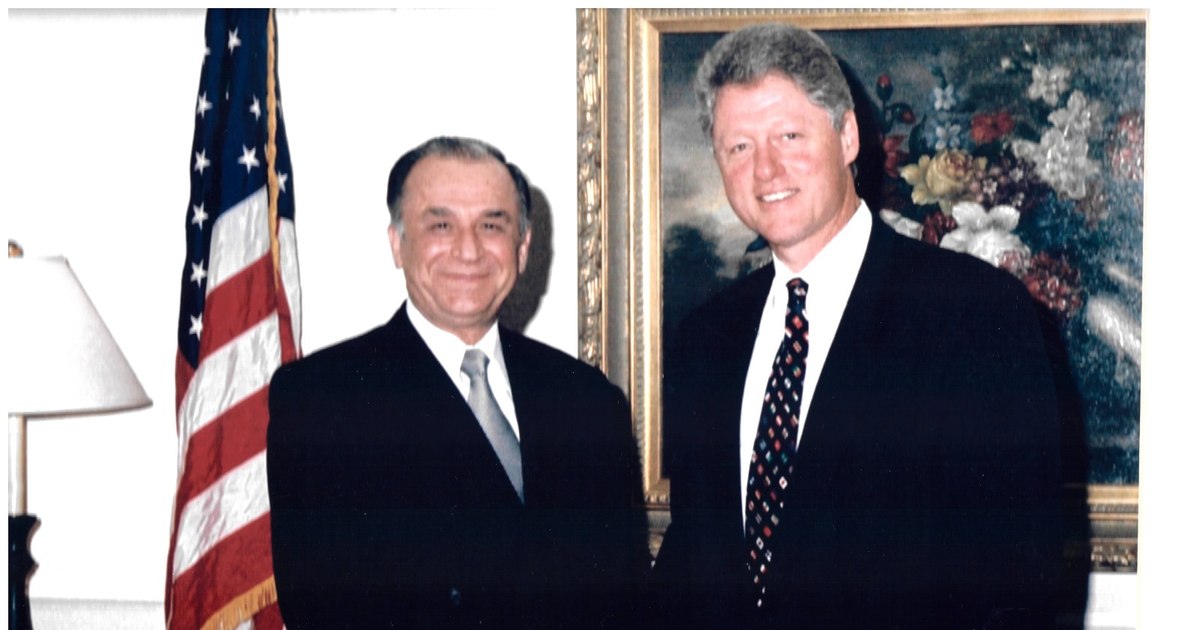
Ion Iliescu and American President Bill Clinton PHOTO The truth
In 1990, for the first time in history, Romania became a republic and was led by a president, elected following the presidential elections on May 20, 1990. They were the first free elections after 45 years of communism. The first president of Romania was Ion Iliescu, a former nomenclatureist, seen since the communist period as one of the people considered as Ceaușescu’s successor. His election as president of Romania, in his first term, was marked by street protests, mining raids and events that had little to do with the freedom of expression that many had dreamed of when Ceaușescu died. Moreover, there are rumors and opinions that show that what actually happened after the street riots in Timișoara and Bucharest was a long-awaited seizure of power by Iliescu and other second-echelon communist leaders, a victory in the struggle for succession with Nicu Ceaușescu and other close relatives of the Ceaușescu clan.
The child abandoned by his mother, with a tangled biography
Ion Iliescu, the first president of Romania, was born on March 3, 1930, in Oltenița, Călărași county. His father, Alexandru Iliescu, was a railway worker and illegal communist. Ion Iliescu’s mother was Maria Toma, a Bulgarian woman who abandoned him since childhood. After the divorce from the Bulgarian woman, Alexandru Iliescu remarries Maria, a chambermaid. Ion Iliescu was raised by his grandparents, but also by his stepmother. His father, Alexandru, a fervent communist, went to Moscow for four years where he also participated in the 5th Congress of the Romanian Communist Party in Gorikovo, near Moscow. When he returned, he was arrested by the Romanian authorities.
Alexandru Iliescu died in prison, say some versions. Others that he would have died later, in Oltenita, during a demonstration on May 1. His son had a difficult childhood, devoid of parental affection. There are many variants regarding the origin of Ion Iliescu’s parents, some rumors, others testimonies of people from the Oltenița area. Some say that his grandfather’s name was Vasile Penu and he was a peasant, a war veteran, from the Oltenița area. Ion Iliescu’s father, Alexandru, being disowned by the family for his communist leanings, would have changed his name from Penu to Iliescu. Other sources show that, in fact, Iliescu’s grandfather had Jewish origins. Vasili Ivanovich would have called him and he would have arrived in Romania from the Tsarist Empire, where he was persecuted for his communist views.
The communist child raised under the spell of “Stalin in a skirt”
Coming from a family of communists, from father to son, it was natural for Ion Iliescu to take the same path. Communist ideas were instilled in him since childhood. In addition, he was the protégé of Anna Pauker, nicknamed “Stalin in a skirt” for his fanaticism and ideological intransigence. Ion Iliescu was adopted, at the age of 9, by his aunt Arisita. He was a child effectively abandoned by his parents, and his aunt and grandparents they tried to make sense of it. He attended primary school in Oltenița, and then secondary school in Bucharest, where he moved with his aunt during high school, things started to go better and better for the orphaned teenager from Oltenita.
Arisita, his aunt (or his stepmother, Marița, according to some sources) worked as a cook for Anna Pauker, who, after 1945, had become an important figure in Romania, a man of the Soviets charged with the Stalinization of the country. The young Iliescu is taken under the protective wing of the communist leader. He attended important high schools in Bucharest, such as “Spiru Haret” and “Sfântul Sava” and then he was sent to college. He studied fluid mechanics at the Polytechnic Institute of Bucharest and then he arrived at the University of Bucharest, where he studied the field of energy. Iliescu follows the deology of the grandfather, the father, the benefactor. That is, he becomes a communist with schooling, prepared for the nomenclature elite and the transformation of Romania into a communist state. In Moscow, he becomes secretary of the “Romanian Students Association”. Here he also makes his first serious acquaintances. It is said that he also met Gorbachev during his student days, although both officially denied this.
A young man from the future of the Communist Party
Ion Iliescu has always been a leftist, as he testified in various interviews. It was not surprising, most of the relatives were illegals. However, Ion Iliescu caught the favorable train of communism. He did not have to suffer persecution, nor was he threatened with imprisonment. He became a UTC-ist in 1944 and later a full member of the Communist Party in 1953, when Romania had already become a Socialist Republic. Being a young man trained and at the same time loyal to the party, with “healthy” illegal origins, Ion Iliescu quickly advanced up the ranks of power within the party. He was nominated secretary of the Central Committee of the Communist Youth Union, in 1956, and later a member of the Committee Central Committee (CC) of the Communist Party, he was the head of the Propaganda Department and later the Minister of Youth 1967. At not even 40 years old, Iliescu was a rising star of the Communist Party.
Possible ties to Gorbachev and power struggles between communist factions
Although close to the Ceaușescu family, present in family photos of the dictatorial couple, Ion Iliescu, the young perspective of the communist regime in Romania was removed, apparently suddenly and without good reasons. Iliescu’s removal was as strange as possible. He was marginalized, but not even Ceaușescu had the courage to smear him, compromise him and possibly take clear measures against him. And this in the conditions in which Iliescu was part of a plot against him, foiled by the dictator’s services. Is it possible that Iliescu had much stronger support outside Romania’s borders? It’s a question many have asked themselves. Including foreign newspapers. For example, the French magazine Paris Match advanced the idea that there would have been a connection between Iliescu and Gorbachev, established since the college years and cultivated later, in secret.
Foreign journalists came to this conclusion considering Ceaușescu’s behavior. During Gorbachev’s visit to Romania in July 1989, Iliescu was effectively banished from Bucharest in order not to contact the Russian leader. Was it just paranoia? It is certain that Iliescu, starting in 1972, is distant, but without sudden movements. Until 1985, Ceaușescu did not have the courage to remove him from the Central Committee. Only one from the plot manages to do this. In the meantime, however, he walked Iliescu through functions, as far away from Bucharest as possible. He was successively vice-president of the Timiș People’s Council and then in Iași, until 1979. Finally, until 1989 he was director of the Technical Publishing House. It is suspected that all the peasantry with Iliescu was pulled from the fight for the succession. Ceaușescu was suffering from prostate cancer, plus uncontrolled diabetes. There were doctors who said he would live until the summer of 1991 at the most. Others saw him dead already in the summer of ’90. Under these conditions, two power camps were formed, which sought the succession to power in communist Romania.
On one side was Nicu Ceaușescu, supported by his mother, but also by all Ceaușescu’s cheerleaders, the servant members of his chamber, including Emil Bobu. On the other side was Iliescu, considered by many to be Ceaușescu’s successor, but also a host of generals including Nicolae Militaru or commander Radu Nicolae. In 1984, this group, which met at General Ioniță’s home, was one step away from overthrowing Ceaușescu. The action would have been planned for 1985, when Ceaușescu had planned a visit to Canada. This plot supposedly had Gorbachev’s blessing. In any case, the plan failed. Some say that Militaru would have betrayed. Even so, Iliescu remained untouchable. Marginalized, but not in prison.
The Mazilit nomenclaturist becomes president of free Romania
At first sight it seemed that the struggle for the succession was won by the Ceauști clan, which thus became a hereditary dynasty of communist Romania. Nicu would follow Nicolae after his predicted death in the summer of 1991. Only at first sight. In reality, against the background of the popular uprisings that broke out in Timișoara and Bucharest, an apparently revolutionary movement appeared, of which Ion Iliescu was also a part, called CFSN. The revolutionary movement turns into a political one, and the FSN presents itself in the first free elections after 45 years of communism. Ion Iliescu, who had failed six years ago to bring down Nicolae Ceaușescu in the “conspiracy of the generals”, was running for the presidency of Romania.
On May 20, 1990, Iliescu was elected unanimously, despite the protests in Piața Victoriei and later in Piața Revoluției, in which people accused the FSN-ists of not keeping their word given at the Revolution not to constitute a political party. In fact, they accused that Iliescu, a former nomenclaturist, was preparing to run. Things were solved, brutally, with the help of the miners, by methods that did not at all resemble democracy or freedom of speech. Ion Iliescu was president of Romania for two terms, between 1992-1996 and also during 2000-2004. At the same time, he was a PSD senator, in the period 1996-2000 but also 2004-2008.
