
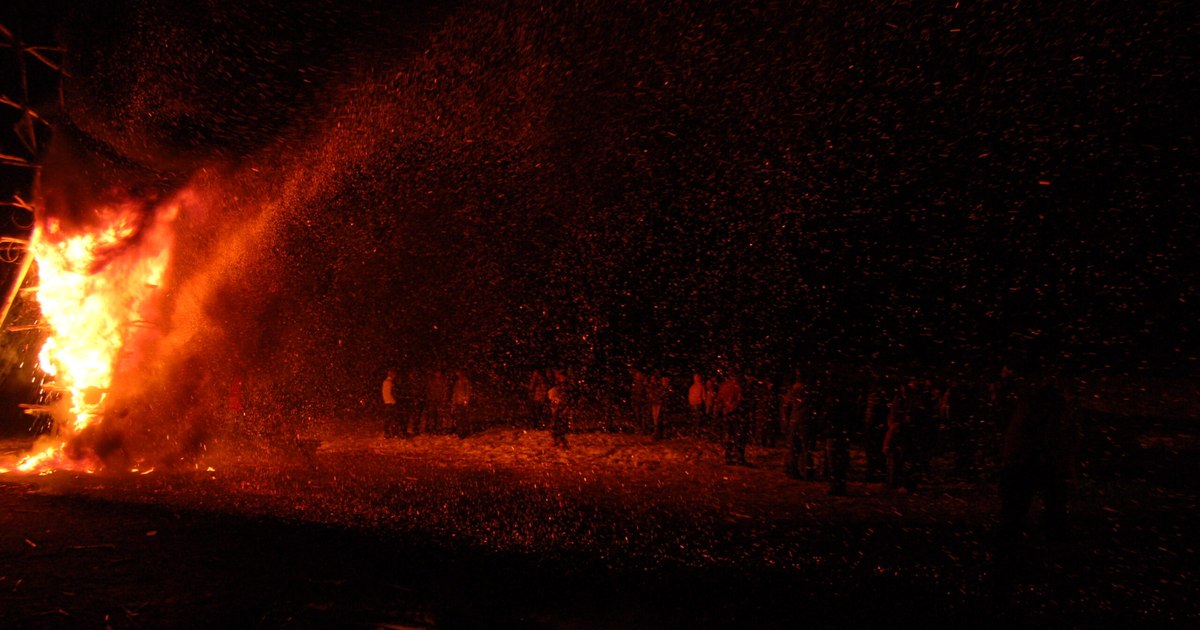
The Winter Estates and the Meat Drying Rack are two events that bring relatives and members of the local community together this weekend. A custom once practiced on the hills in Oltenia has now moved to the center of the village.
“Winter estates”, “Mosii de piftii” or “Mosii cei mari” (throughout the year there are four holidays, in the four seasons, dedicated to the memory of the ancestors), along with Lăsatul Cului, are two popular holidays that mark this weekend. If Moșii de Iarnă is the holiday dedicated to the departed, for whose souls food is ritually distributed (meatballs are the base), Lăsatul de Cului is a custom that succeeds in bringing family members together. The children go to their parents, the godparents to the grandparents, the little ones to the big ones, and spend time together at rich meals, with dishes that will no longer be able to be eaten once the Easter Lent begins.
Also on Lăsatului de Sec Sunday, the ritual fires are also lit, events that this time bring together – where the custom has been preserved, or has been revived – the whole community. In the past, these fires were organized outside the town, accompanied by the shouts of young people distributed in groups, on the hills.
Winter Estates – trial by fire for housewives, Lăsatul Secului – a New Year’s Eve on the eve of spring
Midsummer is a holiday that combines religious and secular traditions, as it happens with many other holidays. According to the ethnologist Ion Ghinoiu, before Lăsatul de Sec, the practices of commemorating grandparents and ancestors abounded. In the past, Fathers’ Saturday was marked before Lăsatul de Sec, the day when the dead who met their end in sudden circumstances and those who did not have a candle were commemorated. Also on this Saturday, the faithful share food for the souls of the departed, thus marking the Winter Estates – also called the Carnelegi Estates in Moldova and Bucovina, the Piftii Estates in Oltenia and Muntenia, Sacrilegi and Sacrilegiu Mic in Banat. On this occasion, steaks and baked goods, pies and drinks, vessels for drinking water, etc. are given as alms.
In Oltenia, meatballs are the main food shared by the souls of the dead on this occasion, and for housewives today, as in the past, they represent a true test of culinary mastery.
The Winter Estates are followed, on Sunday, by Lăsatul Secului. In ancient times, people knew that Lăsatul Secului is positioned between Fool’s Week and Holy Week. A custom is linked to Lăsatul Secului – shouting across the village – preserved to this day in Oltenia, a custom practiced without great differences in other areas of the country as well, but at another time.
“QThere are no essential differences between the transylvanian village shout at New Year and Easter (Joimari or Easter Saturday) and the village shout in the Romanian country practiced at Lăsatul Secului. The goal is the same: the communication of the bad deeds that happened throughout the year, in a nocturnal setting and on a calendar date specified by tradition, so that those concerned enter the new year (ed. – in this case the new agrarian year) purified and with equal chances of fulfillment as the other members of the community”. notes Ion Ghinoiu in the volume “Romanian Holidays and Customs”.
The night of Lăsatului de Sec, located in the middle between Fool’s Week and Sântoader’s Horse Week, used to be celebrated as a real New Year’s Eve.
“Everything that is done at Lăsatul Secului is abundant: they play a lot to grow hemp, they eat and drink in abundance to make up for the severity of the fast and so on. We find very interesting the information from Bucovina according to which the merriment and the party ended with the consumption of boiled or baked chicken eggs (Marian, 1898, vol. I, p. 265). in Wallachia, the nocturnal party took place on Sunday evening, on the day of Lăsatul de Sec. The party was family: the little ones came to the big ones, the children to the parents, the grandchildren to the godparents. Those who came to perform the Lăsatul Secului would bring a plum each, kiss the hand and ask for forgiveness and reconciliation from the host, who was an older relative or a godfather. In Transylvania and Banat, the nocturnal party had different names, depending on the area: Alimori (wheel of fire), La Zăpostit (Left of the Century), Priveghi (term that designates any nocturnal party of the time), Opaiţ (name received from an ancient lighting instrument), Hodăiţe (the club with two branches between which straw and corn cobs are stuffed, which are set on fire). In its archaic form, the party was held under the open sky, by the light of a fire, usually on a hill or a rise, and had small calendar variations (Saturday evening before Meat Shallow, Saturday evening before Cheese Shallow, Sunday evening before White Week, Sunday evening before Shallow)”. it is mentioned in the volume “Romanian Holidays and Customs” signed by Ion Ghinoiu.
“Come to Bobotaie/ With a handful of straw/ And one of cocini/ Like at poteleni!”
In many towns in Oltenia, the custom of “fires” is preserved to this day, even if it has undergone certain changes over time. The young people who have the role of making the calls no longer gather on the hills, but in the village, either at the gates or at the crossroads. The moment of organizing the “Shouts across the village”, or “Bobotăile”, or “Fireworks”, can be different from one locality to another. There are villages where the celebration takes place on Shrove Tuesday (in 2026, Sunday 15 February) and others where the community gathers on Shrove Tuesday (the following Sunday). In other localities, the cry is organized across the village on both Sundays, hence the phrase “we put the girls in cheese and next week we take them out”.
In Olt County, Lăsatul Secului will organize such a moment on Sunday, February 15, 2026, in the Ianca commune, in the Ianca and Potelu localities.
“In Ianca and Potelu this custom is called Bobotaie. So
The custom of lighting large fires on this occasion is still preserved in Olt in many localities, although not in all of them it has survived in its former structure. Those people from the village interested in passing on the custom as they received it need to be encouraged, says artistic consultant Valeru Ciurea, from the Olt County Center for Culture and Art.
“Crying across the village” meant that the crier, divided into two groups, would position themselves on the hills. From one group started the shout, aiming at a certain person in the village, and the other group had to give the answer regarding the invoked one. Various things were revealed about the “shouted” that did them no credit. Also from the hills were launched towards the valley the burning chariot wheels, previously prepared with straw and other inflammable materials. The fire was then maintained throughout the night, with the light and warmth of the flames passing through the entire community. Currently, the fires have moved from the hill to the locality, and the “cries” are today harmless, for fear of the criminal complaints that – it happened – the victims can file. The town halls that organize such events are also obliged to ensure fire protection and safety measures, and fire has also become an environmental problem, over time reaching from the old wagon wheels and dry trees in the forests to old tires whose burning emits toxic smoke.
With all the changes that have occurred over time, since Lăsatul Secului there are good chances to see bigger or smaller fires in the villages of the south of the country.
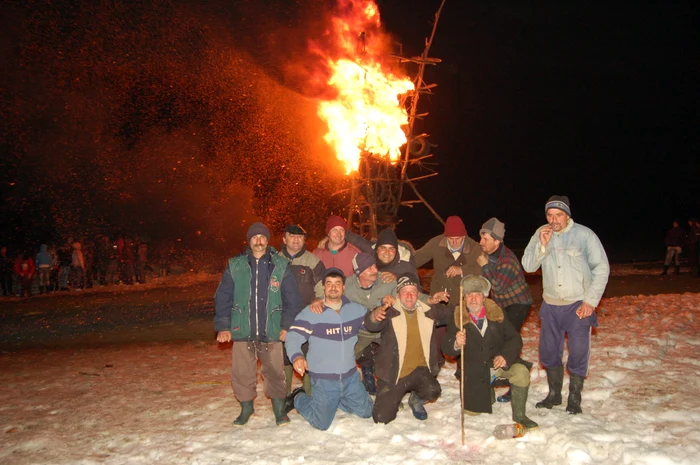
“Those who make their way to the gates, two, three, four, five families at a time, are the ones who light the fire to have a reason to party. They are the ones who have no end of income. But where things happen organized, many people come, as they were last year in Morunglav. Always where this is done there is a man in charge, or a handful of men. When they are gone, each one will light a tire at the gate and that’s it. Locals who maintain the custom should be encouraged. I write about them and talk about them”artistic consultant Valeru Ciurea also said.
