
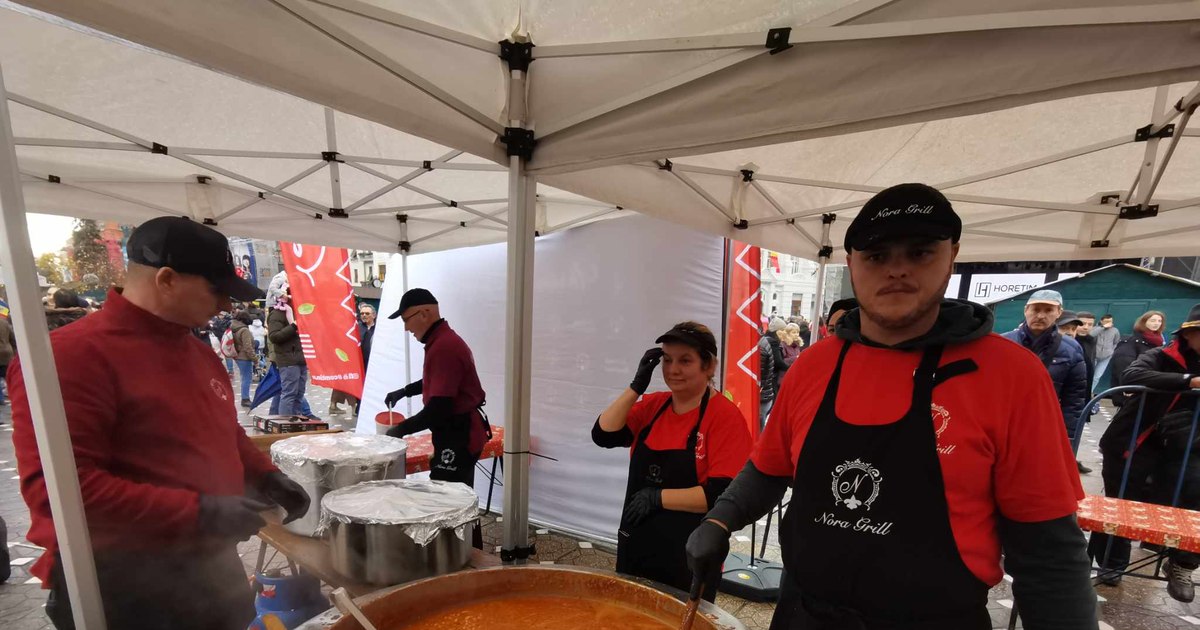
It is unrealistic to believe that the Mediterranean/Nordic diets, the healthiest in the world, will be able to be introduced in Romania on a large scale. Romanian researchers are analyzing the Carpathian-Danubian diet, a food model that tries to reconcile specific Romanian products with healthy eating.
From the traditional National Day food, we keep the beans and give up the sausage. PHOTO: Ş. Both
Babeș-Bolyai University will study the Carpathian-Danubian diet created by Cluj-based nutritionist Nicolae Hâncu and his team, inspired by the healthiest diets in the world: the Mediterranean and Nordic diets.
The project is called “CARPO for a healthy eating behavior” (CARPO the acronym for the “Carpatho-Danubian” diet) and is run by the National Center of Competences in Healthy Lifestyle, founded by the Romanian Academy and UBBMed.
“It is unrealistic to believe that the Mediterranean/Nordic diets will be able to be implemented in Romania on a large scale with products imported directly from those areas, taking into account the availability of products and their costs, this option being unproductive for the country's economy”– claimed the rector of UBB, Daniel David.
In the first half of 2024, Romanian products that can replace Mediterranean/Nordic products will be biochemically analyzed, but respecting the principles of the Mediterranean/Nordic diet.
An example of this is replacing the well-known salmon from the Nordic countries with Romanian trout or replacing olive oil with cold-pressed sunflower oil.
Starting from autumn 2024, the “Carpatho-Danubian” diet will be tested in controlled clinical trials, involving the UBB Canteen, the University Clinic of Psychology, which will analyze the implications on mental health and adherence mechanisms (including cognitive-behavioral changes in eating behavior ), as well as various UBBMed structures, which, through the existing laboratories, in collaboration with other necessary specialists, will analyze the biomedical implications.
Conclusions and practical implications, based on scientific evidence, will be formulated in early 2025.
“Adevărul” talked with the founder of the Clinical Center for Diabetes, Nutrition and Metabolic Diseases in Cluj-Napoca, Prof. Univ. Dr. Nicolae Hâncu, about the basics of the Carpathian-Danubian diet and what we can keep from traditional Romanian cuisine.
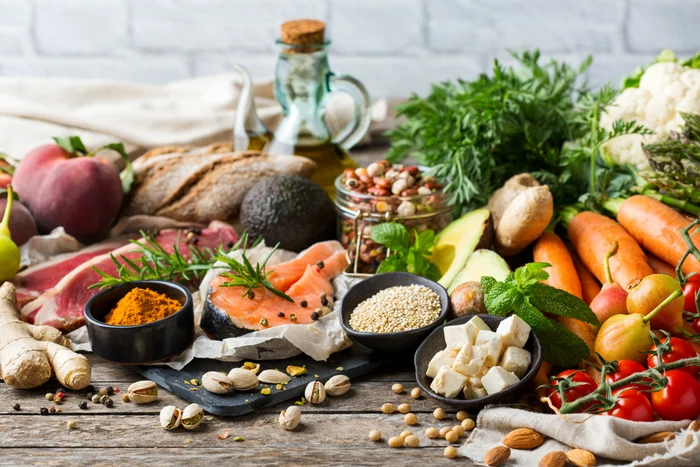
The healthiest diet is the Mediterranean diet. PHOTO: Shutterstock
The healthiest food pattern
Hâncu claimed that the most famous food model in the world is the Mediterranean one.
“It enjoys, at the moment, unanimous appreciation all over the world, even with awards calculated on the basis of surveys done in the United States, in the media, in the scientific world, in the university world on several levels. Every year, results are announced in January. For five years, the Mediterranean diet has been the absolute winner”says the teacher.
In addition, the Mediterranean diet has been declared UNESCO heritage. “Because the Mediterranean diet is a diet that has been taken up in the scientific world, studies have been carried out that have made some extraordinary contributions in primary and secondary prevention in cardiology. The first studies in the world of nutrition that demonstrated that through this type of diet, the occurrence of cardiovascular diseases can be prevented in those who do not have such conditions, and in those who have cardiovascular diseases, their worsening can be prevented. The success of the Mediterranean diet is immense and many countries have sought to adopt it”claims Hâncu.
Before the pandemic, Nicolae Hâncu and his team designed a food model with Mediterranean and Nordic influences, also known for its undeniable health benefits.
“And then we said, we are in the middle of the distance between the areas where these diets are dominant, so we came up with our model, which involved replacing some foods from the Mediterranean/Nordic diet with others found in our country”explains the teacher.
An example in this sense is the salmon from the Nordic diet, which is found in the Mediterranean diet, and which will be replaced by the trout from Romania.
“We want to see to what extent the foods we want to replace from there with others from us have the same value”explains the teacher.
Another extremely important food of the Mediterranean diet is extra virgin olive oil.
“We want to replace it with oils from Romania, especially cold-pressed sunflower and corn oils, which are not refined, but we lack the scientific basis. And then we set out to analyze whether there are similar beneficial effects, because there is no perfect diet, there is no perfect food, which is why it's called diversification, diversification, diversification”Hâncu explained.
The teacher explains what a food pattern means: “Until about 15-20 years ago, diets were based on macronutrients, i.e. carbohydrates, lipids and proteins. Now the rule is given by a food model that assumes everything a person eats during a day, weeks, months”.
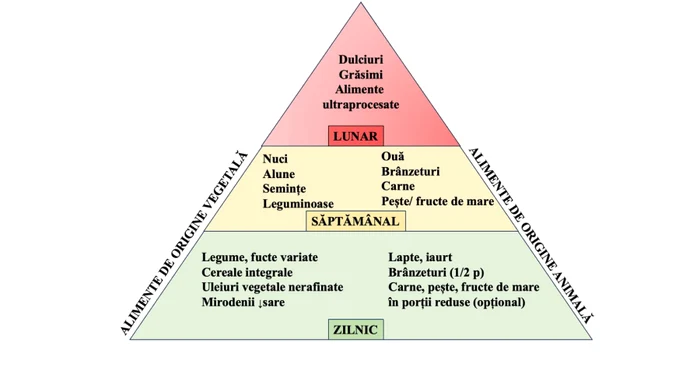
Carpatho-Danubian food pyramid. PHOTO: CARPO project
Healthy food pyramid
The nutritionist explains what the Mediterranean model consists of: “We eat all five food groups, cereals, fruits, legumes, foods based on proteins – of vegetable or animal origin – or very fatty and very sweet foods, and then a food pyramid was formed. At the base of the pyramid we have cereals, vegetables, fruits. In the middle of the pyramid we have meat, fish, eggs, cheeses, dairy products. And right above, at the top of the pyramid, we have everything fatty and sweet“.
To make it easier to use, Hâncu and the team modified the pyramid.
“We modified the pyramid a bit and said we're not interested in stratification by food, we're interested in how often the food is eaten”he explained.
In the original pyramid, designed by Spanish and Italian nutritionists, olive oil was somewhere at the top of the pyramid, given the fact that we need to consume little fat.
“We decided to bring it down to the bottom of the pyramid, because it is consumed daily in small quantities, of course. This is just an example that shows how we built this pyramid and we have been working with it for many years”.
The pyramid helps us determine how often and how many portions of food we can eat daily, weekly, monthly: “Vegetables, i.e. grains, fruits, vegetables, we eat daily and even several times a day. In contrast, the foods in the middle of the pyramid – meat, fish, eggs, seafood, cheeses, dairy – are eaten several times a week. What we find at the top of the pyramid, fats and sweets, are eaten a few times a month, so very rarely.”
Patients will be able to use the food pyramid more effectively. “Can you eat a slice of bacon? This is at the top of the pyramid, so maybe once a month”the teacher explained.
Hâncu emphasizes: “The food must be predominantly vegetable, the diet is omnivorous. You eat everything, but vegetables are ubiquitous.”
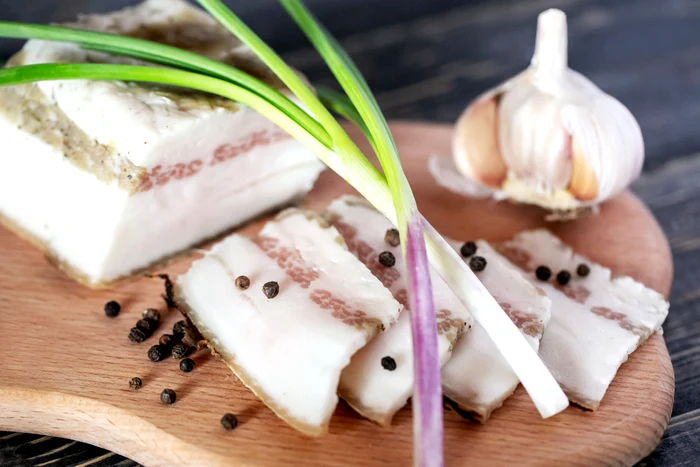
Fatty foods should not be part of your daily diet. PHOTO: Shutterstock
The truth about traditional cuisine
The nutritionist states: “The food must be of high quality, fresh, unrefined, the oil must be unrefined, the grains must be unrefined and their preparation must be adequate, in the sense that the traditional cuisine, especially here in Transylvania, focused on frying, on rantaş, practically must disappear“.
Asked if the traditional Romanian diet has its place in the Carpathian-Danubian model, Hâncu answered: “Of course, traditional Romanian cuisine is very tasty, but we do not have enough data to say that it is a healthy diet. On the contrary. You will ask me: where are the smoked meats, where are the pork dishes, where is the lamb that appears now at Easter? What do we keep from this traditional diet?”.
The answer of the well-known specialist will not please the followers of traditional cuisine.

Nicolae Hâncu, founder of the Cynical Center for Diabetes, Nutrition and Metabolic Diseases. PHOTO: The truth
“There are too few things we can say at the moment that we can keep. Sure, beans are traditional, but without sausage, for example”explains the nutritionist.
Hâncu claims that the traditional dishes specific to the two important religious holidays, Easter and Christmas, such as pork and lamb dishes, are far from having a superior quality in nutrition.
“They do not find their place in a healthy diet. Eventually, they can be used as a simple snack. That is, let's eat 100-150 grams of lamb steak once, then at Easter, and that's it”he explains.
Around the Christmas period, the situation is even more problematic, because for almost a month, a lot of pork dishes are consumed.
“You're going to ask me, good, but then, what's the point of the CARPO project. Science has no limits and we are now looking for new valences, we are looking for new arguments regarding how valuable specific Romanian foods are”explains the teacher.
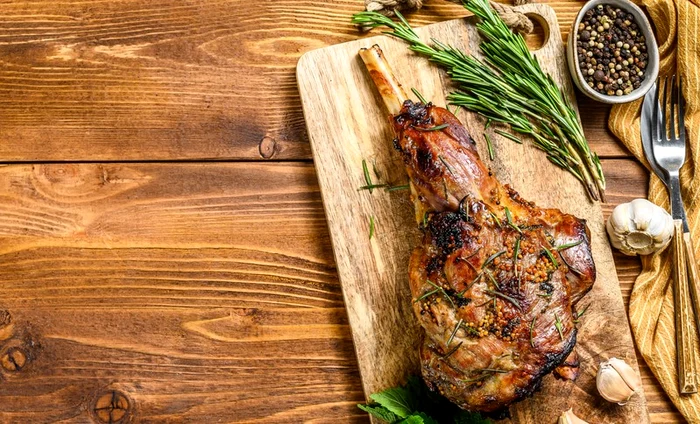
Hâncu recommends roast lamb only for Easter. And so. PHOTO: Shutterstock
Healthy lifestyle
In addition, the project carried out by UBB and the Romanian Academy, which established the National Center of Competences in Healthy Lifestyle, analyzes all the elements that presuppose a healthy lifestyle.
“A healthy lifestyle has three vital elements: nutrition, exercise, sleep. There are other components, but these are vital. Another component refers to the extent to which we engage or adhere to education programs, go to regular medical check-ups, comply with the vaccination regime, etc. Who is prescribing this lifestyle? Lifestyle means the sum of behaviors. Who is responsible for the behaviors? psychology”explains the teacher.
He points out that there is a very important mutual influence between nutrition and the mental state of people.
“The Mediterranean diet is currently the diet that prevents depression and delays the aging process. So two extremely important elements. UBB launched the model according to which man must be viewed from three points of view: biomedical, psychological and social. The Mediterranean diet does exactly that, it allows the perfect integration of the food pattern in the psychological and social fields. Because it is affordable food. It is very well tolerated because it is very tasty. And if we rely only on the fact that we can afford to publish a nutrition book in which we say: “eat Mediterranean” means that the social impact is commensurate“, concluded the doctor.
