
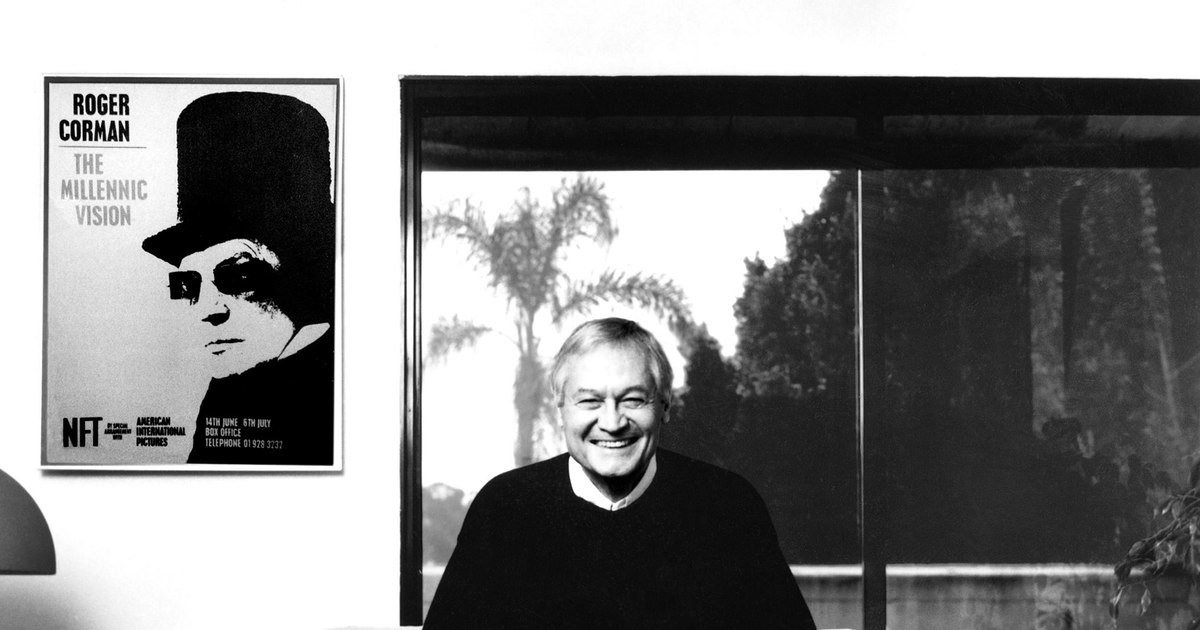
Roger Corman, who directed a string of cult films including 1960's The Little Shop of Horrors, has died aged 98.
Roger Corman died at the age of 98 PHOTO: facebook
His family told Variety that the director died at his home in Santa Monica, California, writes bbc.com.
“His films were revolutionary and iconoclastic and captured the spirit of an age,” it is shown in the family statement.
Jack Nicholson and Robert De Niro are among the actors he helped develop, and directors James Cameron and Martin Scorsese found success with his films.
Many of his films became cult classics, and he became famous for the speed with which he worked, often making two films in the same location at the same time to save money.
Roger Corman was born in Detroit on April 5, 1926. His father, William, was an engineer, and he intended to follow in his footsteps.
However, while in college, he was drawn to cinematography, and after a stint working for General Motors, he quit his job and went to work for 20th Century Fox as a messenger.
Failing to make much progress, he went to Europe, where, among other things, he briefly studied English literature at Oxford. He returned to the US with the ambition of becoming a screenwriter.
He sold his first screenplay, The House in the Sea, in 1953, and the following year it was filmed as Highway Dragnet, with Corman credited as a co-producer.
However, he was so upset by the changes to his story that he raised some money and set himself up as a producer.
Corman began directing in 1955 with Swamp Women, and over the next 15 years he made more than 50 films, gaining a reputation for the speed with which he could make them.
It became something of a running joke in the movie industry that Corman could negotiate a contract from a pay phone, shoot the movie in the phone booth, and pay for it with coins from the change slot.
The 1960 release The Little Shop of Horrors, which featured a brief appearance by a young Jack Nicholson, was shot in just two days, with Corman using the set of an earlier film, Bucket of Blood ( The bucket of blood).
A stage musical based on this film premiered in 1982 and would in turn spawn a second film version four years later.
Corman decided to broaden his horizons with a series of films based on the works of Edgar Allan Poe, starring Vincent Price in all but one of the films.
The House of Usher was released in 1960 and was followed by a number of other films including The Raven, The Masque of the Red Death and The Tomb of Ligeia.
His 1962 film The Intruder, which examined racial tensions in America's Deep South, starred a young William Shatner and won an award at the Venice Film Festival.
Despite this, the film flopped at the box office and became Corman's first film to make a loss, prompting him to remark that he would stick to making films that entertain rather than convey a social message.
For a time, he became part of the 1960s counterculture, making the biker film The Wild Angels, starring Peter Fonda and Nancy Sinatra.
He also directed the film The Trip, which was written by and starred Jack Nicholson. The film was considered the precursor to Easy Rider, starring Peter Fonda and Dennis Hopper.
In the late 1960s, he started his own production company, New World Pictures.
In addition to continuing to make low-budget films, he began taking on films made by renowned foreign directors, including Francois Truffaut, Ingmar Bergman, and Federico Fellini, and introducing them to American audiences.
He sold New World Pictures in the 1980s but went on to form two other production companies. He also returned to the director's chair in 1990 with Frankenstein Unbound.
Based on a novel by Brian Aldiss, the film starred John Hurt and Bridget Fonda and featured a cameo appearance by Michael Hutchence, lead singer of the Australian band INXS.
He received a lifetime achievement Oscar in 2009 and continued to work into his 80s, producing the 2010 films Dinoshark and Sharktopus for the Syfy television channel.
The sheer amount of films he has worked on is almost unprecedented, as is his ability to find and nurture new talent.
Many of his films have achieved cult status and few directors have managed to make popular films on such low budgets.
When asked how Corman would like to be remembered, he said: “I was a director, that's all” the family said.
