
Scientists have warned that this summer could include some of the shortest days of all humanity.
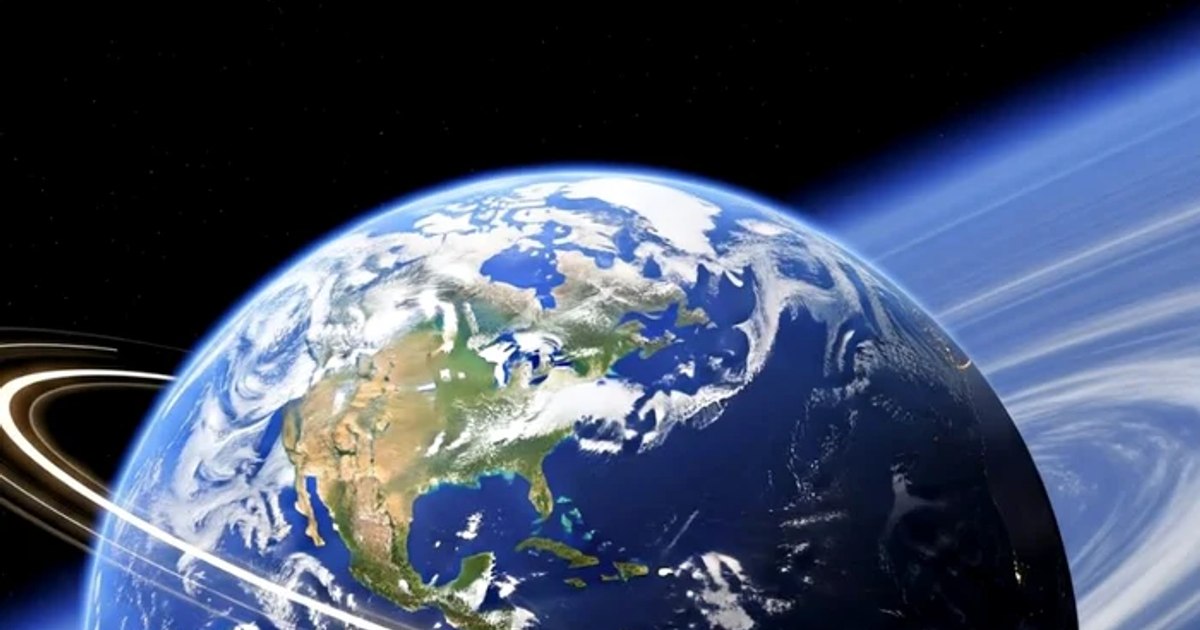
The rotation of the earth/photo: x
On July 22 and August 5, experts provide that the day will be 1.38 and 1.51 milliseconds shorter than the average.
This is due to the fact that the rotation of the planet has entered a period of an unexpected acceleration, reducing the duration of a solar day.
But what would happen if the world continued to move faster and faster?
Given that a blink lasts 100 milliseconds, you are unlikely to notice major changes for a long time, writes the Daily Mail.
However, scientists say that an uncontrolled acceleration would eventually lead to disastrous consequences.
If the Earth would rotate with only 160 km/h faster than it does now, the world would be hit by stronger hurricanes, catastrophic floods and collapse of satellite networks.
And, if the world doubled their speed, it would probably be the end of life as we know it.
By 1.6 km/h faster
On average, the planet needs 24 hours, or 86,400 seconds, to make a complete rotation, called solar day.
Small fluctuations, such as the position of the moon or volcanic eruptions, can change this duration by approximately one millisecond in both directions, but rotation is generally quite stable.
Because the earth is a sphere, its circumference is smaller near the poles than in the equator, so that the surface of the planet moves faster as you move away from the poles.
A person standing at the equator rotates in space by approximately 1,668 km/h, while a person in London only moves about 1,041 km/h.
Compared to these speeds, an increase of only one kilometer per hour may not seem like a big difference.
The days would be about one and a half minute shorter in total, which our biological clock probably would not notice immediately.
Witold Fraczek, an analyst in ESRI, a mapping software company, said for the popular science: “It may take a few years before we notice this. “
However, an unexpected effect is that the satellites in orbit would soon be removed from synchronization.
Some satellites are “geosynchronous ”,
which means it moves at the same speed as the ground rotation to stay in the same location.
If the Earth accelerates, these satellites will lose their position, and the navigation, communications and meteorological monitoring services will start to work defective.
However, some satellites transport fuel to adjust their orbit, and others could be replaced, so that the results should not be disastrous.
Fraczek says: “They could disrupt the life and comfort of some people, but they should not be catastrophic for anyone. The greater impact is that the water would begin to move from Poli to the equator due to increased centrifugal forces. ”
Even at only 1.6 km/h, this would cause the sea level to increase by a few centimeters around the equator.
For cities already at sea level or very close to it, this could lead to devastating floods.
With 160.9 km/h faster
If the Earth continued to accelerate until they get to move with 160.9 km/h faster at the equator, this would start to trigger extremely dangerous consequences.
Instead of growing a few centimeters, these speeds would begin to flood the equator, as the water flowed from Poli.
Fraczek says: “I think the Amazon basin, northern Australia and, of course, the islands in the equatorial region, would all be covered by water. I don’t know exactly how deep, but I estimate that it would be between 9 and 20 meters. “
For those who would survive the floods, the world would begin to become a much more hostile place.
The solar day would last only 22 hours ago, disrupting the natural balance of our circadian rhythms.
The effect would be similar to that of a change of the biological clock two hours back every day, without having the chance to adapt.
Studies have shown that changes such as switching to summer time increases the rate of heart attacks, strokes and road accidents – and this phenomenon would be even worse.
In addition, the Earth’s climate would begin to become more extreme.
NASA astronomer, Dr. Sten Odenwald, says: “The temperature difference will remain the main factor that determines the winds ”
However, at these speeds, Dr. Odenwald says that “The hurricanes will rotate faster and have more energy. ”
This is due to a phenomenon called the Coriolis effect, which gives the hurricanes their rotational energy.
If the earth did not rotate, the winds would blow from the North Pole to the equator in a straight line. But, as the earth rotates, the wind is diverted to the east, and this gives the hurricane its rotation.
If the world was beginning to rotate faster, the winds would be more diverted, and the Coriolis effect would become stronger.
Dr. Odenwald says: “This makes the rotation more severe.”
With 1,609 km/h faster
At a speed of 1,609 km/h higher, the Earth would rotate about twice as soon as possible, with disastrous consequences.
Fraczek says: “It would be clearly a disaster. “ The centrifugal forces would attract hundreds of meters of water to the equator.
“With the exception of the highest mountains, such as Kilimanjaro or the highest peaks of the Andes, I think everything in the equatorial region would be covered by water”, says Fraczek.
At a speed with 1,609 km/hour, the centrifugal forces generated by rotation would also be much stronger.
This would facilitate the escape of water from the gravitational force and its evaporation into the atmosphere.
The already flooded regions of the equator would be affected by almost constant rains and would be permanently wrapped in fog and black.
At extreme speeds of approximately 27,350 km/h, 17 times faster than normal, centrifugal forces would be strong enough to overcome gravity.
Anyone who would be at the equator would become weightless, because the centrifugal force would counteract gravity, and may even start raining “in the opposite direction ”,
because the water would fall into the atmosphere.
However, someone is unlikely to be around to see this, because the equator has become uninhabited for a long time.
Franczek says: “If those some unhappy people would be alive after most of the water on Earth would have been transferred to the atmosphere and beyond it, they would obviously want to flee from the equator area as soon as possible. “
Finally, once the planet begins to reach speeds of about 38,600 km/h at the equator, life as we know it would be practically completed.
The centrifugal forces would be so powerful that they would begin to flatten the ground as a clay ball.
The tectonic boards would move, and the terrestrial bark would crack, leading to catastrophic results.
Franczek says: “We would have huge earthquakes. Tectonic boards would move quickly, which would be disastrous for life in the world. ”
